


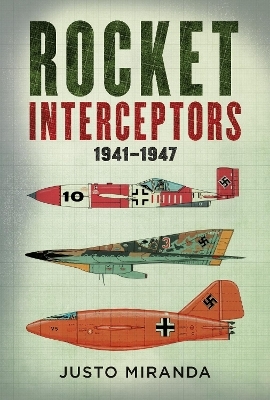
Rocket Interceptors 1941–1947
Seiten
2026
Fonthill Media Ltd (Verlag)
978-1-78155-955-0 (ISBN)
Fonthill Media Ltd (Verlag)
978-1-78155-955-0 (ISBN)
- Noch nicht erschienen (ca. März 2026)
- Versandkostenfrei
- Auch auf Rechnung
- Artikel merken
During its short life, the rocket interceptor, a concept that reached maturity towards the end of the Second World War, attracted the attention of top scientists, designers and aeronautical engineers in Germany, the USSR, the United States and Japan. It was universally agreed that an interceptor capable of flying 300 mph faster than any other aircraft would give the wielding power untouchable aerial superiority. However, this new technology was unable to adapt to the realities of war.
The complexity of the propulsion system and the need to develop new aerodynamic concepts were challenges too great for the aeronautical industries of the major powers at the time, which specialized in the mass construction of piston fighters. Nor were fighter pilots able to adapt to the high-G combat conditions that came with achieving speeds of nearly 900 mph; it was simply not possible for them to aim and fire.
In 280 immaculate technical drawings, each set within its historical context and with full performance specifications, Rocket Interceptors 1941–1947 presents 125 project, prototype and combat rocket-powered aircraft developed by Germany, the United States, the USSR and Japan in the 1940s, though initial development for some can be traced as far back as the 1920s. This is the last word on a technology that, had it been properly harnessed, might have changed the course of the Second World War.
The complexity of the propulsion system and the need to develop new aerodynamic concepts were challenges too great for the aeronautical industries of the major powers at the time, which specialized in the mass construction of piston fighters. Nor were fighter pilots able to adapt to the high-G combat conditions that came with achieving speeds of nearly 900 mph; it was simply not possible for them to aim and fire.
In 280 immaculate technical drawings, each set within its historical context and with full performance specifications, Rocket Interceptors 1941–1947 presents 125 project, prototype and combat rocket-powered aircraft developed by Germany, the United States, the USSR and Japan in the 1940s, though initial development for some can be traced as far back as the 1920s. This is the last word on a technology that, had it been properly harnessed, might have changed the course of the Second World War.
Justo Miranda is a technical illustrator and Spanish Air Force Museum advisor who uses advanced drawing methods to help rebuild historical aircraft. As a historian he specializes in German secret weaponry, and his research has helped deconstruct several myths on flying saucers and Hitler’s ‘A’ bomb. Justo has published thirty-three books and thirty monographs on aeronautical subjects. He lives in Madrid with his wife Paula, a journalist at Reuters.
| Erscheint lt. Verlag | 30.3.2026 |
|---|---|
| Zusatzinfo | 252 mono, 28 colour |
| Sprache | englisch |
| Maße | 172 x 246 mm |
| Themenwelt | Geschichte ► Allgemeine Geschichte ► 1918 bis 1945 |
| Geschichte ► Teilgebiete der Geschichte ► Militärgeschichte | |
| ISBN-10 | 1-78155-955-4 / 1781559554 |
| ISBN-13 | 978-1-78155-955-0 / 9781781559550 |
| Zustand | Neuware |
| Informationen gemäß Produktsicherheitsverordnung (GPSR) | |
| Haben Sie eine Frage zum Produkt? |
Mehr entdecken
aus dem Bereich



aus dem Bereich
Deutschland 1933 bis 1945
Buch | Hardcover (2025)
S. Fischer (Verlag)
CHF 47,60
ein Psychologe erlebt das Konzentrationslager
Buch | Hardcover (2024)
Kösel (Verlag)
CHF 30,80


