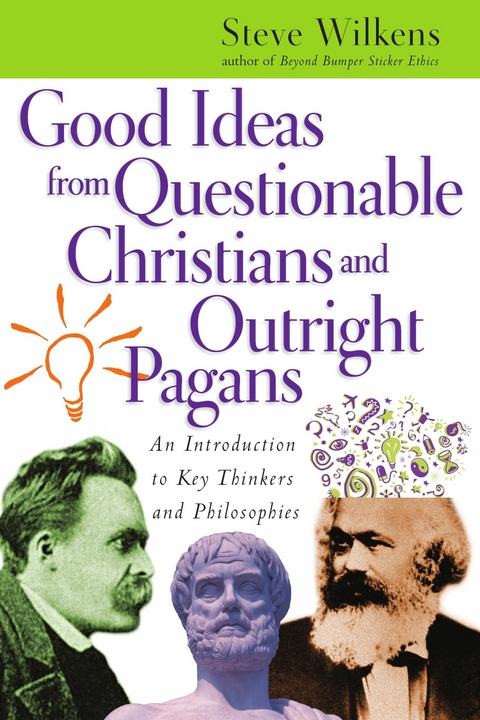
Good Ideas from Questionable Christians and Outright Pagans (eBook)
256 Seiten
InterVarsity Press, LLC (Verlag)
978-1-5140-1519-3 (ISBN)
Steve Wilkens (PhD, Fuller Theological Seminary) is professor of philosophy and ethics at Azusa Pacific University. His books include Hidden Worldviews, Faith and Reason: Three Views, Christianity and Western Thought (volumes 2 and 3), and Beyond Bumper Sticker Ethics.
"e;What indeed has Athens to do with Jerusalem? What concord is there between the Academy and the church?"e; - Tertullian, 3rd centurySuch skepticism about the place of philosophy in the life of Christians persists down through the ages. As a student, author Steve Wilkens had deep reservations about studying the works of "e;pagans"e; or even "e;questionable Christians."e; Now a teacher at a Christian university, Wilkens has developed a deep appreciation for teaching and studying philosophy. In fact, he believes that the life of faith can be enriched by good philosophical reflection. In this book Wilkens helps you begin the same journey. Using generous quotations from the original sources, Wilkens provides an introduction to the study of philosophy by exploring a single key issue from each of the following philosophers: Socrates, Plato, Aristotle, Augustine, Aquinas, Descartes, Kierkegaard, Marx, Nietzsche and Sartre. The questions considered include- Why ask why?- Is a just society possible?- Is God responsible for evil?- Can you be certain of anything?- Is morality all about power?- Do you really want to be free?Wilkens encourages you not to be a mere spectator but to actively and critically engage the questions and ideas these philosophers raise. Here is a book for beginning students, thoughtful Christians or anyone who wants to explore life's deepest questions.
Introduction
What’s a Nice Christian like You
Doing in a Place like Athens?
It happened many years ago, but my memories of the moment are still vivid. I was waiting for my first introduction to philosophy class to begin. I was apprehensive about what would happen over the next sixteen weeks of the course. Actually, apprehensive is not a strong enough word; I was flat-out scared. This is probably not an unusual state of affairs for many students anticipating an introductory philosophy class, but my situation was somewhat different. I was the instructor! It is a bit unusual for a person to teach an introductory college course he or she has never taken, and it is not a route to teaching that I would suggest. However, there is a story behind this story.
The fear I experienced while waiting for my introductory philosophy class to begin was not a new emotion. Fear of philosophy had been there during my college years. While no one ever said it explicitly, a message had been quite effectively communicated from all the sources I relied on for good advice: stay away from philosophy. It isn’t the type of thing that is good for a Christian. In fact, it is downright dangerous. It may not be on any list of official psychological disorders, but I had a severe case of “philosophobia.” I was not sure why my fine Christian college offered such a course, but I was certain that I should let nothing interfere with my faith. Philosophy, I was certain, would do that. My goal, after getting my degree, was to go to graduate school and eventually teach Bible or theology. I would not let philosophy mess up those plans. Fortunately, I could get my degree without an introductory philosophy class. I did have to take philosophy of religion, but since it had “religion” in the title, it seemed as if it would be safe as long as I did not take the philosophy part too seriously.
My dream of graduate school on my way to a teaching career began to come true. I made it through my master’s degree and entered a Ph.D. program in systematic theology. Somewhere in this process, a couple of interesting things happened. First, I discovered that I could not do theology without a fairly solid grasp of philosophy. The two disciplines kept intersecting, so I had to learn on my own what I could have started learning during my college days. Second, as my explorations of philosophy continued, I found out how wrong my early impressions of this field of study were wrong. Philosophy actually helped me think through theological issues with greater clarity. I learned from it. It was more than just learning from it, however. I became a convert to the value of philosophy for Christians.
This brings us back to the beginning of my story. Colleges offer a lot more philosophy classes than theology courses, and as a freshly minted Ph.D. with no teaching experience, I couldn’t get too picky about what jobs I took. I started teaching philosophy courses while I waited for a “real” job in theology. Eventually, as I grew to have an increasing respect for philosophy and its value to Christians, I landed a full-time philosophy position at a Christian university. Perhaps it is testimony to God’s sense of humor that a college student with philosophobia would, a decade later, enter a career teaching philosophy to students with the same fears he had.
Christianity and Philosophy
Nervousness within the church about the proper role of philosophy, if it should have a place at all, is nothing new. A well-known quote by Tertullian, a Christian intellectual who wrote at the beginning of the third century, reveals this. He asks, “What indeed has Athens to do with Jerusalem? What concord is there between the Academy and the Church?” (On Prescription Against Heretics 7). These questions are intended to be rhetorical, with the assumed answer that Athens, which is representative of Greek philosophy, has nothing to do with the church. However, Tertullian asked these questions in a historical context in which other prominent Christians were finding great utility in expressing Christian ideas within a framework of Greek philosophical language and categories. They obviously would not have answered these questions in the same way; nor would many Christian thinkers up to the present.
One might ask why people like Tertullian would question whether Christians should pay attention to ideas from Athens, but today the burden of proof in Christian circles is generally assumed to lie on the other side of this debate. Why would Christians think that philosophy would have something to say that Christians ought to hear? Since the title of this book indicates that I find some of the ideas from “questionable Christians” and “outright pagans” to be good ones, I’ll attempt a few reasons for giving them a hearing. Before we get to this, however, let’s make certain we understand the two categories that I work with.
The “questionable Christians” referred to in the title are thinkers who identify themselves as Christians. Thus, this label applies to Augustine, Aquinas, Descartes and Kierkegaard. So if these four are self-identified Christians, why are they referred to as “questionable?” I want to be very clear that I do not find their Christian commitment questionable. However, while the “questionable” label does not represent my view, my opinion is not universally shared within the Christian world. For some, the assumptions behind Tertullian’s rhetorical questions explain the tone of doubt. The very fact that they engaged in philosophical discourse at all makes their faith subject to scrutiny. For others, their conclusions raise questions about whether they deserve to be designated as Christians. The fact that Augustine, Descartes and Aquinas fall within the Catholic tradition may make them suspect to some Protestants, and Kierkegaard’s Protestantism may cause certain Catholics to be wary. For most, however, it is the basic unfamiliarity with ideas that come from times that are, in some cases, centuries removed from our time that make us wonder whether they are relevant to twenty-first-century Christians.
“Outright pagans” refers to the remaining six philosophers surveyed here who make no claim at all to Christian faith. Some might cut a little slack for the first three—Socrates, Plato and Aristotle—since they all died a few centuries before Jesus appeared on the scene. It would be a little unfair to blame them for not embracing the faith. Many Christian readers would have more problems with the last three in this group—Nietzsche, Sartre and Marx. Not only are they non-Christians, but they are intentionally anti-Christian in their beliefs. Nevertheless, I will maintain that they all have some wisdom that can be of benefit to anyone.
Now that we have the tags straight, why should Christians care what philosophers have to say? I hope some of the reasons will be apparent as you ponder the ideas of the thinkers in the book, but I will start with four preliminary reasons. Perhaps we might begin with a simple observation. We do not find it illegitimate for Christians to learn any number of things—from sociology to auto mechanics—from people outside the faith, even if we might have learned the same things from fellow believers. Christians do not have a corner on truth in all its different facets, and, if God is the ultimate author of what is true, the conduits through which it passes on the way to us do not seem to be that important. Moreover, we recognize that some non-Christians have great wisdom about how to conduct certain aspects of their life. My challenge in this book is that you examine the ideas of some of the most influential thinkers in western intellectual history and draw your own conclusions about whether they offer any insight for living.
Second, over the years, I have read too many essays by college students and heard too many sermons from preachers declaring some philosopher a complete fool without having any real clue as to what that philosopher actually said. Many people outside the church have a stereotype of Christians as uninformed idiots, and experiences like this strongly reinforce that image. Disagreeing with someone’s ideas is not bad, but uninformed disagreement is irresponsible and an embarrassment. If we are going to weigh in on an issue, we have a duty to do so honestly and intelligently.
This leads to a third reason for Christians to think through important philosophical issues. There are certain essential questions that every human should think through, and philosophers have had something to say about these matters for centuries. If we are going to address these questions thoughtfully, we cannot help but bump into others who struggle with the issues that go square to the heart of life. What does it mean to be free? Why does evil exist? How should we think about ethics? Can we know anything with certainty? Moreover, these questions all converge at a point that marks what is perhaps the most basic issue of human existence. Each philosopher, either directly or indirectly, addresses the question of how one might get the most out of life. Unless we believe that we are the only ones who have this matter nailed down, we might want to see if we can find some good ideas in others who have wrestled with the big questions.
Finally, I think there are good reasons to listen to certain philosophers precisely because of their opposition to Christianity. Too often, Christians develop blinds spots and are unable to recognize our weaknesses and flaws. Even when we are aware of problems, we may be reluctant to air our dirty...
| Erscheint lt. Verlag | 28.8.2025 |
|---|---|
| Sprache | englisch |
| Themenwelt | Religion / Theologie ► Christentum ► Kirchengeschichte |
| ISBN-10 | 1-5140-1519-6 / 1514015196 |
| ISBN-13 | 978-1-5140-1519-3 / 9781514015193 |
| Informationen gemäß Produktsicherheitsverordnung (GPSR) | |
| Haben Sie eine Frage zum Produkt? |
 EPUB (Adobe DRM)
Kopierschutz: Adobe-DRM
Adobe-DRM ist ein Kopierschutz, der das eBook vor Mißbrauch schützen soll. Dabei wird das eBook bereits beim Download auf Ihre persönliche Adobe-ID autorisiert. Lesen können Sie das eBook dann nur auf den Geräten, welche ebenfalls auf Ihre Adobe-ID registriert sind.
Details zum Adobe-DRM
Dateiformat: EPUB (Electronic Publication)
EPUB ist ein offener Standard für eBooks und eignet sich besonders zur Darstellung von Belletristik und Sachbüchern. Der Fließtext wird dynamisch an die Display- und Schriftgröße angepasst. Auch für mobile Lesegeräte ist EPUB daher gut geeignet.
Systemvoraussetzungen:
PC/Mac: Mit einem PC oder Mac können Sie dieses eBook lesen. Sie benötigen eine
eReader: Dieses eBook kann mit (fast) allen eBook-Readern gelesen werden. Mit dem amazon-Kindle ist es aber nicht kompatibel.
Smartphone/Tablet: Egal ob Apple oder Android, dieses eBook können Sie lesen. Sie benötigen eine
Geräteliste und zusätzliche Hinweise
Buying eBooks from abroad
For tax law reasons we can sell eBooks just within Germany and Switzerland. Regrettably we cannot fulfill eBook-orders from other countries.
aus dem Bereich