


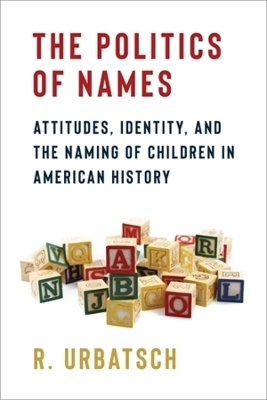
The Politics of Names
Attitudes, Identity, and the Naming of Children in American History
Seiten
2026
Columbia University Press (Verlag)
978-0-231-22169-6 (ISBN)
Columbia University Press (Verlag)
978-0-231-22169-6 (ISBN)
This book explores the politics of naming across American history, revealing the surprising ways parents’ choices shed light on public opinion past and present.
Since the earliest days of the United States, some parents have felt moved to capture their political moment in their children’s names. A Massachusetts child received the name Federal Constitution in 1790. The nineteenth century saw the name States Rights crop up across the South. A younger brother of a boy called McKinley in the early twentieth century was disproportionately likely to be named Roosevelt. Residents of areas that supported Reagan were prone to choose the spelling “Meagan” over “Megan.” The name Hillary surged in popularity after the Clintons emerged on the political scene—then crashed just as dramatically. What do trends like these tell us about political identities and enthusiasms in the United States?
R. Urbatsch explores the politics of naming across American history, revealing the surprising ways parents’ choices shed light on public opinion past and present. He argues that naming is a weathervane for political attitudes: Names touch on every sort of identity, from race and gender to nationalism and religion. Tracing the rise and fall of names that evoked the leaders, ideas, and issues that fired political imaginations of their times, Urbatsch opens new windows onto a wide range of historical questions. By analyzing when politics-tinged names gained or lost popularity, this book offers an unconventional and illuminating new perspective on identity, public sentiment, and political behavior in the United States.
Since the earliest days of the United States, some parents have felt moved to capture their political moment in their children’s names. A Massachusetts child received the name Federal Constitution in 1790. The nineteenth century saw the name States Rights crop up across the South. A younger brother of a boy called McKinley in the early twentieth century was disproportionately likely to be named Roosevelt. Residents of areas that supported Reagan were prone to choose the spelling “Meagan” over “Megan.” The name Hillary surged in popularity after the Clintons emerged on the political scene—then crashed just as dramatically. What do trends like these tell us about political identities and enthusiasms in the United States?
R. Urbatsch explores the politics of naming across American history, revealing the surprising ways parents’ choices shed light on public opinion past and present. He argues that naming is a weathervane for political attitudes: Names touch on every sort of identity, from race and gender to nationalism and religion. Tracing the rise and fall of names that evoked the leaders, ideas, and issues that fired political imaginations of their times, Urbatsch opens new windows onto a wide range of historical questions. By analyzing when politics-tinged names gained or lost popularity, this book offers an unconventional and illuminating new perspective on identity, public sentiment, and political behavior in the United States.
R. Urbatsch is professor of political science at Iowa State University. He is the author of Families’ Values: How Parents, Siblings, and Children Affect Political Attitudes (2014).
Acknowledgments
Introduction
1. Beginnings (ca. 1760–1800)
2. Regional Identities (ca. 1850–1880)
3. Political Celebrity (ca. 1860–1940)
4. Foreign Affairs (ca. 1898–1990)
5. Culture Wars (ca. 1980–2020)
6. Names, Today and Tomorrow (ca. 2020–)
Appendix: Methodology
Notes
Index
| Erscheinungsdatum | 26.11.2025 |
|---|---|
| Zusatzinfo | 53 b&w illustrations |
| Verlagsort | New York |
| Sprache | englisch |
| Maße | 152 x 229 mm |
| Themenwelt | Geisteswissenschaften ► Geschichte ► Regional- / Ländergeschichte |
| Geschichte ► Teilgebiete der Geschichte ► Kulturgeschichte | |
| Sozialwissenschaften ► Politik / Verwaltung ► Politische Systeme | |
| Sozialwissenschaften ► Politik / Verwaltung ► Politische Theorie | |
| ISBN-10 | 0-231-22169-X / 023122169X |
| ISBN-13 | 978-0-231-22169-6 / 9780231221696 |
| Zustand | Neuware |
| Informationen gemäß Produktsicherheitsverordnung (GPSR) | |
| Haben Sie eine Frage zum Produkt? |
Mehr entdecken
aus dem Bereich



aus dem Bereich
Die Revolution des Gemeinen Mannes
Buch | Softcover (2024)
C.H.Beck (Verlag)
CHF 16,80
Eine Geschichte des Geschmacks
Buch | Hardcover (2025)
C.H.Beck (Verlag)
CHF 49,95


