


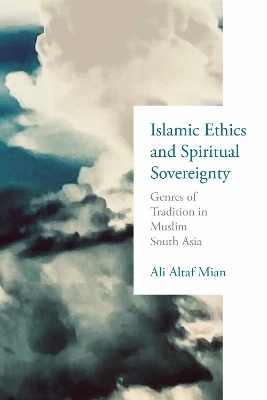
Islamic Ethics and Spiritual Sovereignty
Genres of Tradition in Muslim South Asia
Seiten
2026
University of Notre Dame Press (Verlag)
978-0-268-21090-8 (ISBN)
University of Notre Dame Press (Verlag)
978-0-268-21090-8 (ISBN)
- Noch nicht erschienen (ca. Juni 2026)
- Versandkostenfrei
- Auch auf Rechnung
- Artikel merken
Ali Altaf Mian demonstrates how attention to genre and embodiment illuminates the concepts and practices of the Islamic tradition—and how theologians, Sufi mystics, and ordinary Muslims respond to the incapacitating tribulations of creaturely existence in modernity.
Islamic Ethics and Spiritual Sovereignty is grounded in the rich textual archive of one of modern South Asia's foremost Muslim theologians and Sufis: Maulānā Ashraf ʿAlī Thānavī (1863–1943). Through a close examination of Maulānā Thānavī's vast corpus of writings, Ali Altaf Mian elaborates a profound theorization of tradition as a discursive and affective crucible of ethical formation and spiritual sovereignty.
With philological and philosophical rigor, Islamic Ethics and Spiritual Sovereignty elucidates connections between tradition's forms of life and language. Mian demonstrates how intended and unconscious movements between genres in the life of tradition attend to the felt and perceived needs of the ensouled body at the dual scales of singularity and collectivity. Through a novel attention to genre and affect, Mian models a way to study religious traditions and their tensions as productive sites for understanding ritual law and moral agency in the modern world. Insofar as modernity has been about individualism, the rise of literalism, and the disciplining of desire, religious traditions' capacity to respond to these hardships depend on coming up with new configurations of community, activating textuality and the creativity of genres, and keeping alive the unknowability of desire.
Islamic Ethics and Spiritual Sovereignty is grounded in the rich textual archive of one of modern South Asia's foremost Muslim theologians and Sufis: Maulānā Ashraf ʿAlī Thānavī (1863–1943). Through a close examination of Maulānā Thānavī's vast corpus of writings, Ali Altaf Mian elaborates a profound theorization of tradition as a discursive and affective crucible of ethical formation and spiritual sovereignty.
With philological and philosophical rigor, Islamic Ethics and Spiritual Sovereignty elucidates connections between tradition's forms of life and language. Mian demonstrates how intended and unconscious movements between genres in the life of tradition attend to the felt and perceived needs of the ensouled body at the dual scales of singularity and collectivity. Through a novel attention to genre and affect, Mian models a way to study religious traditions and their tensions as productive sites for understanding ritual law and moral agency in the modern world. Insofar as modernity has been about individualism, the rise of literalism, and the disciplining of desire, religious traditions' capacity to respond to these hardships depend on coming up with new configurations of community, activating textuality and the creativity of genres, and keeping alive the unknowability of desire.
Ali Altaf Mian is the Izzat Hasan Sheikh Fellow in Islamic Studies and assistant professor of religion at the University of Florida. He is the author of many peer-reviewed articles and book chapters on Islam in South Asia, Sufi thought and practice, Hadith studies, Islamic philosophy, critical theory, and psychoanalysis.
Introduction. The Trans-Genre Traversal of Tradition
1. Tradition and Transference
2. Genres and Genealogies
3. Prophetic Humor
4. The Struggle for Equilibrium
5. Living with the Stranger Inside
6. The Gaze and the Traversal of Fantasy
7. Ḥikma and Ḥukm, or Spiritual Sovereignty
Appendix I. The Islamic Tradition in North India circa 1863
Appendix II. Maulānā Thānavī's Sufi Successors (khulafā')
Acknowledgements
Bibliography
Notes
Index
| Erscheint lt. Verlag | 30.6.2026 |
|---|---|
| Reihe/Serie | Contending Modernities |
| Verlagsort | Notre Dame IN |
| Sprache | englisch |
| Maße | 152 x 229 mm |
| Themenwelt | Geisteswissenschaften ► Geschichte |
| Geisteswissenschaften ► Philosophie ► Östliche Philosophie | |
| Geisteswissenschaften ► Religion / Theologie ► Islam | |
| ISBN-10 | 0-268-21090-X / 026821090X |
| ISBN-13 | 978-0-268-21090-8 / 9780268210908 |
| Zustand | Neuware |
| Informationen gemäß Produktsicherheitsverordnung (GPSR) | |
| Haben Sie eine Frage zum Produkt? |
Mehr entdecken
aus dem Bereich


aus dem Bereich


