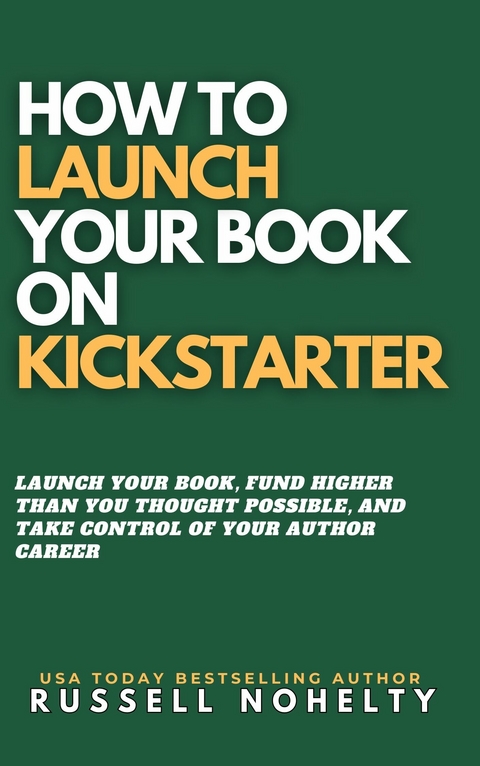
How to Launch Your Book on Kickstarter (eBook)
414 Seiten
Wannabe Press (Verlag)
978-0-00-100222-7 (ISBN)
Launch your book like a pro. Get paid up front. Build readers for life.
Looking for more control over your book launches? Tired of relying on algorithms to reach your readers? Ready to turn loyal fans into your most valuable launch partners?
Kickstarter makes all that possible, and more.
In this practical, no-fluff guide, USA Today bestselling author Russell Nohelty, veteran of over 50 successful campaigns, shares the exact strategies he's used to raise over $650,000 for his own
projects, along with the tactics that have helped other authors raise millions more. You'll learn how to plan, price, and launch your campaign, avoid common pitfalls, and use Kickstarter to build long-term momentum for your career.
Whether you're launching your first project or leveling up your next one, this book walks you through every step. If you're ready to stop gambling on algorithms and start launching with purpose, this is the playbook you need.
For years, authors have felt chained to the whims of Amazon algorithms and traditional publishers. Crowdfunding is changing all that. Kickstarter has opened a new frontier where you launch your book directly to readers on your own terms. No more praying that some platform’s roulette wheel lands on your book. Instead, even a modest fanbase can turn into thousands of dollars of support.
In fact, it’s often easier to rally 500 die-hard fans to back your project at $10–$40 each than to find 10,000 strangers to buy a $0.99 ebook on Amazon. I’ve seen this firsthand: one of my campaigns raised $26,000 in funding from only a few hundred backers, and another cracked $39,000 with under a thousand fans behind it
Brandon Sanderson shattered records with a $41 million Kickstarter, proving that crowdfunding isn’t some fringe gimmick, and he did it with only 185,341 backers. That’s over $200 per backer.
It’s a game-changing launch strategy for authors at every level.
Unlike a traditional retail release, a Kickstarter campaign generates cash flow upfront, buzz, and an interactive community around your book. You’re not just selling a book. You’re creating an event. Readers who pledge aren’t casual buyers; they become invested superfans who feel like partners in your success. They’ll cheer you on, share your project, and eagerly anticipate updates. This level of engagement simply doesn’t happen when someone one-clicks an ebook on Amazon.
I’ve been part of close to 100 successful crowdfunding projects myself, raising over $1.2 million, and I can tell you that the energy and goodwill from a Kickstarter launch is incomparable. You get validation that your idea has an audience before you spend months or years bringing it to life. You get pre-orders and revenue in hand, which means no more guessing how many books to print or going out-of-pocket hoping people buy later. And perhaps best of all, you get direct access to your readers. Not just their emails, but their feedback and their enthusiasm, too, which is something no retailer will ever give you. In short, a well-run Kickstarter doesn’t just fund your book; it builds a fan community that will stick with you for the long haul.
Now, before you start seeing dollar signs, Kickstarter is not a magic money tree or a last-ditch rescue raft. It’s a strategy, not a charity drive. If you come to the platform with a half-baked project or no audience to speak of, guess what? Crickets. A Kickstarter campaign will expose the truth of what you’ve built, or haven’t built, faster than any tweet or Amazon launch ever could. If your offer is weak or your outreach is nonexistent, Kickstarter will make that painfully obvious. No fluff, no fairy dust, no “Field of Dreams” delusions that if you simply launch, backers will magically appear. I’ve seen authors treat Kickstarter as a Hail Mary for a failing series or a way to “get money for marketing” because their book wasn’t selling. It never ends well.
Kickstarter won’t save a sinking ship. It reflects the groundwork and the trust you’ve earned with readers. On the flip side, if you have put in the work to cultivate even a small but passionate readership, Kickstarter can amplify that like nothing else. Throughout this book, we’re going to be brutally honest about common pitfalls and how to avoid them. I’m not here to sell you a fairy tale. I’m here to show you how to put in the work so Kickstarter pays off, and to warn you where you might screw up. Consider this your friendly reality check: if you’re looking for a get-rich-quick shortcut, you won’t find it here, but if you’re ready to hustle and treat your campaign as seriously as a product launch, you can absolutely crush it.
How to Launch Your Book on Kickstarter is structured as a step-by-step journey from the earliest planning stages all the way to post-campaign strategy. Each chapter is packed with tactics. I’ll give you motivation, but I’ll also give you homework. This isn’t a book you plow through passively with a shrug. By the end, you won’t just have head knowledge, you’ll have a concrete campaign plan on paper. Treat this like a hands-on workshop. I’ll be pushing you to actually do the exercises, because that’s where the real progress happens. This book dishes out some tough love and no-nonsense advice, but it’s all in service of getting you across the finish line with a successful, stress-free (okay, less-stressful) campaign. So, engage with the material, pause to complete the workbook prompts, and embrace the process.
By the time you turn the last page, you’ll have a complete blueprint for your Kickstarter launch from crystallizing your initial vision and deciding on what exactly you’re funding, to delivering rewards to your backers and nurturing them afterward. You’ll know exactly what steps to take and in what order. More importantly, you’ll have the confidence to execute.
This is huge. Confidence means you’ll approach launch day knowing you have a plan, not just a wish. You’ll see Kickstarter for what it truly is: a launchpad, not a gamble. Yes, there’s always uncertainty, but with solid preparation, you tilt the odds dramatically in your favor. My goal is that you finish this book feeling empowered and fired up, with any fears left in the dust. We’re going to replace any lingering “What if no one backs me?” anxieties with an attitude of “I can’t wait to show my readers something awesome.” Sound good? Great, because it’s time for some tough love and serious strategy. Buckle up, and let’s crush it.
What's new
Since we first launched Get Your Book Selling on Kickstarter in October 2021, there has been a seismic shift in the way Kickstarter has been perceived in the indie community. With the addition of a new CEO, they have made huge changes in how the platform works.
Mindset shifts
Brandon Sanderson broke open the fiction category: In March 2022, Brandon Sanderson launched a “secret” Kickstarter that raised over $41 million and became the highest-grossing Kickstarter campaign ever by a wide margin. This showed fiction authors, and especially fantasy authors, that they could make serious money on Kickstarter. Prior to that campaign, it was hard to find 5-10 fiction campaigns live at any one time. Now, you would be hard pressed to find a time when there weren’t 100+ fiction campaigns live at any time.
The community grew into something massive and powerful: Whether it’s our Writer MBA community, the Kickstarter for Authors Facebook group, Kickstarter specialists that will help you run and fulfill your campaign, or just the general discourse of the indie community, there are exponentially more people who can help you with Kickstarter now than there were in 2021 when we had to introduce the concept to the whole community.
Special edition Kickstarters: Prior to 2021, there were many different varieties of fiction campaign, while now people seem to be using Kickstarter mainly to produce special edition Kickstarter campaigns (which we’ll talk about later) with all the bells and whistles. There has been a standardization of what a campaign looks like for both good and bad.
Competition ramped up: Along with Indiegogo, Crowdfundr and Backerkit have emerged as direct competitors to Kickstarter on a global scale, while platforms like Zoop (Comics), Seed and Spark (Movies) and Gamefound (Games) have built category-specific platforms for crowdfunding.
Platform changes
Late pledges: Since the inception of Kickstarter, backers have had to pledge while a project is live, or not at all. Other platforms, like Indiegogo, allow for late pledges after a campaign is over. Now Kickstarter does, too. At the bottom of the basics section of your campaign, you can enable late pledges and allow backers to pledge even after your successful campaign ends. Unlike a live campaign, funds are deducted from backer accounts immediately, and you are paid weekly for any new funds that might accrue. Another nice feature of late pledges is that you can turn them on at the reward level, so if you want certain rewards to keep going and others to end when a campaign is over, you have that flexibility. You can also set a different price for late pledges so that people who back while it’s live get the best deal. Finally, I should mention that yes, your campaign has to successfully fund before late pledges work. You can’t keep limping along with a failed campaign forever.
Images in your rewards and add-ons: You now have ability to upload imagery in your rewards. It used to be that we had to create clunky lists in our campaign pages, but now we can create graphics (or you can hire somebody to do it for you) where people can easily see what they get in every pledge. This added the newest complexity to a campaign, but overall we think it’s a good change.
A redesigned home page: The discover tab (where you look for new projects) used to be on the left and now it’s on the right. Additionally, the top menu has every category now, with dropdowns that make it easier to search for projects. This had the effect of basically eliminating the landing page for each category.
Pivot to video: When a backer searches for a campaign, the video starts playing automatically when you hover over the image. This makes a video even more important...
| Erscheint lt. Verlag | 25.8.2025 |
|---|---|
| Sprache | englisch |
| Themenwelt | Geisteswissenschaften ► Sprach- / Literaturwissenschaft |
| ISBN-10 | 0-00-100222-8 / 0001002228 |
| ISBN-13 | 978-0-00-100222-7 / 9780001002227 |
| Informationen gemäß Produktsicherheitsverordnung (GPSR) | |
| Haben Sie eine Frage zum Produkt? |
 EPUB (Adobe DRM)
Größe: 351 KB
Kopierschutz: Adobe-DRM
Adobe-DRM ist ein Kopierschutz, der das eBook vor Mißbrauch schützen soll. Dabei wird das eBook bereits beim Download auf Ihre persönliche Adobe-ID autorisiert. Lesen können Sie das eBook dann nur auf den Geräten, welche ebenfalls auf Ihre Adobe-ID registriert sind.
Details zum Adobe-DRM
Dateiformat: EPUB (Electronic Publication)
EPUB ist ein offener Standard für eBooks und eignet sich besonders zur Darstellung von Belletristik und Sachbüchern. Der Fließtext wird dynamisch an die Display- und Schriftgröße angepasst. Auch für mobile Lesegeräte ist EPUB daher gut geeignet.
Systemvoraussetzungen:
PC/Mac: Mit einem PC oder Mac können Sie dieses eBook lesen. Sie benötigen eine
eReader: Dieses eBook kann mit (fast) allen eBook-Readern gelesen werden. Mit dem amazon-Kindle ist es aber nicht kompatibel.
Smartphone/Tablet: Egal ob Apple oder Android, dieses eBook können Sie lesen. Sie benötigen eine
Geräteliste und zusätzliche Hinweise
Buying eBooks from abroad
For tax law reasons we can sell eBooks just within Germany and Switzerland. Regrettably we cannot fulfill eBook-orders from other countries.
aus dem Bereich