


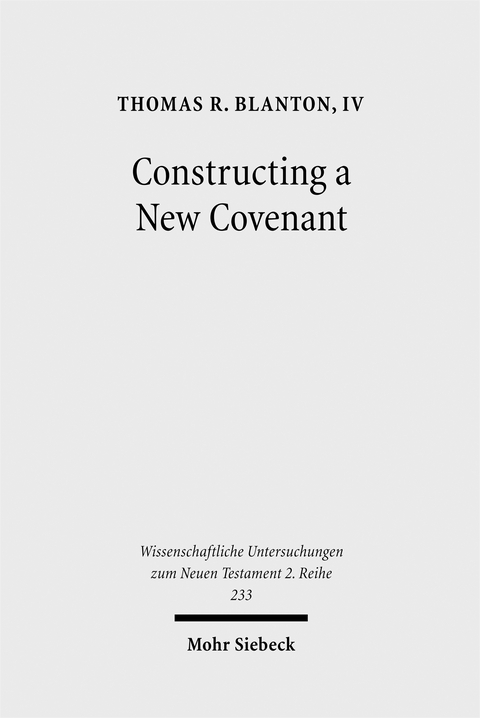
Constructing a New Covenant
Discursive Strategies in the Damascus Document and Second Corinthians
2007
Mohr Siebeck (Hersteller)
9783161515767 (ISBN)
Mohr Siebeck (Hersteller)
9783161515767 (ISBN)
Thomas R. Blanton, IV untersucht die diskursiven Strategien in der Damaskus-Schrift und im 2. Korintherbrief, da sich beide mit der Idee des neuen Bundes befassen. Er zeigt, daß die diskursiven Strategien jeweils eingesetzt werden, um gegen rivalisierende Meinungen zu argumentieren.
Thomas R. Blanton, IV untersucht die diskursiven Strategien in der Damaskus-Schrift und im 2. Korintherbrief, da sich beide mit der Idee des neuen Bundes befassen. Er zeigt, daß der Diskurs in der Damaskus-Schrift von den Essenern benutzt wird, um sowohl die makkabäischen Ansprüche an das hohe Priesteramt als auch die Ansprüche der Pharisäer, die alleinigen Interpreten der Tora zu sein, zu widerlegen. Den 2. Korintherbrief interpretiert der Autor als Antwort auf einen traditionellen Diskurs, der aus der heiligen Schrift abgeleitet und von rivalisierenden Predigern in Korinth eingesetzt wurde, die das Gesetz mit dem Geist verbanden. Paulus schreibt genau dagegen im 2. Korintherbrief an und hält an der Trennung zwischen Toraobservanz und Geist fest. Thomas R. Blanton, IV seeks to reconstruct the social contexts in which two discourses that involve the "new covenant" were written, and to which they responded. He first examines the Damascus Document from among the Dead Sea scrolls, arguing that this discourse was crafted in order to delegitimate Hasmonean claims to the high priesthood and Pharisaic claims to authority in legal interpretation. In response to the claims and practices advocated by these rival groups, the Essene sect crafted a discourse which construed the new covenant as one that supported Essene claims that they were the legitimate bearers of high priestly authority and the divinely authorized interpreters of the Torah. In the second half of the book, the author argues that Paul crafted his discourse on the new covenant in opposition to an ideology that was espoused by a rival group of missionaries, according to which, under the conditions of the new covenant, the spirit of God was thought to empower individuals to follow the Torah with perfect obedience. Paul crafted his own discourse in opposition to this view, positing that law and spirit were antithetical terms. By arguing in this way, he attempted to bolster the credibility of his own law-free message.
Thomas R. Blanton, IV untersucht die diskursiven Strategien in der Damaskus-Schrift und im 2. Korintherbrief, da sich beide mit der Idee des neuen Bundes befassen. Er zeigt, daß der Diskurs in der Damaskus-Schrift von den Essenern benutzt wird, um sowohl die makkabäischen Ansprüche an das hohe Priesteramt als auch die Ansprüche der Pharisäer, die alleinigen Interpreten der Tora zu sein, zu widerlegen. Den 2. Korintherbrief interpretiert der Autor als Antwort auf einen traditionellen Diskurs, der aus der heiligen Schrift abgeleitet und von rivalisierenden Predigern in Korinth eingesetzt wurde, die das Gesetz mit dem Geist verbanden. Paulus schreibt genau dagegen im 2. Korintherbrief an und hält an der Trennung zwischen Toraobservanz und Geist fest. Thomas R. Blanton, IV seeks to reconstruct the social contexts in which two discourses that involve the "new covenant" were written, and to which they responded. He first examines the Damascus Document from among the Dead Sea scrolls, arguing that this discourse was crafted in order to delegitimate Hasmonean claims to the high priesthood and Pharisaic claims to authority in legal interpretation. In response to the claims and practices advocated by these rival groups, the Essene sect crafted a discourse which construed the new covenant as one that supported Essene claims that they were the legitimate bearers of high priestly authority and the divinely authorized interpreters of the Torah. In the second half of the book, the author argues that Paul crafted his discourse on the new covenant in opposition to an ideology that was espoused by a rival group of missionaries, according to which, under the conditions of the new covenant, the spirit of God was thought to empower individuals to follow the Torah with perfect obedience. Paul crafted his own discourse in opposition to this view, positing that law and spirit were antithetical terms. By arguing in this way, he attempted to bolster the credibility of his own law-free message.
Born 1968; 1991 BA (Psychology) University of North Carolina at Chapel Hill; 1994 M.T.S. Duke Divinity School; 2006 PhD (Biblical Studies) Divinity School, University of Chicago; Adjunct Professor of New Testament at Lutheran School of Theology at Chicago.
| Erscheint lt. Verlag | 5.11.2007 |
|---|---|
| Reihe/Serie | Wissenschaftliche Untersuchungen zum Neuen Testament 2. Reihe |
| Verlagsort | Tübingen |
| Sprache | englisch |
| Themenwelt | Religion / Theologie ► Christentum ► Bibelausgaben / Bibelkommentare |
| Geisteswissenschaften ► Religion / Theologie ► Judentum | |
| Schlagworte | constructing • Covenant • New |
| ISBN-13 | 9783161515767 / 9783161515767 |
| Zustand | Neuware |
| Informationen gemäß Produktsicherheitsverordnung (GPSR) | |
| Haben Sie eine Frage zum Produkt? |
Mehr entdecken
aus dem Bereich
aus dem Bereich
Die Begründung von Lebensformen angesichts gesellschaftlicher …
Online Resource (2025)
Mohr Siebeck (Hersteller)
CHF 39,95


