


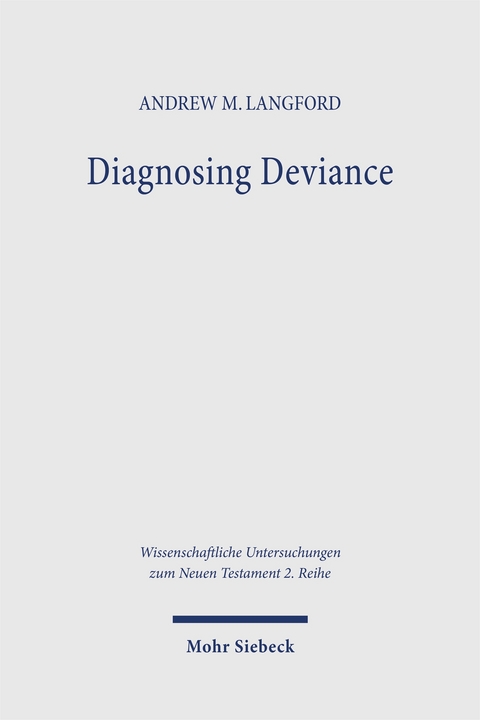
Diagnosing Deviance
Pathology and Polemic in the Pastoral Epistles
2023
Mohr Siebeck (Hersteller)
978-3-16-161972-4 (ISBN)
Mohr Siebeck (Hersteller)
978-3-16-161972-4 (ISBN)
In dieser Studie untersucht Andrew M. Langford die Rhetorik medizinischer Metaphern in drei neutestamentlichen Briefen (1. Timotheus, 2. Timotheus und Titus) und zeigt auf, wie diese Briefe Krankheitsmetaphern verwenden, um eine bestimmte Sicht auf Gegner und den Umgang mit ihnen in der nachpaulinischen Ära zu verbreiten.
In dieser Studie untersucht Andrew M. Langford die Rhetorik medizinischer Metaphern in drei neutestamentlichen Briefen (1. Timotheus, 2. Timotheus und Titus) und zeigt auf, wie diese Briefe Krankheitsmetaphern verwenden, um eine bestimmte Sicht auf Gegner und den Umgang mit ihnen in der nachpaulinischen Ära zu verbreiten. In this study, Andrew M. Langford demonstrates that the single, post-Pauline author of the Pastoral Epistles ("the Pastor”) crafts a stigmatizing depiction of his theological opponents by spatializing, demonizing, and pathologizing their alleged deviance. Through close comparative readings of ancient medical and philosophical literature, the author argues for the necessity of interpreting the Pastor's pathologizing of deviance in light of ancient disease etiologies and models of corporeality. With this book, the author contributes to recent interpretive insights about the function of authorial fiction in antiquity and demonstrates that the Pastor is self-consciously appropriating the Pauline epistolary to craft his approach to his theological opponents.
In dieser Studie untersucht Andrew M. Langford die Rhetorik medizinischer Metaphern in drei neutestamentlichen Briefen (1. Timotheus, 2. Timotheus und Titus) und zeigt auf, wie diese Briefe Krankheitsmetaphern verwenden, um eine bestimmte Sicht auf Gegner und den Umgang mit ihnen in der nachpaulinischen Ära zu verbreiten. In this study, Andrew M. Langford demonstrates that the single, post-Pauline author of the Pastoral Epistles ("the Pastor”) crafts a stigmatizing depiction of his theological opponents by spatializing, demonizing, and pathologizing their alleged deviance. Through close comparative readings of ancient medical and philosophical literature, the author argues for the necessity of interpreting the Pastor's pathologizing of deviance in light of ancient disease etiologies and models of corporeality. With this book, the author contributes to recent interpretive insights about the function of authorial fiction in antiquity and demonstrates that the Pastor is self-consciously appropriating the Pauline epistolary to craft his approach to his theological opponents.
Born 1983; PhD, University of Chicago Divinity School; currently instructor at the University of Oregon and ordained pastor in the Evangelical Lutheran Church of America.
| Erscheint lt. Verlag | 14.9.2023 |
|---|---|
| Reihe/Serie | Wissenschaftliche Untersuchungen zum Neuen Testament 2. Reihe |
| Verlagsort | Tübingen |
| Sprache | englisch |
| Themenwelt | Religion / Theologie ► Christentum ► Bibelausgaben / Bibelkommentare |
| Schlagworte | Ancient medicine • medical metaphors • Pauline Studies • Pseudepigraphy |
| ISBN-10 | 3-16-161972-2 / 3161619722 |
| ISBN-13 | 978-3-16-161972-4 / 9783161619724 |
| Zustand | Neuware |
| Informationen gemäß Produktsicherheitsverordnung (GPSR) | |
| Haben Sie eine Frage zum Produkt? |
Mehr entdecken
aus dem Bereich

aus dem Bereich
Die Begründung von Lebensformen angesichts gesellschaftlicher …
Online Resource (2025)
Mohr Siebeck (Hersteller)
CHF 39,95


