


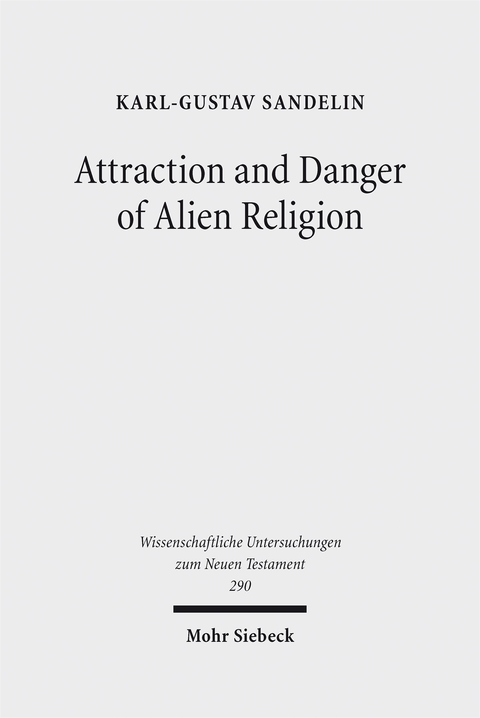
Attraction and Danger of Alien Religion
Studies in Early Judaism and Christianity
2012
Mohr Siebeck (Hersteller)
9783161521058 (ISBN)
Mohr Siebeck (Hersteller)
9783161521058 (ISBN)
In antiquity Jews and Christians met with Hellenistic religion. Did they consider themselves free to participate in alien religious activities? Some of them did, but most of their leading figures did not. Philo Judaeus, the Apostle Paul and John, the seer of Patmos, denounced participation by their co-religionists in what they saw as idolatry.
Early Judaism and early Christianity emerged during the Hellenistic and early Roman imperial era. They were, naturally, confronted with the Hellenistic and the Roman religion. The question therefore arose as to whether Jews or Christians were free to participate in religious activities alien to the religious heritage of their own. In his articles, Karl-Gustav Sandelin presents documentary material showing that this problem was a burning issue within Judaism from the beginning of the Hellenistic period until the end of the first century C.E. Several Jewish individuals converted to the Hellenistic or the Roman religion. Such behavior was also discussed and generally condemned, for example by the Books of Maccabees and authors such as Philo of Alexandria and Flavius Josephus. A similar problem is to be found in the New Testament, notably in the letters of Paul, especially in the first letter to the Corinthians and in the Revelation of John.
Early Judaism and early Christianity emerged during the Hellenistic and early Roman imperial era. They were, naturally, confronted with the Hellenistic and the Roman religion. The question therefore arose as to whether Jews or Christians were free to participate in religious activities alien to the religious heritage of their own. In his articles, Karl-Gustav Sandelin presents documentary material showing that this problem was a burning issue within Judaism from the beginning of the Hellenistic period until the end of the first century C.E. Several Jewish individuals converted to the Hellenistic or the Roman religion. Such behavior was also discussed and generally condemned, for example by the Books of Maccabees and authors such as Philo of Alexandria and Flavius Josephus. A similar problem is to be found in the New Testament, notably in the letters of Paul, especially in the first letter to the Corinthians and in the Revelation of John.
Born 1940; ordained 1968; 1977 ThD; 1975-95 Lecturer for Exegetics and the Languages of the Bible at the Åbo Akademi University, Finland; 1995-2006 Professor of New Testament Exegetics at the Åbo Akademi University; since 2006 retired and Professor emeritus.
| Erscheint lt. Verlag | 10.9.2012 |
|---|---|
| Reihe/Serie | Wissenschaftliche Untersuchungen zum Neuen Testament |
| Verlagsort | Tübingen |
| Sprache | englisch |
| Themenwelt | Religion / Theologie ► Christentum ► Bibelausgaben / Bibelkommentare |
| Geisteswissenschaften ► Religion / Theologie ► Judentum | |
| Schlagworte | Hellenism • Idolatry • Paul • Philo |
| ISBN-13 | 9783161521058 / 9783161521058 |
| Zustand | Neuware |
| Informationen gemäß Produktsicherheitsverordnung (GPSR) | |
| Haben Sie eine Frage zum Produkt? |
Mehr entdecken
aus dem Bereich

aus dem Bereich
Die Begründung von Lebensformen angesichts gesellschaftlicher …
Online Resource (2025)
Mohr Siebeck (Hersteller)
CHF 39,95


