


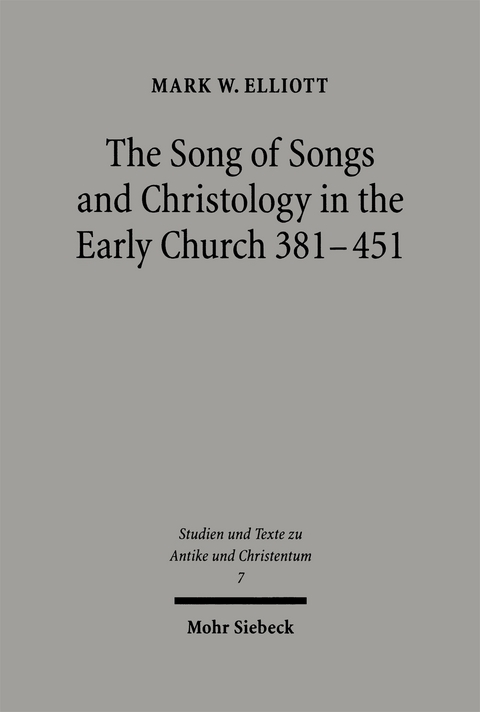
The Song of Songs and Christology in the Early Church
2020
Mohr Siebeck (Hersteller)
978-3-16-158651-4 (ISBN)
Mohr Siebeck (Hersteller)
978-3-16-158651-4 (ISBN)
Mark W. Elliott bietet unterschiedliche Interpretationen der im Hohen Lied verwendeten Metaphorik. Er zeigt, wie die Figuren des Bräutigams und der Braut verstanden wurden. Er richtet seine Aufmerksamkeit auf den historischen Kontext der Figuren, die einen Kommentar zum Lied zwischen den Konzilien von Konstantinopel in 381 und Chalcedon in 451 abgeben und berücksichtigt dabei theologische Auseinandersetzungen und geistige Bewegungen. Die meisten Ausleger sind sich darin einig, daß sich das Lied auf ein Zusammentreffen des Wort Gottes in seiner menschgewordenen Form bezieht. Dieses richtet sich an die gesamte Menschheit, die als gehorsame Braut gesehen wird.
Mark W. Elliott bietet unterschiedliche Interpretationen der im Hohen Lied verwendeten Metaphorik. Er zeigt, wie die Figuren des Bräutigams und der Braut verstanden wurden. Er richtet seine Aufmerksamkeit auf den historischen Kontext der Figuren, die einen Kommentar zum Lied zwischen den Konzilien von Konstantinopel in 381 und Chalcedon in 451 abgeben und berücksichtigt dabei theologische Auseinandersetzungen und geistige Bewegungen. Die meisten Ausleger sind sich darin einig, daß sich das Lied auf ein Zusammentreffen des Wort Gottes in seiner menschgewordenen Form bezieht. Dieses richtet sich an die gesamte Menschheit, die als gehorsame Braut gesehen wird. Mark W. Elliott presents a range of interpretations of the imagery used in the Song of Songs and demonstrates how the figures of the Bridegroom and Bride were understood. He pays attention to the historical context of those commenting on the Song between the councils of Constantinople 381 and Chalcedon 451, including theological disputes and spiritual movements. Showing how they found significance in such an unlikely text leads on to the conclusion that the commentators are largely in agreement that the Song refers to a meeting of the Word of God in his incarnate form, reaching out to all humanity, and the collective humanity, viewed in the obedient responsiveness of a bride. This responsive collective humanity is described variously in terms of 'church', believing soul, soul of Christ and humanity of Christ. Mark W. Elliott selects specifically Christological readings (i.e. those which interpret the Song with reference to the incarnation) and gives some reasons for the demise of such an interpretation and of commentary writing as a whole during that period.
Mark W. Elliott bietet unterschiedliche Interpretationen der im Hohen Lied verwendeten Metaphorik. Er zeigt, wie die Figuren des Bräutigams und der Braut verstanden wurden. Er richtet seine Aufmerksamkeit auf den historischen Kontext der Figuren, die einen Kommentar zum Lied zwischen den Konzilien von Konstantinopel in 381 und Chalcedon in 451 abgeben und berücksichtigt dabei theologische Auseinandersetzungen und geistige Bewegungen. Die meisten Ausleger sind sich darin einig, daß sich das Lied auf ein Zusammentreffen des Wort Gottes in seiner menschgewordenen Form bezieht. Dieses richtet sich an die gesamte Menschheit, die als gehorsame Braut gesehen wird. Mark W. Elliott presents a range of interpretations of the imagery used in the Song of Songs and demonstrates how the figures of the Bridegroom and Bride were understood. He pays attention to the historical context of those commenting on the Song between the councils of Constantinople 381 and Chalcedon 451, including theological disputes and spiritual movements. Showing how they found significance in such an unlikely text leads on to the conclusion that the commentators are largely in agreement that the Song refers to a meeting of the Word of God in his incarnate form, reaching out to all humanity, and the collective humanity, viewed in the obedient responsiveness of a bride. This responsive collective humanity is described variously in terms of 'church', believing soul, soul of Christ and humanity of Christ. Mark W. Elliott selects specifically Christological readings (i.e. those which interpret the Song with reference to the incarnation) and gives some reasons for the demise of such an interpretation and of commentary writing as a whole during that period.
Born 1965; 1997 PhD, Cambridge University; Professor of Biblical and Historical Theology at the University of the Highlands and Islands, Scotland, and Professorial Fellow at Wycliffe College, Toronto, Canada.
| Erscheint lt. Verlag | 31.8.2020 |
|---|---|
| Reihe/Serie | Studien und Texte zu Antike und Christentum / Studies and Texts in Antiquity and Christianity |
| Verlagsort | Tübingen |
| Sprache | englisch |
| Themenwelt | Geisteswissenschaften ► Religion / Theologie ► Christentum |
| Schlagworte | Frühchristentum • Song • Songs |
| ISBN-10 | 3-16-158651-4 / 3161586514 |
| ISBN-13 | 978-3-16-158651-4 / 9783161586514 |
| Zustand | Neuware |
| Informationen gemäß Produktsicherheitsverordnung (GPSR) | |
| Haben Sie eine Frage zum Produkt? |
Mehr entdecken
aus dem Bereich


aus dem Bereich
Weltweites polyzentrisch-plurales Christentum als Bildungsreligion
Online Resource (2025)
Mohr Siebeck (Hersteller)
CHF 124,60
Grundfragen - Kontexte - Themenfelder
Online Resource (2023)
Mohr Siebeck (Hersteller)
CHF 75,60
Berliner Dogmatikvorlesung
Online Resource (2023)
Mohr Siebeck (Hersteller)
CHF 68,60


