


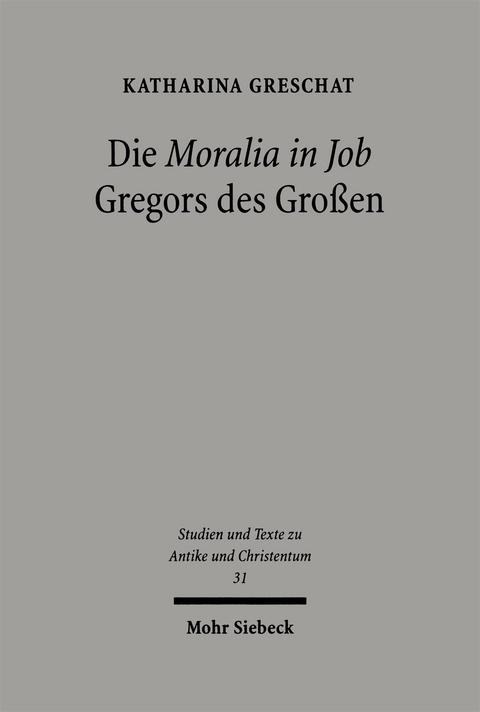
Die 'Moralia in Job' Gregors des Großen
Ein christologisch-ekklesiologischer Kommentar
2020
Mohr Siebeck (Hersteller)
978-3-16-158659-0 (ISBN)
Mohr Siebeck (Hersteller)
978-3-16-158659-0 (ISBN)
Wie hat Papst Gregor der Große (590-604) das Buch Hiob für seine Zeit fruchtbar zu machen versucht? Katharina Greschat untersucht auf dem theologischen und kulturellen Hintergrund des ausgehenden 6. Jahrhunderts die Auslegung Gregors, die kirchliche Amtsträger zur Nachahmung Christi in dieser Welt anleiten will.
Dem modernen Leser erscheint Papst Gregors des Großen (590-604) umfangreiche Auslegung zum Buch Hiob nicht selten als willkürliche Allegorese ohne Anhalt am Text und an der historischen Situation des ausgehenden 6. Jahrhunderts. Katharina Greschat zeigt jedoch, daß Gregor den biblischen Text ganz aus dem Blickwinkel der Erfordernisse kirchlicher Amtsträger im nachjustinianischen Zeitalter interpretiert. In Fortschreibung augustinischer Theologie und von neuchalkedonensischer Reichstheologie ausgehend versteht er die Gestalt des Hiob als Sinnbild für Christus und seinen Leib, der Kirche. Dessen zwei Naturen erweisen sich für Gregor als Schlüssel für die Verbindung zwischen der vita contemplativa und der vita activa, die die kirchlichen Amtsträger in der Nachahmung Christi leben sollen. To the modern reader, Pope Gregory the Great's (590-604) comprehensive interpretation of Job often seems to be an arbitrary allegorization which is not backed up by the text and the historical situation at the end of the 6th century. Katharina Geschat shows however that Gregory interpreted the biblical text completely from the standpoint of the requirements of church office-holders in the post-Justinian period. In continuation of Augustinian theology and based on neo- Chalcedonian imperial theology, he sees the figure of Job as a symbol of Christ and his body, the church. Christ's two natures are for Gregory the key to the connection between the vita contemplativa and the vita activa, which the office-holders of the church are supposed to live in imitation of Christ.
Dem modernen Leser erscheint Papst Gregors des Großen (590-604) umfangreiche Auslegung zum Buch Hiob nicht selten als willkürliche Allegorese ohne Anhalt am Text und an der historischen Situation des ausgehenden 6. Jahrhunderts. Katharina Greschat zeigt jedoch, daß Gregor den biblischen Text ganz aus dem Blickwinkel der Erfordernisse kirchlicher Amtsträger im nachjustinianischen Zeitalter interpretiert. In Fortschreibung augustinischer Theologie und von neuchalkedonensischer Reichstheologie ausgehend versteht er die Gestalt des Hiob als Sinnbild für Christus und seinen Leib, der Kirche. Dessen zwei Naturen erweisen sich für Gregor als Schlüssel für die Verbindung zwischen der vita contemplativa und der vita activa, die die kirchlichen Amtsträger in der Nachahmung Christi leben sollen. To the modern reader, Pope Gregory the Great's (590-604) comprehensive interpretation of Job often seems to be an arbitrary allegorization which is not backed up by the text and the historical situation at the end of the 6th century. Katharina Geschat shows however that Gregory interpreted the biblical text completely from the standpoint of the requirements of church office-holders in the post-Justinian period. In continuation of Augustinian theology and based on neo- Chalcedonian imperial theology, he sees the figure of Job as a symbol of Christ and his body, the church. Christ's two natures are for Gregory the key to the connection between the vita contemplativa and the vita activa, which the office-holders of the church are supposed to live in imitation of Christ.
Geboren 1965; Studium der Evangelischen Theologie und Geschichte in Münster und Marburg; 1997 Promotion Dr. theol.; 2004 Habilitation; z. Zt. Lehrbeauftragte zur Krankenvertretung des Lehrstuhlinhabers Prof. Dr. G. May in Mainz.
| Erscheint lt. Verlag | 31.8.2020 |
|---|---|
| Reihe/Serie | Studien und Texte zu Antike und Christentum / Studies and Texts in Antiquity and Christianity |
| Verlagsort | Tübingen |
| Sprache | deutsch |
| Themenwelt | Geschichte ► Allgemeine Geschichte ► Vor- und Frühgeschichte |
| Religion / Theologie ► Christentum ► Kirchengeschichte | |
| Schlagworte | Gregor der Große • Hiobbuch • Katholische Kirchengeschichte |
| ISBN-10 | 3-16-158659-X / 316158659X |
| ISBN-13 | 978-3-16-158659-0 / 9783161586590 |
| Zustand | Neuware |
| Informationen gemäß Produktsicherheitsverordnung (GPSR) | |
| Haben Sie eine Frage zum Produkt? |


