


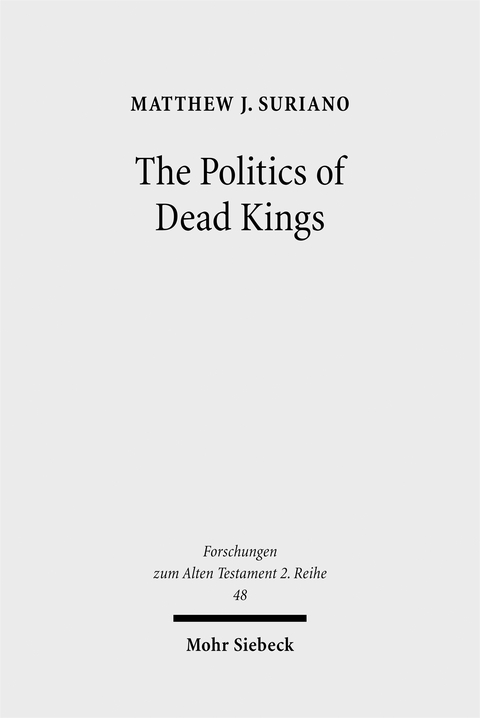
The Politics of Dead Kings
Dynastic Ancestors in the Book of Kings and Ancient Israel
2010
Mohr Siebeck (Hersteller)
9783161511462 (ISBN)
Mohr Siebeck (Hersteller)
9783161511462 (ISBN)
Der Autor untersucht die Äußerungen im Buch der Könige, die vom Problem des königlichen Todes und der Nachfolge handeln.
In der Erzählung von Israel und Juda im Buch der Könige wird das Ende einer königlichen Herrschaft in einer Reihe von Standardaussagen zusammengefaßt, die mit dem poetischen Ausdruck für Tod beginnen: "Und der König] legte sich zu seinen Vätern". Die Schlußäußerungen drehen sich alle um das Problem des königlichen Todes und der Nachfolge, eingebettet in einen kurzen Epilog, der normalerweise aus einer Begräbnisnotiz (in den königlichen Gräbern) und der Vorstellung des Nachfolgers bestand. Als solche übermittelten die formelhaften Erklärungen königliche Legitimität durch die Ideale politischer Kontinuität und die geradlinige Übertragung der Macht. Die politische Ideologie in den Epilogen des Buches der Könige stimmt mit der politischen Landschaft der Levante während der Eisenzeit überein. Die formelhaften Epiloge der Könige spiegelten die Bedeutung der Beerdigungsrituale und der königlichen Gräber wider, denn damit konnten sie dem politischen Problem begegnen, das durch den Tod eines Königs und den anschließenden Akt dynastischer Nachfolge gestellt wurde. In the narrative of Israel and Judah found in the Book of Kings, the end of a king's rule is summed up in a series of stock statements that begin with the poetic idiom for death: "and [the king] lay with his fathers." The summary statements all revolve around the problem of royal death and succession, encapsulated in a brief epilogue that consisted typically of a notice of burial (in the royal tombs) and the introduction of the successor. As such, the formulaic statements conveyed royal legitimacy through the ideals of political continuity and the linear descent of power. The formulaic epilogues reflected the importance of funerary rituals and royal tombs in their ability to confront the political problem posed by a king's death and the subsequent act of dynastic succession. This political ideology found in the epilogues of Kings was consistent with the political landscape of the Levant during the Iron Age.
In der Erzählung von Israel und Juda im Buch der Könige wird das Ende einer königlichen Herrschaft in einer Reihe von Standardaussagen zusammengefaßt, die mit dem poetischen Ausdruck für Tod beginnen: "Und der König] legte sich zu seinen Vätern". Die Schlußäußerungen drehen sich alle um das Problem des königlichen Todes und der Nachfolge, eingebettet in einen kurzen Epilog, der normalerweise aus einer Begräbnisnotiz (in den königlichen Gräbern) und der Vorstellung des Nachfolgers bestand. Als solche übermittelten die formelhaften Erklärungen königliche Legitimität durch die Ideale politischer Kontinuität und die geradlinige Übertragung der Macht. Die politische Ideologie in den Epilogen des Buches der Könige stimmt mit der politischen Landschaft der Levante während der Eisenzeit überein. Die formelhaften Epiloge der Könige spiegelten die Bedeutung der Beerdigungsrituale und der königlichen Gräber wider, denn damit konnten sie dem politischen Problem begegnen, das durch den Tod eines Königs und den anschließenden Akt dynastischer Nachfolge gestellt wurde. In the narrative of Israel and Judah found in the Book of Kings, the end of a king's rule is summed up in a series of stock statements that begin with the poetic idiom for death: "and [the king] lay with his fathers." The summary statements all revolve around the problem of royal death and succession, encapsulated in a brief epilogue that consisted typically of a notice of burial (in the royal tombs) and the introduction of the successor. As such, the formulaic statements conveyed royal legitimacy through the ideals of political continuity and the linear descent of power. The formulaic epilogues reflected the importance of funerary rituals and royal tombs in their ability to confront the political problem posed by a king's death and the subsequent act of dynastic succession. This political ideology found in the epilogues of Kings was consistent with the political landscape of the Levant during the Iron Age.
BA in History from University of Illinois, Urbana-Champaign; MA in Ancient History from Jerusalem University College, MA and PhD in Hebrew Bible and Northwest Semitics from University of California, Los Angeles; has taught at University of Southern California's School of Religion and was a Lecturer in Near Eastern Languages and Cultures at UCLA with a visiting faculty appointment in the Department of Religious Studies at the University of California, Santa Barbara; currently Visiting Lecturer in Hebrew Bible and Ancient Judaism in the Department of Religious Studies at Indiana University, Bloomington.
| Erscheint lt. Verlag | 5.10.2010 |
|---|---|
| Reihe/Serie | Forschungen zum Alten Testament 2. Reihe |
| Verlagsort | Tübingen |
| Sprache | englisch |
| Themenwelt | Religion / Theologie ► Christentum ► Bibelausgaben / Bibelkommentare |
| Geisteswissenschaften ► Religion / Theologie ► Judentum | |
| Schlagworte | Dead • Kings • Politics |
| ISBN-13 | 9783161511462 / 9783161511462 |
| Zustand | Neuware |
| Informationen gemäß Produktsicherheitsverordnung (GPSR) | |
| Haben Sie eine Frage zum Produkt? |
Mehr entdecken
aus dem Bereich
aus dem Bereich
Die Begründung von Lebensformen angesichts gesellschaftlicher …
Online Resource (2025)
Mohr Siebeck (Hersteller)
CHF 39,95


