


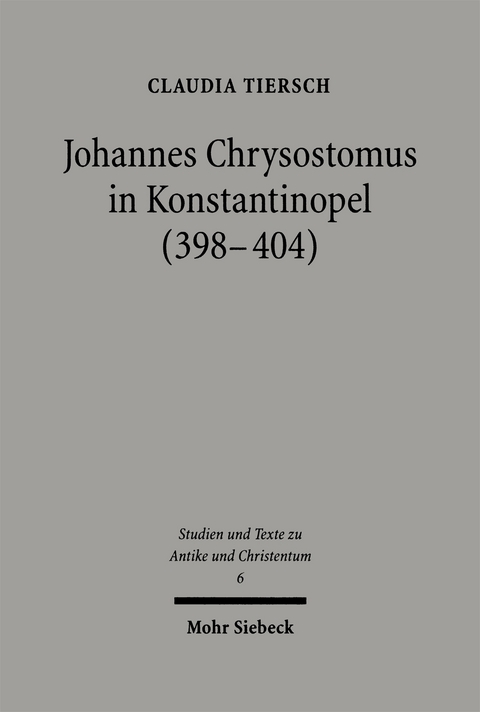
Johannes Chrysostomus in Konstantinopel (398-404)
Weltsicht und Wirken eines Bischofs in der Hauptstadt des Oströmischen Reiches
2020
Mohr Siebeck (Hersteller)
978-3-16-158680-4 (ISBN)
Mohr Siebeck (Hersteller)
978-3-16-158680-4 (ISBN)
Welche Ursachen führten zum Sturz von Johannes Chrysostomus, einem der begabtesten Prediger und Bischöfe im Römischen Reich? Claudia Tiersch untersucht die Amtsführung des Bischofs in Wechselwirkung mit städtischen, höfischen und kirchlichen Strukturen Konstantinopels und bestimmt sein Verhältnis zu verschiedenen sozialen Gruppen.
Welche Ursachen führten zum Sturz von Johannes Chrysostomus, einem der begabtesten Prediger und Bischöfe im Römischen Reich? Claudia Tiersch untersucht die Amtsführung des Bischofs in Wechselwirkung mit städtischen, höfischen und kirchlichen Strukturen Konstantinopels und bestimmt sein Verhältnis zu verschiedenen sozialen Gruppen. What caused the fall of St. John Chrysostom, Bishop of Constantinople from 398-404 AD? Claudia Tiersch examines the Bishop's conduct in office, his interaction with the urban, court and church structures in Constantinople and describes his relationship to various social groups in the capital city. The author sees the decisive factors for the increasing resistance to him, especially from the highest circles, in the Bishop's socially non-conformist life-style and in his consistent demands for a reform of earthly structures according to biblical norms , in which Chrysostom did not show any compatibility between Christian ideals and social norms. As a result of this, members of the social elite increasingly regarded him as a threat to society.
Welche Ursachen führten zum Sturz von Johannes Chrysostomus, einem der begabtesten Prediger und Bischöfe im Römischen Reich? Claudia Tiersch untersucht die Amtsführung des Bischofs in Wechselwirkung mit städtischen, höfischen und kirchlichen Strukturen Konstantinopels und bestimmt sein Verhältnis zu verschiedenen sozialen Gruppen. What caused the fall of St. John Chrysostom, Bishop of Constantinople from 398-404 AD? Claudia Tiersch examines the Bishop's conduct in office, his interaction with the urban, court and church structures in Constantinople and describes his relationship to various social groups in the capital city. The author sees the decisive factors for the increasing resistance to him, especially from the highest circles, in the Bishop's socially non-conformist life-style and in his consistent demands for a reform of earthly structures according to biblical norms , in which Chrysostom did not show any compatibility between Christian ideals and social norms. As a result of this, members of the social elite increasingly regarded him as a threat to society.
Geboren 1967; 1987-93 Studium der Alten Geschichte in Leipzig und München; 1993-96 Mitarbeiterin am Lehrstuhl für Alte Geschichte an der Technischen Universität Dresden; seit 1997 wiss. Mitarbeiterin am Sonderforschungsbereich 'Institutionalität und Geschichtlichkeit' an der Technischen Universität Dresden; 1998 Promotion.
| Erscheint lt. Verlag | 31.8.2020 |
|---|---|
| Reihe/Serie | Studien und Texte zu Antike und Christentum / Studies and Texts in Antiquity and Christianity |
| Verlagsort | Tübingen |
| Sprache | deutsch |
| Themenwelt | Religion / Theologie ► Christentum ► Kirchengeschichte |
| Schlagworte | Chrysostomus • Johannes • Johannes (Chrysostomus) |
| ISBN-10 | 3-16-158680-8 / 3161586808 |
| ISBN-13 | 978-3-16-158680-4 / 9783161586804 |
| Zustand | Neuware |
| Informationen gemäß Produktsicherheitsverordnung (GPSR) | |
| Haben Sie eine Frage zum Produkt? |


