


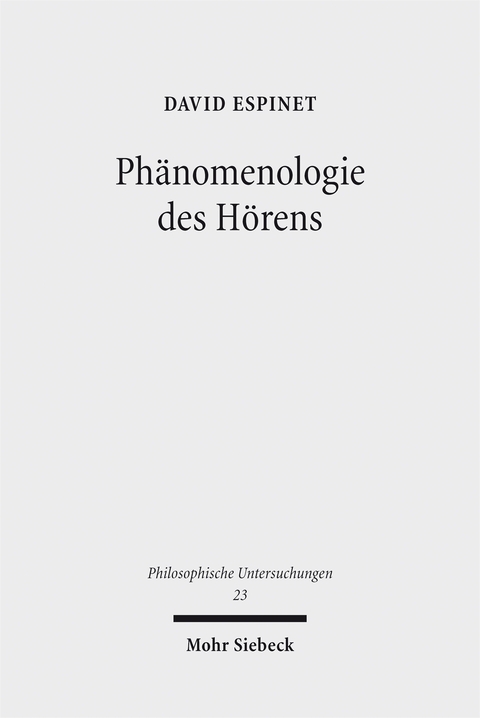
Phänomenologie des Hörens
Eine Untersuchung im Ausgang von Martin Heidegger
2016
|
2., ergänzte Auflage
Mohr Siebeck (Hersteller)
978-3-16-154348-7 (ISBN)
Mohr Siebeck (Hersteller)
978-3-16-154348-7 (ISBN)
Was heißt Hören? Wie bestimmt es unser Denken? Im Ausgang von Heideggers Phänomenologie nimmt David Espinet die Frage nach der Rehabilitierung des Hörens im Kontext philosophischer Theoriebildung auf. Dabei erweist sich die besondere Nähe des Hörens zur vorintentionalen Offenheit, die das zulässt, was zu denken gibt.
David Espinet deals with the question of the re-establishment of listening within the development of philosophical theory. Contrary to an often visually influenced epistemic tradition which neglects listening, the auditive experience patterns are shown to be crucial for Heidegger's thinking. The experience of listening creates a particular pre-intentional openness which allows the emergence of whatever is to be thought. In its complete structure, the experience of listening ranges from sensual listening to the act of understanding or thinking. Listening and thinking develop in a differential interplay - as thinking that listens, which is open for the unexpected, still silent sense, and as listening that thinks, that in its bodily existence has to listen beyond the comprehensible to the incomprehensible sense as a completely other sense. In the resonating cavity of the body, the claim of openness is thus addressed to thinking, a demand to which it only close itself, but from which it cannot withdraw.
David Espinet deals with the question of the re-establishment of listening within the development of philosophical theory. Contrary to an often visually influenced epistemic tradition which neglects listening, the auditive experience patterns are shown to be crucial for Heidegger's thinking. The experience of listening creates a particular pre-intentional openness which allows the emergence of whatever is to be thought. In its complete structure, the experience of listening ranges from sensual listening to the act of understanding or thinking. Listening and thinking develop in a differential interplay - as thinking that listens, which is open for the unexpected, still silent sense, and as listening that thinks, that in its bodily existence has to listen beyond the comprehensible to the incomprehensible sense as a completely other sense. In the resonating cavity of the body, the claim of openness is thus addressed to thinking, a demand to which it only close itself, but from which it cannot withdraw.
ist Professor für Geschichte der deutschen Philosophie an der Universität Strasbourg.
| Erscheint lt. Verlag | 17.6.2016 |
|---|---|
| Reihe/Serie | Philosophische Untersuchungen |
| Verlagsort | Tübingen |
| Sprache | deutsch |
| Themenwelt | Geisteswissenschaften ► Philosophie ► Allgemeines / Lexika |
| Geisteswissenschaften ► Philosophie ► Geschichte der Philosophie | |
| Geisteswissenschaften ► Philosophie ► Philosophie der Neuzeit | |
| Schlagworte | Hermeneutik • Hören • Phänomenologie • Wahrnehmung |
| ISBN-10 | 3-16-154348-3 / 3161543483 |
| ISBN-13 | 978-3-16-154348-7 / 9783161543487 |
| Zustand | Neuware |
| Informationen gemäß Produktsicherheitsverordnung (GPSR) | |
| Haben Sie eine Frage zum Produkt? |


