


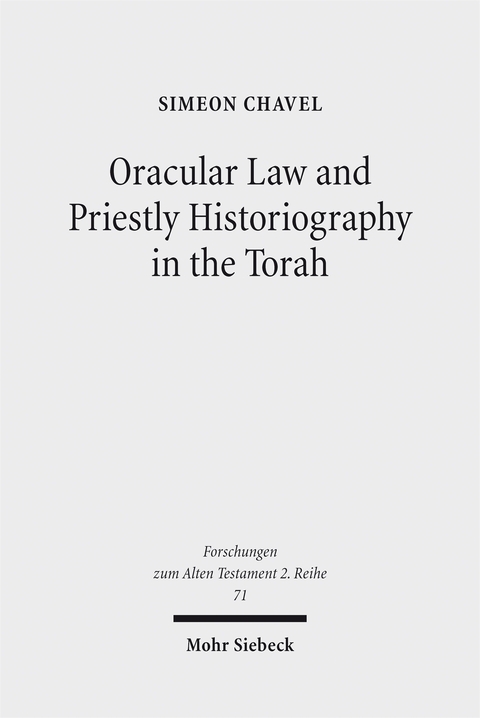
Oracular Law and Priestly Historiography in the Torah
2014
Mohr Siebeck (Hersteller)
9783161533426 (ISBN)
Mohr Siebeck (Hersteller)
9783161533426 (ISBN)
Simeon Chavel arbeitet eine bestimmte Art der Geschichte in der Tora heraus, die "Orakelnovelle", sowie ihr Profil und ihre Poetik, ihren historischen Hintergrund und ihre Verwendung.
Simeon Chavel arbeitet eine bestimmte Art der Geschichte in der Tora heraus, die "Orakelnovelle", sowie ihr Profil und ihre Poetik, ihren historischen Hintergrund und ihre Verwendung. Als kurze Geschichte über ein menschliches Dilemma, welches durch göttliches Gesetz gelöst wird, schildert die Orakelnovelle ein Ereignis oder eine Reihe von Umständen in Israel, Orakelbefragungen durch Moses und Anweisungen durch Yahweh. Die Tora enthält vier solche Geschichten, alle in der Priesterschrift, über das Verfluchen von Yahweh (Lev 24,10-23), den Aufschub der Passahfeier (Num 9,1-14 ), die Sabbatschändung (Num 15,32-36) und das Erbrecht der Töchter (Num 27,1-11). Alle vier behandeln Thematiken der vorausgehenden göttlichen Reden und von Gott gelenkten Handlungen in dramatischer Form. Aber jede verwendet die rechtliche Klimax unterschiedlich, hat eine andere kompositorische Geschichte und beeinflusst andere biblische Texte auf unterschiedliche Art. Antike Quellen zeigen, dass die Orakelnovelle eine Form des priesterlichen Handelns für die Geschichtsschreibung aufgreift. Gemeinsam beleuchten sie die Geschichte des Priestertums, die den Willen Gottes als Gesetz auslegt, und heben judäische Priester hervor, die Orakelbefragungen als das Verbindungsglied zwischen göttlicher und menschlicher Gesellschaft preisen. In this study, Simeon Chavel establishes the existence of a distinct type of story within the Torah, the "oracular novella," traces its contours and poetics, identifies its historical background, and analyzes its use. The oracular novella is a very short story with a legal climax, in which divine adjudication and legislation resolves human complication. In a spartan style, the narrative recounts how an incident or set of circumstances in Israel led through oracular inquiry of Moses to legal resolution by Yahweh. The Torah contains four oracular novellas, all in the Priestly History, two action stories and two situation stories: a man curses Yahweh (Lev 24:10-23), a man gathers wood on the Sabbath (Num 15:32-36), impurity of certain Israelites at the time of the Pesaḥ threatens to cut them off forever (Num 9:1-14), and the name of a man who died without sons to possess his portion in Canaan stands to go to oblivion (Num 27:1-11). Each utilizes the legal climax differently as an expressive ideological moment; each was composed, incorporated, and revised separately and differently; and each had a different effect on prior and subsequent biblical literature. But all function similarly within the Priestly History to dramatize a set of principles and themes in the immediately preceding divine legislative speeches and divinely directed activities. Ancient court records and biblical materials show the oracular novellas to adapt a form of priestly activity for historiographical purposes. As a group, they illuminate the Priestly History as a narrative founded on a deep and extensive troping of divine will as law and legislation, and highlight how Judean priests cherished oracular inquiry as the nexus of divine and human society.
Simeon Chavel arbeitet eine bestimmte Art der Geschichte in der Tora heraus, die "Orakelnovelle", sowie ihr Profil und ihre Poetik, ihren historischen Hintergrund und ihre Verwendung. Als kurze Geschichte über ein menschliches Dilemma, welches durch göttliches Gesetz gelöst wird, schildert die Orakelnovelle ein Ereignis oder eine Reihe von Umständen in Israel, Orakelbefragungen durch Moses und Anweisungen durch Yahweh. Die Tora enthält vier solche Geschichten, alle in der Priesterschrift, über das Verfluchen von Yahweh (Lev 24,10-23), den Aufschub der Passahfeier (Num 9,1-14 ), die Sabbatschändung (Num 15,32-36) und das Erbrecht der Töchter (Num 27,1-11). Alle vier behandeln Thematiken der vorausgehenden göttlichen Reden und von Gott gelenkten Handlungen in dramatischer Form. Aber jede verwendet die rechtliche Klimax unterschiedlich, hat eine andere kompositorische Geschichte und beeinflusst andere biblische Texte auf unterschiedliche Art. Antike Quellen zeigen, dass die Orakelnovelle eine Form des priesterlichen Handelns für die Geschichtsschreibung aufgreift. Gemeinsam beleuchten sie die Geschichte des Priestertums, die den Willen Gottes als Gesetz auslegt, und heben judäische Priester hervor, die Orakelbefragungen als das Verbindungsglied zwischen göttlicher und menschlicher Gesellschaft preisen. In this study, Simeon Chavel establishes the existence of a distinct type of story within the Torah, the "oracular novella," traces its contours and poetics, identifies its historical background, and analyzes its use. The oracular novella is a very short story with a legal climax, in which divine adjudication and legislation resolves human complication. In a spartan style, the narrative recounts how an incident or set of circumstances in Israel led through oracular inquiry of Moses to legal resolution by Yahweh. The Torah contains four oracular novellas, all in the Priestly History, two action stories and two situation stories: a man curses Yahweh (Lev 24:10-23), a man gathers wood on the Sabbath (Num 15:32-36), impurity of certain Israelites at the time of the Pesaḥ threatens to cut them off forever (Num 9:1-14), and the name of a man who died without sons to possess his portion in Canaan stands to go to oblivion (Num 27:1-11). Each utilizes the legal climax differently as an expressive ideological moment; each was composed, incorporated, and revised separately and differently; and each had a different effect on prior and subsequent biblical literature. But all function similarly within the Priestly History to dramatize a set of principles and themes in the immediately preceding divine legislative speeches and divinely directed activities. Ancient court records and biblical materials show the oracular novellas to adapt a form of priestly activity for historiographical purposes. As a group, they illuminate the Priestly History as a narrative founded on a deep and extensive troping of divine will as law and legislation, and highlight how Judean priests cherished oracular inquiry as the nexus of divine and human society.
Born 1969; 1992 BA in English Literature; 1994 MA in Religious Studies; 2006 PhD Biblical Studies; 2006-09 Lecturer in Hebrew Bible at the Department of Religion, Princeton University; since 2009 Assistant Professor of Hebrew Bible at the University of Chicago Divinity School.
| Erscheint lt. Verlag | 19.11.2014 |
|---|---|
| Reihe/Serie | Forschungen zum Alten Testament 2. Reihe |
| Verlagsort | Tübingen |
| Sprache | englisch |
| Themenwelt | Religion / Theologie ► Christentum ► Bibelausgaben / Bibelkommentare |
| Geisteswissenschaften ► Religion / Theologie ► Judentum | |
| Schlagworte | Ancient Israel • Biblical Criticism • Law and Narrative |
| ISBN-13 | 9783161533426 / 9783161533426 |
| Zustand | Neuware |
| Informationen gemäß Produktsicherheitsverordnung (GPSR) | |
| Haben Sie eine Frage zum Produkt? |
Mehr entdecken
aus dem Bereich
aus dem Bereich
Die Begründung von Lebensformen angesichts gesellschaftlicher …
Online Resource (2025)
Mohr Siebeck (Hersteller)
CHF 39,95


