


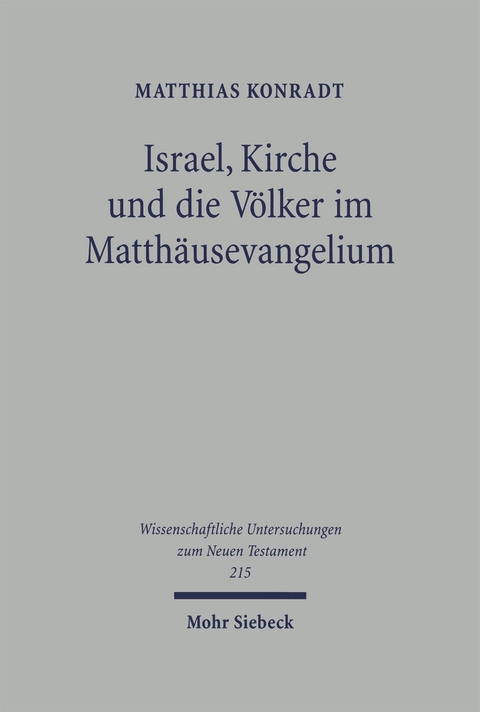
Israel, Kirche und die Völker im Matthäusevangelium
2019
Mohr Siebeck (Hersteller)
978-3-16-157285-2 (ISBN)
Mohr Siebeck (Hersteller)
978-3-16-157285-2 (ISBN)
Im Zuge einer kritischen Auseinandersetzung mit der traditionellen Deutung des Matthäusevangeliums, dass der Evangelist einer Ablösung Israels durch die Kirche bzw. die Völker das Wort rede, entwickelt Matthias Konradt eine differenzierte Sicht über das Verhältnis von Israel, Kirche und Völkerwelt in der matthäischen Theologie.
Matthias Konradt explores a problem central to the theological conception of the Gospel of Matthew: What is the cause for the transition from the Israel-centered activities of Jesus and his disciples previous to Easter to the universal mission after Easter, and how is the formation of the church related to Israel's role as God's chosen nation in Matthew's concept? In conjunction with a detailed scrutiny of the traditional interpretation that Matthew propagates the replacement of Israel by the church and - in keeping with this - of the mission to Israel by the universal mission, the author maintains that the Israel-centered and the universal dimension of salvation are positively interconnected in the narrative conception, in which Matthew develops Jesus' messianic identity as the Son of David and the Son of God. At the same time, Matthew did not see the church as a "new" or "true" Israel.
Matthias Konradt explores a problem central to the theological conception of the Gospel of Matthew: What is the cause for the transition from the Israel-centered activities of Jesus and his disciples previous to Easter to the universal mission after Easter, and how is the formation of the church related to Israel's role as God's chosen nation in Matthew's concept? In conjunction with a detailed scrutiny of the traditional interpretation that Matthew propagates the replacement of Israel by the church and - in keeping with this - of the mission to Israel by the universal mission, the author maintains that the Israel-centered and the universal dimension of salvation are positively interconnected in the narrative conception, in which Matthew develops Jesus' messianic identity as the Son of David and the Son of God. At the same time, Matthew did not see the church as a "new" or "true" Israel.
Born 1967; 1996 Dr. theol.; 1999 Ordination; 2002 Habilitation; 2025 Dr. h.c.; Professor of New Testament at Ruprecht-Karls-University Heidelberg.
| Erscheint lt. Verlag | 10.12.2019 |
|---|---|
| Reihe/Serie | Wissenschaftliche Untersuchungen zum Neuen Testament |
| Verlagsort | Tübingen |
| Sprache | deutsch |
| Themenwelt | Religion / Theologie ► Christentum ► Bibelausgaben / Bibelkommentare |
| Geisteswissenschaften ► Religion / Theologie ► Judentum | |
| Schlagworte | Ekklesiologie • Israel • Kirche • Matthäus • Matthäusevangelium |
| ISBN-10 | 3-16-157285-8 / 3161572858 |
| ISBN-13 | 978-3-16-157285-2 / 9783161572852 |
| Zustand | Neuware |
| Informationen gemäß Produktsicherheitsverordnung (GPSR) | |
| Haben Sie eine Frage zum Produkt? |
Mehr entdecken
aus dem Bereich
aus dem Bereich
Die Begründung von Lebensformen angesichts gesellschaftlicher …
Online Resource (2025)
Mohr Siebeck (Hersteller)
CHF 39,95


