


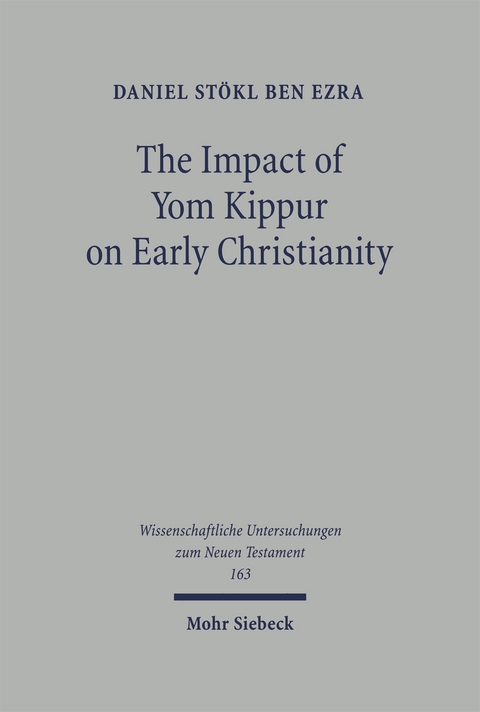
The Impact of Yom Kippur on Early Christianity
The Day of Atonement from Second Temple Judaism to the Fifth Century
2019
Mohr Siebeck (Hersteller)
978-3-16-157230-2 (ISBN)
Mohr Siebeck (Hersteller)
978-3-16-157230-2 (ISBN)
Der Versöhnungstag (Jom Kippur) war das wichtigste Fest des antiken Judentums. Dennoch lag sein Einfluß auf das Christentum bislang im Dunkeln. Daniel Stökl Ben Ezra präsentiert hier die erste umfassende Untersuchung der Rituale, Institutionen und Mythen des nachbiblischen jüdischen Versöhnungstages und ihren Einfluß auf die Religion des frühen Christentums bis zum fünften Jahrhundert.
Der Versöhnungstag (Jom Kippur) war das wichtigste Fest des antiken Judentums. Dennoch lag sein Einfluß auf das Christentum bislang im Dunkeln. Daniel Stökl Ben Ezra präsentiert hier die erste umfassende Untersuchung der Rituale, Institutionen und Mythen des nachbiblischen jüdischen Versöhnungstages und ihren Einfluß auf die Religion des frühen Christentums bis zum fünften Jahrhundert. The Day of Atonement (Yom Kippur) was the most important festival of late-antique Judaism, but its influence on Christianity was not generally recognized. Daniel Stökl Ben Ezra here not only reveals the profound influence of Yom Kippur on early Christianity up to the fifth century but also offers the first detailed analysis of the festival itself. He examines the rituals of and the concepts underlying Yom Kippur in various types of Second Temple and rabbinic Judaism. In detailed analyses of many New Testament and extra-canonical writings, as well as Gnostic and early mystical texts, the author portrays the sweeping influence of the high priest, Holy of Holies, blood sacrifice and scapegoat ritual on early Christian thought and practice. In the final part he examines Christian exegesis of Leviticus 16, Christian-Jewish polemics and the impact of Yom Kippur on Christian liturgy.
Der Versöhnungstag (Jom Kippur) war das wichtigste Fest des antiken Judentums. Dennoch lag sein Einfluß auf das Christentum bislang im Dunkeln. Daniel Stökl Ben Ezra präsentiert hier die erste umfassende Untersuchung der Rituale, Institutionen und Mythen des nachbiblischen jüdischen Versöhnungstages und ihren Einfluß auf die Religion des frühen Christentums bis zum fünften Jahrhundert. The Day of Atonement (Yom Kippur) was the most important festival of late-antique Judaism, but its influence on Christianity was not generally recognized. Daniel Stökl Ben Ezra here not only reveals the profound influence of Yom Kippur on early Christianity up to the fifth century but also offers the first detailed analysis of the festival itself. He examines the rituals of and the concepts underlying Yom Kippur in various types of Second Temple and rabbinic Judaism. In detailed analyses of many New Testament and extra-canonical writings, as well as Gnostic and early mystical texts, the author portrays the sweeping influence of the high priest, Holy of Holies, blood sacrifice and scapegoat ritual on early Christian thought and practice. In the final part he examines Christian exegesis of Leviticus 16, Christian-Jewish polemics and the impact of Yom Kippur on Christian liturgy.
Geboren 1970; Studium der Religionswissenschaften, Judaistik und Theologie; 2002 Promotion; 2011 Habilitation; derzeit Forschungsprofessor an der Ãcole pratique des hautes études in Paris auf dem Lehrstuhl für Sprache, Literatur, Paläographie und Epigraphie des Hebräischen und Aramäischen vom vierten Jahrhundert v. Chr. bis zum vierten Jahrhundert n. Chr.
| Erscheint lt. Verlag | 10.12.2019 |
|---|---|
| Reihe/Serie | Wissenschaftliche Untersuchungen zum Neuen Testament |
| Verlagsort | Tübingen |
| Sprache | englisch |
| Themenwelt | Religion / Theologie ► Christentum ► Kirchengeschichte |
| Wirtschaft ► Betriebswirtschaft / Management | |
| Schlagworte | Early Christianity • Second Temple Judaism • Yom Kippur |
| ISBN-10 | 3-16-157230-0 / 3161572300 |
| ISBN-13 | 978-3-16-157230-2 / 9783161572302 |
| Zustand | Neuware |
| Informationen gemäß Produktsicherheitsverordnung (GPSR) | |
| Haben Sie eine Frage zum Produkt? |


