


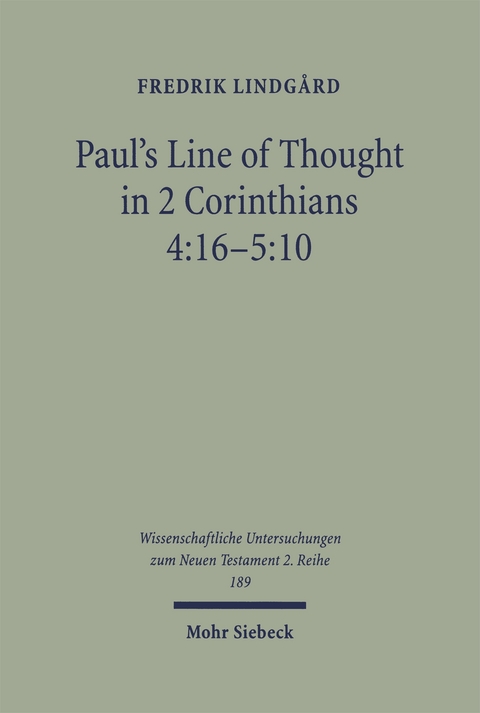
Paul's Line of Thought in 2 Corinthians 4:16-5:10
2019
Mohr Siebeck (Hersteller)
978-3-16-157054-4 (ISBN)
Mohr Siebeck (Hersteller)
978-3-16-157054-4 (ISBN)
Fredrik Lindgård untersucht den zweiten Korintherbrief und zeigt, daß sich die Einstellung des Paulus zu Fragen der Eschatologie gegenüber früheren Briefen nicht geändert hat. Der Autor analysiert vor allem den Sprachgebrauch des Apostels und weist nach, daß er - die Anthropologie betreffend - sowohl holistische als auch dualistische Ausdrücke verwendet, wobei der Dualismus allerdings überwiegt.
Fredrik Lindgård untersucht den zweiten Korintherbrief (4,16 - 5,10) und zeigt, daß sich die Einstellung des Paulus zu Fragen der Eschatologie gegenüber früheren Briefen nicht geändert hat. Vielmehr steht in diesem Brief die Präsentation seiner Person im Vordergrund: er zeigt Emotionen und Willensäußerungen, um seine Position zu verstärken. Der Autor analysiert vor allem den Sprachgebrauch des Apostels und weist nach, daß er - die Anthropologie betreffend - sowohl holistische als auch dualistische Ausdrücke verwendet, wobei der Dualismus allerdings überwiegt. Es zeigt sich, daß der Ansatz einer literarischen und rhetorischen Analyse nützlich ist, um den Gesamtzusammenhang des zweiten Korintherbriefes zu verstehen. Fredrik Lindgård analyzes verses 4:16-5:10 in 2 Corinthians, verses which have often been used to argue that Paul's eschatology developed over time or to ascertain whether or not Paul is an anthropological dualist. Paul's concern is how the Corinthians see him. His aim is to show them that he is frank and "open" to them and that his attitude to adversities confirms that he is a real apostle. He reveals his thoughts and emotions when facing suffering. The author shows that the section and its context do not support the view that Paul changed or developed his eschatology. Instead, the text displays the unsystematic character of Paul's eschatology. Concepts which Paul normally uses separately occur side by side without elaboration. Although Paul uses both dualistic and holistic language, the dominating feature is dualism. The analysis shows that a wide rhetorical approach can be useful when trying to understand Paul.
Fredrik Lindgård untersucht den zweiten Korintherbrief (4,16 - 5,10) und zeigt, daß sich die Einstellung des Paulus zu Fragen der Eschatologie gegenüber früheren Briefen nicht geändert hat. Vielmehr steht in diesem Brief die Präsentation seiner Person im Vordergrund: er zeigt Emotionen und Willensäußerungen, um seine Position zu verstärken. Der Autor analysiert vor allem den Sprachgebrauch des Apostels und weist nach, daß er - die Anthropologie betreffend - sowohl holistische als auch dualistische Ausdrücke verwendet, wobei der Dualismus allerdings überwiegt. Es zeigt sich, daß der Ansatz einer literarischen und rhetorischen Analyse nützlich ist, um den Gesamtzusammenhang des zweiten Korintherbriefes zu verstehen. Fredrik Lindgård analyzes verses 4:16-5:10 in 2 Corinthians, verses which have often been used to argue that Paul's eschatology developed over time or to ascertain whether or not Paul is an anthropological dualist. Paul's concern is how the Corinthians see him. His aim is to show them that he is frank and "open" to them and that his attitude to adversities confirms that he is a real apostle. He reveals his thoughts and emotions when facing suffering. The author shows that the section and its context do not support the view that Paul changed or developed his eschatology. Instead, the text displays the unsystematic character of Paul's eschatology. Concepts which Paul normally uses separately occur side by side without elaboration. Although Paul uses both dualistic and holistic language, the dominating feature is dualism. The analysis shows that a wide rhetorical approach can be useful when trying to understand Paul.
Born 1964; 1990 Master of Theology; 2006 Doctor of Theology; Pastor in the Lutheran Church of Finland.
| Erscheint lt. Verlag | 10.12.2019 |
|---|---|
| Reihe/Serie | Wissenschaftliche Untersuchungen zum Neuen Testament 2. Reihe |
| Verlagsort | Tübingen |
| Sprache | englisch |
| Themenwelt | Religion / Theologie ► Christentum ► Bibelausgaben / Bibelkommentare |
| Schlagworte | Altes Testament • Neues Testament • Pauline Eschatology |
| ISBN-10 | 3-16-157054-5 / 3161570545 |
| ISBN-13 | 978-3-16-157054-4 / 9783161570544 |
| Zustand | Neuware |
| Informationen gemäß Produktsicherheitsverordnung (GPSR) | |
| Haben Sie eine Frage zum Produkt? |
Mehr entdecken
aus dem Bereich
aus dem Bereich
Die Begründung von Lebensformen angesichts gesellschaftlicher …
Online Resource (2025)
Mohr Siebeck (Hersteller)
CHF 39,95


