


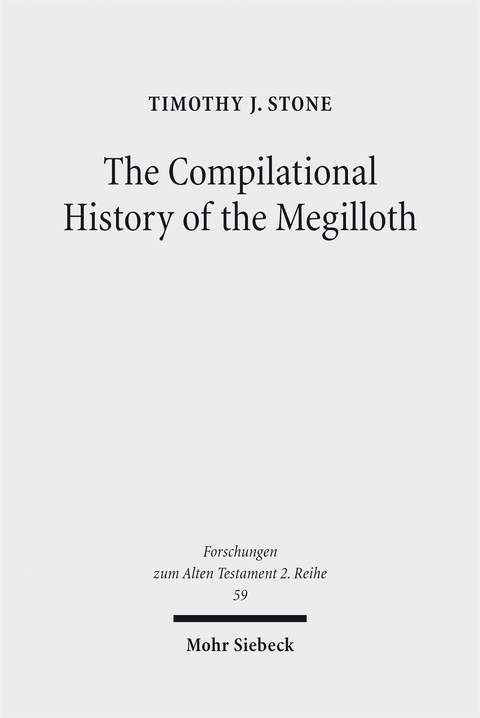
The Compilational History of the Megilloth
Canon, Contoured Intertextuality and Meaning in the Writings
2013
Mohr Siebeck (Hersteller)
9783161523762 (ISBN)
Mohr Siebeck (Hersteller)
9783161523762 (ISBN)
Timothy J. Stone untersucht die kanonische Form des dritten Teils des hebräischen Kanons, der "Schriften", und stellt den Forschungskonsens in Frage, dass es sich bei dieser Sammlung um eine Anthologie von Büchern handelt, die nichts miteinander zu tun haben.
Timothy J. Stone untersucht die kanonische Form des dritten Teils des hebräischen Kanons, der "Schriften", und stellt den Forschungskonses infrage, dass es sich bei dieser Sammlung um eine Anthologie von Büchern handelt, die nichts miteinander zu tun haben. Zunächst analysiert er die Entstehung und die unterschiedliche Anordnung der "Schriften" in der Antike. Die Auffassung von Umfang und Inhalt der heiligen Literatur variierte im Judentum, aber innerhalb des Umkreises des Tempels hatten sich die "Schriften" und der hebräische Kanon wahrscheinlich vor dem Ende des ersten Jahrhunderts gefestigt. Trotz des Forschungskonsenses, dass es viele verschiedene Anordnungen der "Schriften" gab, können vor dem 12. Jahrhundert nur die masoretische und die talmudische Reihenfolge nachgewiesen werden. Des Weiteren prüft Stone die Bücher Megillot auf Hinweise zu ihrer Zusammenstellung, vor allem Rut und Ester. Er folgert, dass die Sammlung der Bücher Megillot wesentlich für den kanonischen Verlauf ist und die Form der antiken Anordnung der "Schriften" bewahrte. Timothy J. Stone explores the canonical shape of the third part of the Hebrew canon, the Writings, challenging the common assumption that the collection is an anthology of unrelated books. First he analyzes the formation and various orders for the Writings in antiquity. Conceptions of sacred literature differed in Judaism, but within temple circles, the Writings and the Hebrew canon were likely solidified prior to the end of the first century. Despite the consensus that there are a large number of orders for the Writings, there is only evidence of the Masoretic and the Talmudic orders prior to the twelfth century. Stone also examines the books of the "Megilloth" for signs of their compilation, especially Ruth and Esther. He concludes that the codification of the "Megilloth" into a collection is integral to the canonical process and preserved in the shape of the Writings' ancient arrangements.
Timothy J. Stone untersucht die kanonische Form des dritten Teils des hebräischen Kanons, der "Schriften", und stellt den Forschungskonses infrage, dass es sich bei dieser Sammlung um eine Anthologie von Büchern handelt, die nichts miteinander zu tun haben. Zunächst analysiert er die Entstehung und die unterschiedliche Anordnung der "Schriften" in der Antike. Die Auffassung von Umfang und Inhalt der heiligen Literatur variierte im Judentum, aber innerhalb des Umkreises des Tempels hatten sich die "Schriften" und der hebräische Kanon wahrscheinlich vor dem Ende des ersten Jahrhunderts gefestigt. Trotz des Forschungskonsenses, dass es viele verschiedene Anordnungen der "Schriften" gab, können vor dem 12. Jahrhundert nur die masoretische und die talmudische Reihenfolge nachgewiesen werden. Des Weiteren prüft Stone die Bücher Megillot auf Hinweise zu ihrer Zusammenstellung, vor allem Rut und Ester. Er folgert, dass die Sammlung der Bücher Megillot wesentlich für den kanonischen Verlauf ist und die Form der antiken Anordnung der "Schriften" bewahrte. Timothy J. Stone explores the canonical shape of the third part of the Hebrew canon, the Writings, challenging the common assumption that the collection is an anthology of unrelated books. First he analyzes the formation and various orders for the Writings in antiquity. Conceptions of sacred literature differed in Judaism, but within temple circles, the Writings and the Hebrew canon were likely solidified prior to the end of the first century. Despite the consensus that there are a large number of orders for the Writings, there is only evidence of the Masoretic and the Talmudic orders prior to the twelfth century. Stone also examines the books of the "Megilloth" for signs of their compilation, especially Ruth and Esther. He concludes that the codification of the "Megilloth" into a collection is integral to the canonical process and preserved in the shape of the Writings' ancient arrangements.
Born 1977; 2000 BA in Biblical Studies from Cairn University (PA); 2004 MA in Biblical Exegesis from Wheaton College (IL); 2010 PhD in Old Testament from St Mary's College, University of St Andrews (UK); since 2012 lecturer in Old Testament and Hebrew at Zomba Theological College, Zomba, Malawi.
| Erscheint lt. Verlag | 5.11.2013 |
|---|---|
| Reihe/Serie | Forschungen zum Alten Testament 2. Reihe |
| Verlagsort | Tübingen |
| Sprache | englisch |
| Themenwelt | Religion / Theologie ► Christentum ► Bibelausgaben / Bibelkommentare |
| Geisteswissenschaften ► Religion / Theologie ► Judentum | |
| Schlagworte | Canon • Esther (book of) • Ruth (book of) • Writings |
| ISBN-13 | 9783161523762 / 9783161523762 |
| Zustand | Neuware |
| Informationen gemäß Produktsicherheitsverordnung (GPSR) | |
| Haben Sie eine Frage zum Produkt? |
Mehr entdecken
aus dem Bereich
aus dem Bereich
Die Begründung von Lebensformen angesichts gesellschaftlicher …
Online Resource (2025)
Mohr Siebeck (Hersteller)
CHF 39,95


