


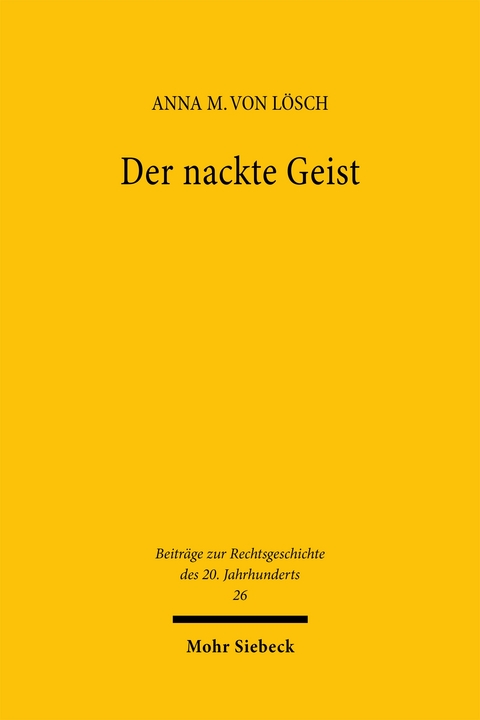
Der nackte Geist
Die Juristische Fakultät der Berliner Universität im Umbruch von 1933
2022
Mohr Siebeck (Hersteller)
978-3-16-160362-4 (ISBN)
Mohr Siebeck (Hersteller)
978-3-16-160362-4 (ISBN)
Was bedeutete die nationalsozialistische Machtergreifung für die relativ abgeschlossene Welt der Berliner Rechtswissenschaftler? In ihrer Untersuchung entdeckt Anna-Maria Lösch das Bild einer Fakultät, die opportunistisch agierte und zu Vertreibungen schwieg.
Was bedeutete die nationalsozialistische Machtergreifung für die relativ abgeschlossene Welt der Berliner Rechtswissenschaftler? In ihrer Untersuchung entdeckt Anna-Maria Lösch das Bild einer Fakultät, die opportunistisch agierte und zu Vertreibungen schwieg. Anna-Maria Lösch examines the Faculty of Law at the University of Berlin on its way to National Socialism. This study encompasses the final phase of the Weimar Republic (1930 - January 1933), the so-called National Socialist revolution in 1933 (and its consequences up to 1934) and the path towards consolidation (1934 to 1936/37). The author takes a separate look at what developments meant for the students, the professors and the other university instructors, and in considering each of these groups is able to present an overall picture. She discusses changes in the curriculum and university regulations and the relationship to the Ministry of Education and Culture. She directs her attention towards the fate of the professors who were exiled and to the dramatic struggle for power among the 'ardent National Socialists' Carl Schmitt, Karl-August Eckhardt and Reinhard Höhn.
Was bedeutete die nationalsozialistische Machtergreifung für die relativ abgeschlossene Welt der Berliner Rechtswissenschaftler? In ihrer Untersuchung entdeckt Anna-Maria Lösch das Bild einer Fakultät, die opportunistisch agierte und zu Vertreibungen schwieg. Anna-Maria Lösch examines the Faculty of Law at the University of Berlin on its way to National Socialism. This study encompasses the final phase of the Weimar Republic (1930 - January 1933), the so-called National Socialist revolution in 1933 (and its consequences up to 1934) and the path towards consolidation (1934 to 1936/37). The author takes a separate look at what developments meant for the students, the professors and the other university instructors, and in considering each of these groups is able to present an overall picture. She discusses changes in the curriculum and university regulations and the relationship to the Ministry of Education and Culture. She directs her attention towards the fate of the professors who were exiled and to the dramatic struggle for power among the 'ardent National Socialists' Carl Schmitt, Karl-August Eckhardt and Reinhard Höhn.
Geboren 1958; 1979-84 Studium der Rechtswissenschaft in München und Passau; 1987 zweite jurist. Staatsprüfung; 1992-98 Wiss. Mitarbeiterin an der Humboldt-Universität Berlin; 1999 Promotion.
| Erscheint lt. Verlag | 15.8.2022 |
|---|---|
| Reihe/Serie | Beiträge zur Rechtsgeschichte des 20. Jahrhunderts |
| Verlagsort | Tübingen |
| Sprache | deutsch |
| Themenwelt | Geschichte ► Teilgebiete der Geschichte ► Militärgeschichte |
| Recht / Steuern ► Allgemeines / Lexika | |
| Recht / Steuern ► Rechtsgeschichte | |
| Schlagworte | Berlin • Berlin, Hochschulwesen • Geist • Hochschulwesen • Mohr Siebeck |
| ISBN-10 | 3-16-160362-1 / 3161603621 |
| ISBN-13 | 978-3-16-160362-4 / 9783161603624 |
| Zustand | Neuware |
| Informationen gemäß Produktsicherheitsverordnung (GPSR) | |
| Haben Sie eine Frage zum Produkt? |


