


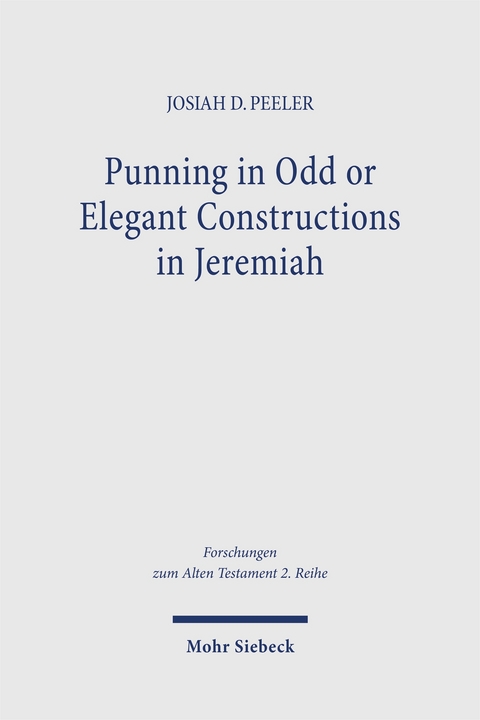
Punning in Odd or Elegant Constructions in Jeremiah
The Convergence of Linguistics, Rhetoric, and Textuality in the Hebrew Text of Jeremiah
2025
Mohr Siebeck (Hersteller)
978-3-16-163199-3 (ISBN)
Mohr Siebeck (Hersteller)
978-3-16-163199-3 (ISBN)
- Noch nicht erschienen (ca. Dezember 2025)
- Versandkostenfrei
- Auch auf Rechnung
- Artikel merken
Der hebräische Text von Jeremia verwendet unpassende oder symmetrische Elemente, um Wortspiele zu erzeugen, die ein kontextbezogenes Thema aufzeigen. Während diese Art von Wortspiel in der Hebräischen Bibel in der Forschung bisher weitgehend ignoriert wurde, zeigt Josiah D. Peeler, dass es ein gängiges Mittel in der Herstellung altorientalischer Texte war.
Der hebräische Text von Jeremia verwendet unpassende oder symmetrische Elemente, um Wortspiele zu erzeugen, die ein kontextbezogenes Thema aufzeigen. Während diese Art von Wortspiel in der Hebräischen Bibel in der Forschung bisher weitgehend ignoriert wurde, zeigt Josiah D. Peeler, dass es ein gängiges Mittel in der Herstellung altorientalischer Texte war. Ancient Near Eastern scribes from Egypt to Mesopotamia, including Israelite scribes of the Hebrew Bible, create infelicitous or symmetric elements in their textual production. By their form, these elements communicate beyond the textual and semantic levels for rhetorical and literary purposes. "Meta-textual semantics" is a widespread scribal device in the ancient world, and ancient audiences and exegetes (e.g., rabbinic, medieval Jewish and Christian exegetes, and Masoretes) properly appreciated it, but it is underappreciated in modern interpretations of the Hebrew Bible. Using Prov 1:1-7 as a paradigm, Josiah D. Peeler explores elements in Hebrew Jeremiah usually considered secondary because of their odd or well-formed nature, to demonstrate that they exemplify a contextual theme.
Der hebräische Text von Jeremia verwendet unpassende oder symmetrische Elemente, um Wortspiele zu erzeugen, die ein kontextbezogenes Thema aufzeigen. Während diese Art von Wortspiel in der Hebräischen Bibel in der Forschung bisher weitgehend ignoriert wurde, zeigt Josiah D. Peeler, dass es ein gängiges Mittel in der Herstellung altorientalischer Texte war. Ancient Near Eastern scribes from Egypt to Mesopotamia, including Israelite scribes of the Hebrew Bible, create infelicitous or symmetric elements in their textual production. By their form, these elements communicate beyond the textual and semantic levels for rhetorical and literary purposes. "Meta-textual semantics" is a widespread scribal device in the ancient world, and ancient audiences and exegetes (e.g., rabbinic, medieval Jewish and Christian exegetes, and Masoretes) properly appreciated it, but it is underappreciated in modern interpretations of the Hebrew Bible. Using Prov 1:1-7 as a paradigm, Josiah D. Peeler explores elements in Hebrew Jeremiah usually considered secondary because of their odd or well-formed nature, to demonstrate that they exemplify a contextual theme.
Born 1986; 2017 MA in Hebrew and Old Testament Studies (Abilene Christian University); 2018 MSt in Classical Hebrew Studies (University of Oxford); 2022 PhD in Hebrew and Old Testament Studies (University of Edinburgh); Assistant professor of Biblical Studies and Languages at Mid-Atlantic Christian University.
| Erscheint lt. Verlag | 31.12.2025 |
|---|---|
| Reihe/Serie | Forschungen zum Alten Testament 2. Reihe |
| Verlagsort | Tübingen |
| Sprache | englisch |
| Themenwelt | Religion / Theologie ► Christentum ► Bibelausgaben / Bibelkommentare |
| Schlagworte | ancient hebrew • Biblical Hebrew • Hebrew Bible • Old Testament • Textual criticism |
| ISBN-10 | 3-16-163199-4 / 3161631994 |
| ISBN-13 | 978-3-16-163199-3 / 9783161631993 |
| Zustand | Neuware |
| Informationen gemäß Produktsicherheitsverordnung (GPSR) | |
| Haben Sie eine Frage zum Produkt? |
Mehr entdecken
aus dem Bereich
aus dem Bereich
Die Begründung von Lebensformen angesichts gesellschaftlicher …
Online Resource (2025)
Mohr Siebeck (Hersteller)
CHF 39,95


