


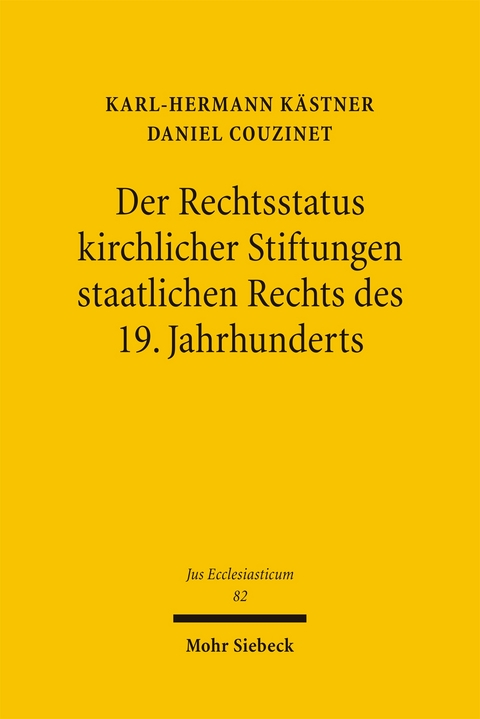
Der Rechtsstatus kirchlicher Stiftungen staatlichen Rechts des 19. Jahrhunderts
Eine Untersuchung am Beispiel der Stiftung Liebenau
2024
Mohr Siebeck (Hersteller)
978-3-16-162877-1 (ISBN)
Mohr Siebeck (Hersteller)
978-3-16-162877-1 (ISBN)
Während Stiftungen früher vielfach den kirchlichen Status erstrebten, um am Selbstbestimmungsrecht der Kirchen teilzuhaben, versuchen kirchliche Stiftungen heute zunehmend, sich dieses Status einseitig zu entledigen. Karl-Hermann Kästner und Daniel Couzinet erörtern am Beispiel einer großen Stiftung des 19. Jahrhunderts die insoweit bestehenden rechtlichen Grenzen.
Although the status as a state-run church foundation used to be a privilege for a foundation, which was able to benefit from the churches' right to self-determination, nowadays church foundations are trying to get rid of this status unilaterally. There are however legal limiting factors involved, since the state-run church foundation is a part of the church-state-foundation network of connections which is based on a legal allocation of church foundations to the church. Karl-Hermann Kästner and Daniel Couzinet show the prerequisites for the legal consequences of this allocation from the standpoint of constitutional law and simple law and, using the Liebenau Foundation as an example, they study the legal status of church foundations in the 19th century. The main issue is the extent to which the historical legal basis is relevant for the decision regarding status which has to be made today in accordance with current law.
Although the status as a state-run church foundation used to be a privilege for a foundation, which was able to benefit from the churches' right to self-determination, nowadays church foundations are trying to get rid of this status unilaterally. There are however legal limiting factors involved, since the state-run church foundation is a part of the church-state-foundation network of connections which is based on a legal allocation of church foundations to the church. Karl-Hermann Kästner and Daniel Couzinet show the prerequisites for the legal consequences of this allocation from the standpoint of constitutional law and simple law and, using the Liebenau Foundation as an example, they study the legal status of church foundations in the 19th century. The main issue is the extent to which the historical legal basis is relevant for the decision regarding status which has to be made today in accordance with current law.
Geboren 1973; Studium der Rechtswissenschaft in Tübingen; 2006 Promotion; seit 2006 wissenschaftlicher Angestellter und Habilitand am Lehrstuhl für Öffentliches Recht und Kirchenrecht der Universität Tübingen.
Geboren 1946; Studium der Rechtswissenschaft an den Universitäten Tübingen und Genf; 1974 Promotion; 1990 Habilitation; Inhaber des Lehrstuhls für Ãffentliches Recht und Kirchenrecht sowie kooptiertes Mitglied der Evangelisch-theologischen Fakultät der Eberhard Karls Universität Tübingen; emeritiert.
| Erscheint lt. Verlag | 23.1.2024 |
|---|---|
| Reihe/Serie | Jus Ecclesiasticum |
| Verlagsort | Tübingen |
| Sprache | deutsch |
| Themenwelt | Religion / Theologie ► Christentum ► Kirchengeschichte |
| Recht / Steuern ► Öffentliches Recht | |
| Schlagworte | Caritas • Diakonie • Kirchliche Einrichtungen • Stiftungen |
| ISBN-10 | 3-16-162877-2 / 3161628772 |
| ISBN-13 | 978-3-16-162877-1 / 9783161628771 |
| Zustand | Neuware |
| Informationen gemäß Produktsicherheitsverordnung (GPSR) | |
| Haben Sie eine Frage zum Produkt? |


