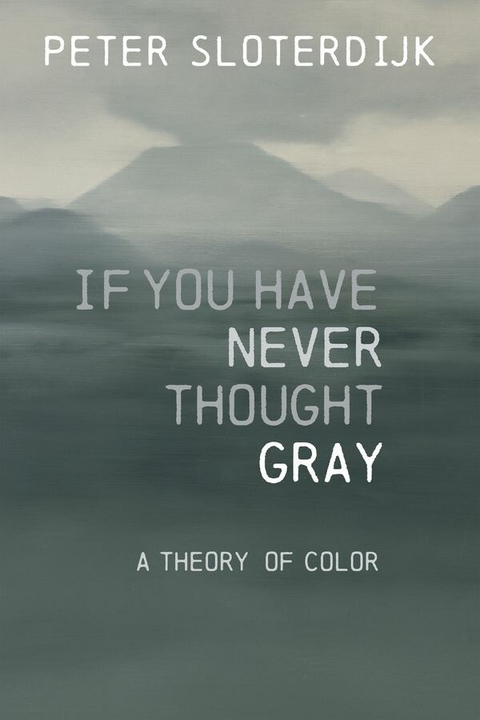
If You Have Never Thought Gray (eBook)
303 Seiten
Polity (Verlag)
978-1-5095-5750-9 (ISBN)
'You're not a painter if you haven't painted gray', declared Paul Cézanne. The same could be said of philosophers: you're not a philosopher if you have never thought gray. This simple four-letter word signifies much more than a quasi-neutral color lying between black and white: we use the same word to describe moods, November skies, the hair of the elderly, the withered features of faces, dusty shelves, faceless bureaucracies, dreary politicians and hundreds of other things. This plain, unassuming word conceals a multitude of thoughts that we seldom pause to consider.
In this exceptionally original book, Peter Sloterdijk follows the grey thread through the history of philosophy, art, literature and politics, enabling us to see familiar things in new ways and highlighting features of our lives that would otherwise remain unseen. Beginning with Plato's allegory of the cave which introduced the concept of gray into thought, Sloterdijk unfolds a chiaroscuro narrative which recognizes the power of grey as a metaphor for the indefinite, the indifferent, the ordinary, the intermediate and the neutralizing. We see the invention of photography and monochrome's journey through modern art - from Malevich's Black Square to Richter's grey panel paintings - in a new light, and we see modern states and modern politics as full of grey zones, from the hidden spheres of the security services to the extraterritorial spaces that harbor illegal activities like money laundering and the drug trade.
A work of brilliance by one of the most creative philosophers writing today, If You Have Never Thought Gray will appeal to a wide readership interested in philosophy, art and politics, and to students and academics in philosophy, visual arts and the humanities generally.
Peter Sloterdijk is Professor of Philosophy and Aesthetics at the Karlsruhe School of Design. He is one of the most influential philosophers writing today and is the author of many books including The Critique of Cynical Reason, In the World Interior of Capital, Spheres, You Must Change Your Life and What Happened in the 20th Century?
You re not a painter if you haven t painted gray , declared Paul C zanne. The same could be said of philosophers: you re not a philosopher if you have never thought gray. This simple four-letter word signifies much more than a quasi-neutral color lying between black and white: we use the same word to describe moods, November skies, the hair of the elderly, the withered features of faces, dusty shelves, faceless bureaucracies, dreary politicians and hundreds of other things. This plain, unassuming word conceals a multitude of thoughts that we seldom pause to consider. In this exceptionally original book, Peter Sloterdijk follows the grey thread through the history of philosophy, art, literature and politics, enabling us to see familiar things in new ways and highlighting features of our lives that would otherwise remain unseen. Beginning with Plato s allegory of the cave which introduced the concept of gray into thought, Sloterdijk unfolds a chiaroscuro narrative which recognizes the power of grey as a metaphor for the indefinite, the indifferent, the ordinary, the intermediate and the neutralizing. We see the invention of photography and monochrome s journey through modern art from Malevich s Black Square to Richter s grey panel paintings in a new light, and we see modern states and modern politics as full of grey zones, from the hidden spheres of the security services to the extraterritorial spaces that harbor illegal activities like money laundering and the drug trade. A work of brilliance by one of the most creative philosophers writing today, If You Have Never Thought Gray will appeal to a wide readership interested in philosophy, art and politics, and to students and academics in philosophy, visual arts and the humanities generally.
1
Ge-gräu – the Gathering of the Gray
Light in Plato’s Cave, Hegel’s Twilight, Heidegger’s Fog
“You’re not a philosopher if you have never thought gray.” It makes a difference, of course, whether one makes such a declaration at an urban art opening or in the opening lecture of a Cambridge philosophy conference. At the gallery, one can count on the smiles and approval of those not affected. Amused attendees would relish seeing others judged by standards that they themselves probably don’t meet. Tant pis pour eux: so much the worse for them! They suddenly understand, Prosecco in hand, why the teachings of most so-called philosophers, living or dead, have never meant much to them. No longer must the unbroken spines of their books inspire guilt feelings. Gray is the dust that gathers upon these books and testifies against their supposed worth and relevance – and rightly so, since, as it turns out, their authors have not adequately contemplated the gray.
Those in attendance concede that a few open-air thinkers stand out as exceptions among the philosophers. Nietzsche knew what he was talking about when he warned against trusting thoughts that hadn’t been conceived while walking in the open. When Merleau-Ponty evoked the “joyous realm of things and their god, the sun,”1 he too was likely on the right track. Similarly, Rilke in the Louvre, standing before the classical torso of Apollo and feeling himself called by a voice of ancient, gray stone: “You must change your life” – though Rilke, even if cited respectfully by a thinker of Heidegger’s stature, was less a philosopher than a bard of unspeakable vibrations.
After all, words spoken lightly can sometimes have far-reaching consequences. This time, from the condescending smile there emerges the outline of an insight: in order to fulfill what their profession demands of them, aspiring members of the philosophical faculty should – as Cézanne would have it – position themselves before Mont Sainte-Victoire and attend to the mountain’s discourse on the flickering of Provençal light, the nuances of the color gray, and the grave presence of the rocky in-itself in its luminous withdrawal.
Presented at a philosophy conference, the thesis declaring that philosophers are made by thinking the thought of gray would drop like an axe splitting the ice of consensus. Appearing as an unexplained declaratory event, before any justification that would lend it support, it is prima facie absurd – debilitating to the ear and seemingly detached from all logical associations. The agreement to disagree, essential at such synods, would collapse within seconds after the airing of such a thesis. Some would conclude that they’d heard a sophisticated provocation and chuckle to themselves, their self-possession unperturbed; others, more violently vexed, would fidget with their conference brochures so irritably that followers of Konrad Lorenz would have a chance to test his theory of displacement activities on an unusual group of subjects. Conference attendees of the neo-Pavlovian school would see their suspicion confirmed that conditioned reflexes are particularly strong in the reflective professions, where they are ingrained to the point of predictability.
In view of the extravagance of the claim that understanding gray is a fundamental task of thought for philosophers, the audience would spontaneously sort itself in a self-fulfilling application of Fichte’s theorem that the philosophy one chooses reflects the type of person one is. Fichte’s distinction, between the lovers of freedom and the determinists who argue that everything depends on external circumstances, would appear in this case as a contrast between those who are accustomed to responding more frontally and those who practice lateral thinking. The “frontalists” would be listeners committed to clear positions on all debatable questions, valuing the intentio recta as the hallmark of honest argumentation. In the current case, this would be expressed by the fact that, with the minimal politeness of British-trained debaters, they come to the judgment that what they’ve heard is nonsense – and not just any nonsense but the kind that cannot be described as elegant, even with the best will in the world. Their discursive ethos dictates that nonsense be given no foothold, the thesis advanced being so absurd as to warrant the predicate not even wrong.
The lateralist group consists of scholars with backgrounds in history and psychology, who typically prefer an indirect approach – the intentio obliqua – in both thought and action. They find it less important to determine whether a statement is correct than to consider how a speaker came to make it. Their experience affirms that false doctrines do not fall from the sky and that every propositional event, no matter how erratic, is interdiscursively and subsymbolically networked in some way or other. In an era when networking takes precedence over reasoning and connections overtake substantiation, it is advisable to see deviance as a different path rather than a wrong one. Thanks to lateral logic, even the most wayward sheep can be reconciled with the meaning-suffused flock. No error need remain unaddressed and isolated. For those committed to obliquity, it seems obvious to look up the speaker’s CV to see whether there are recent engagements with Dadaism or publications on synesthesia. If nonsense doesn’t deserve support, it nonetheless has a context and perhaps a kind of method.
How will the speaker navigate this predicament? “You’re not a philosopher if you have never thought gray.” To a gathering of people who cannot possibly be prepared for the accusation that they have neglected to think the gray, such a thesis would trigger the prompt ostracization of the speaker. One faces ignorance, incapacity, and unwillingness across various fronts of discomfort. While the one faction in the room offers their contempt, another has a therapeutic proposal up its sleeve, and a third thinks it’s time for the speaker to change disciplines. Perhaps the situation will be rescued by a timely recollection of that character in Christian Dietrich Grabbe’s play Duke Theodore of Gothland (1822) who, in dire circumstances, declares that “only despair can save us now.”
In view of such manifest embarrassment, the insistence that thinking the gray is what defines a philosopher can be sustained only by way of a bridging alternative: either one has been hoodwinked by philosophers who display no discernible trace of gray, and one has given them a full pass for only half a job; or else, insofar as they were or are philosophers, they must perforce have commented on the gray – even if their engagement with it may have been (perhaps initially) indirect and implicit. One must not abandon the claim that thinking “the gray” had some formative role in the play of their thought, even if the philosophers in question did not use the term themselves. A concession of this type implies that certain problems, certain topoi of contemporary thought, have a kind of virtual pre-existence, a prefiguration in the shadows of older terms, even if it is only later that they awaken to existence and clarity of concept.
To take a prime example: it cannot be the case that the concepts now central to the modern discourse on “subjectivity” were – notwithstanding Socrates’ legacy – entirely non-existent for well over two thousand years, even if expert intellectual historians demonstrate and confirm that these notions were first articulated with memorable clarity in Fichte’s attempts to elucidate his “original insight” after 1794; it is not without reason that Fichte was called a “fateful man” by Hermann Schmitz (1928–2021), founder of neo-phenomenology and (next to Heidegger) the greatest twentieth-century thinker on German soil, if today largely unknown. The acknowledgment that problems “pre-exist” in latency is compelled by a faint but subtly effective logical and material motif of continuity and compatibility, evident almost universally in the sequence of deliberate and incidental expressions of ideas. One might sum it up as the “principle of increasing explicitness.” One rarely finds it treated affirmatively – as, most prominently, in Hegel’s doctrine of the “labour of the concept” and in Ernst Bloch’s studies on the categories of “bringing forth” inspired by Schelling’s Naturphilosophie.2 Nonetheless, in the absence of assuming its validity, most chronologically consecutive formulation complexes relevant to intellectual history – most “theories,” as we call them – would languish in the semi-obscurity of archives, abandoned to the mercy of haphazard leaps from one “paradigm” to the next. The principle of explicitation encompasses, in sum, all the shifts in focus that form the rational core of so-called paradigm shifts.
To elucidate the analogy with another major theme of twentieth-century “continental” philosophy: human existence has presumably always been immersed in moods – anxiety, boredom, gloom, confidence – that color the modes of its being-in-the-world; yet one finds in the philosophical archives almost nothing useful on this topic until Heidegger’s...
| Erscheint lt. Verlag | 20.8.2025 |
|---|---|
| Übersetzer | Corey Anderson Dansereau, Robert Hughes |
| Sprache | englisch |
| Themenwelt | Geisteswissenschaften ► Philosophie ► Allgemeines / Lexika |
| Schlagworte | aesthetic theory • allegory of the cave • Ambiguity • being-in-the-world • Christianity • color and philosophy • colour-blindness • colour value • Elements of the Philosophy of Right • Hegel • Heidegger • hierarchy of colour • History of Philosophy • If You Have Never Thought Grey • indeterminate • Knowledge • metaphor for public opinion • Monotheism • neutrality • Peter Sloterdijk • Philosopher • philosophy paints its grey in grey • Plato • political and moral ambiguity • postwar • Rainbow Society • Reality • shadows • Theology • the visible • thinking about a single colour • Twentieth century • what does Sloterdijk say about philosophy of colour • what is philosophy • what meaning does colour have • what role does color play in philosophy? • who is a philosopher • Yves Klein |
| ISBN-10 | 1-5095-5750-4 / 1509557504 |
| ISBN-13 | 978-1-5095-5750-9 / 9781509557509 |
| Informationen gemäß Produktsicherheitsverordnung (GPSR) | |
| Haben Sie eine Frage zum Produkt? |
 EPUB (Adobe DRM)
Kopierschutz: Adobe-DRM
Adobe-DRM ist ein Kopierschutz, der das eBook vor Mißbrauch schützen soll. Dabei wird das eBook bereits beim Download auf Ihre persönliche Adobe-ID autorisiert. Lesen können Sie das eBook dann nur auf den Geräten, welche ebenfalls auf Ihre Adobe-ID registriert sind.
Details zum Adobe-DRM
Dateiformat: EPUB (Electronic Publication)
EPUB ist ein offener Standard für eBooks und eignet sich besonders zur Darstellung von Belletristik und Sachbüchern. Der Fließtext wird dynamisch an die Display- und Schriftgröße angepasst. Auch für mobile Lesegeräte ist EPUB daher gut geeignet.
Systemvoraussetzungen:
PC/Mac: Mit einem PC oder Mac können Sie dieses eBook lesen. Sie benötigen eine
eReader: Dieses eBook kann mit (fast) allen eBook-Readern gelesen werden. Mit dem amazon-Kindle ist es aber nicht kompatibel.
Smartphone/Tablet: Egal ob Apple oder Android, dieses eBook können Sie lesen. Sie benötigen eine
Geräteliste und zusätzliche Hinweise
Buying eBooks from abroad
For tax law reasons we can sell eBooks just within Germany and Switzerland. Regrettably we cannot fulfill eBook-orders from other countries.
aus dem Bereich