


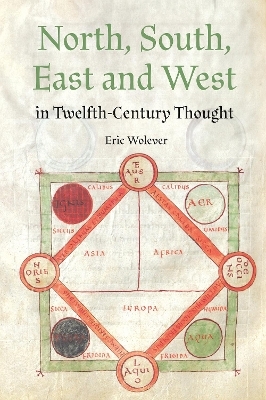
North, South, East and West in Twelfth-Century Thought
Seiten
2025
Boydell & Brewer (Verlag)
978-1-83765-063-7 (ISBN)
Boydell & Brewer (Verlag)
978-1-83765-063-7 (ISBN)
Considers how twelfth-century authors used the four cardinal points as a conceptual system to make sense of and construct their world.
From the Great White North to the West End or the Global South, we frequently carve up our world according to the cardinal points. These divisions are rarely mere geographical conveniences; they bring with them a host of ideas about regions and their inhabitants.
This book examines how this phenomenon operated in the Middle Ages, drawing on sources from the Ordinary Gloss on the Bible to the geographies of Hugh of Saint Victor and Honorius Augustodunensis. It begins by tracing the consolidation of the cardinal points as a foundational spatial vocabulary in the Middle Ages and looks athow these terms accumulated new meaning and significance in biblical exegesis, geography and history writing over the twelfth century. It pays particular attention to the ways in which authors actively engaged with and manipulated this tradition, showing how authors like Sigebert of Gembloux, Romuald of Salerno and Orderic Vitalis made use of these ideas to underscore the broader narrative agendas of their universal histories. Subsequent chapters focus on the role of space in narratives of identity formation, using as case studies histories of the First Crusade, the duchy of Normandy and the abbey of Cluny.
From the Great White North to the West End or the Global South, we frequently carve up our world according to the cardinal points. These divisions are rarely mere geographical conveniences; they bring with them a host of ideas about regions and their inhabitants.
This book examines how this phenomenon operated in the Middle Ages, drawing on sources from the Ordinary Gloss on the Bible to the geographies of Hugh of Saint Victor and Honorius Augustodunensis. It begins by tracing the consolidation of the cardinal points as a foundational spatial vocabulary in the Middle Ages and looks athow these terms accumulated new meaning and significance in biblical exegesis, geography and history writing over the twelfth century. It pays particular attention to the ways in which authors actively engaged with and manipulated this tradition, showing how authors like Sigebert of Gembloux, Romuald of Salerno and Orderic Vitalis made use of these ideas to underscore the broader narrative agendas of their universal histories. Subsequent chapters focus on the role of space in narratives of identity formation, using as case studies histories of the First Crusade, the duchy of Normandy and the abbey of Cluny.
ERIC WOLEVER gained his PhD at the University of York, UK.
List of Illustrations
Acknowledgements
Abbreviations
Notes on Terminology and Translation
Introduction
1. The Exegetical Tradition
2. The Geographical Tradition
3. The North in Universal Histories
4. Western Identity and the First Crusade
5. The Men of the North
6. North and No South
Conclusion
Bibliography
Index
| Erscheinungsdatum | 27.11.2025 |
|---|---|
| Zusatzinfo | 8 b/w illus. |
| Verlagsort | Woodbridge |
| Sprache | englisch |
| Maße | 156 x 234 mm |
| Themenwelt | Geschichte ► Allgemeine Geschichte ► Mittelalter |
| Geisteswissenschaften ► Geschichte ► Regional- / Ländergeschichte | |
| Geisteswissenschaften ► Sprach- / Literaturwissenschaft ► Anglistik / Amerikanistik | |
| Geisteswissenschaften ► Sprach- / Literaturwissenschaft ► Literaturwissenschaft | |
| ISBN-10 | 1-83765-063-2 / 1837650632 |
| ISBN-13 | 978-1-83765-063-7 / 9781837650637 |
| Zustand | Neuware |
| Informationen gemäß Produktsicherheitsverordnung (GPSR) | |
| Haben Sie eine Frage zum Produkt? |
Mehr entdecken
aus dem Bereich


aus dem Bereich
Geschichte einer Augsburger Familie (1367-1650)
Buch | Softcover (2024)
Kohlhammer (Verlag)
CHF 47,60


