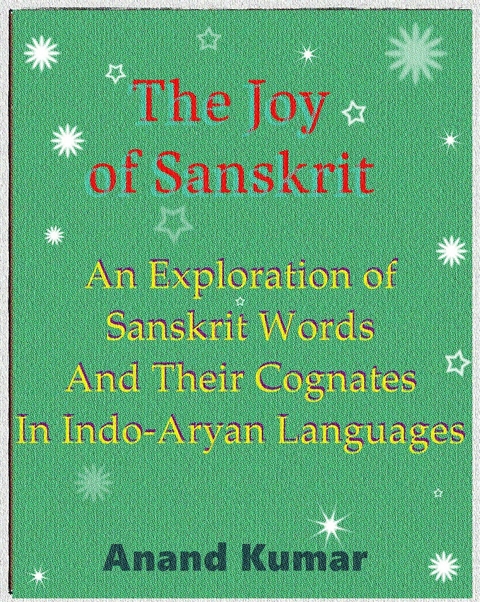
The Joy of Sanskrit (eBook)
67 Seiten
Publishdrive (Verlag)
978-0-00-102230-0 (ISBN)
Which animal has wool in its navel? What's the connection between Mercury and Wednesday? Why do some people see hares in the moon? What's a bamboo got to do with your family history? And what is an air-inflated organ? Find out the answers to these intriguing questions in this book about the wonderful world of Sanskrit and Indo-Aryan words. Discover the history behind words related to animals, society, religion, anatomy, food and much more.
Chapter 1: Animals
One of the Sanskrit words for 'animal' is प्राणिन् prāṇin. It also means 'breathing, alive; living thing'. This word comes from प्राण prāṇa, which means 'breath, life force; spirit or soul'. Our English word animal has a similar history: it comes from Latin animale 'living being, being which breathes' and is derived from anima, 'breath, soul; a current of air'.
Another word of interest is मृग mr̥ga, which was applied to forest animals in general and to deer, gazelles, antelopes, stags and musk-deer in particular. The reconstructed Proto-Indo-Iranian word from which it derives, *mr̥gas, means 'forest animal'. Some words among descendants of मृग in Indo-Aryan languages are Kalasha mru 'mountain goat', Bengali mrig 'deer', Shina brĭṅ 'bird' and Hindi mŕg 'deer; antelope.' In Old English, the word deor ('deer' in Modern English) meant 'wild animal, beast, any wild quadruped'. Over time the word became narrower in its semantic meaning, and by the 15th century it no longer referred to wild beasts in general but to a specific animal. Some hypothesise that this semantic shift occurred via hunting, as the deer was especially preferred by game hunters. And it is believed the word deor comes from Proto-Indo-European *dheusom 'creature that breathes' – by way of comparison, the Latin word animālis is ultimately derived from Proto-Indo-European *h₂enh₁mos 'breath'.
Now let's take a look at words for individual animals. As you read on, you may wonder, why did people have so many alternative names for animals? Why did they use descriptive words, euphemisms and circumlocutions to refer to them? The answer lies in the old practice of referring to something by another name because of superstitious beliefs. One of the most famous examples is the Jews' avoidance of the divine name (commonly transliterated at YHWH). There is some evidence to suggest that such superstition had already developed before the year 70 AD. Even today Jews will use the term Hashem (meaning 'the name') instead. In the same way, the names of some animals that were believed to be connected to the spiritual realm were avoided. This was especially true when wild animals were hunted. People believed that if they uttered the animal's name it would come and kill them. But if they used a different appellation then the animal would stay away. Today we use the expression 'talk of the Devil (and he will appear)' when a person just mentioned appears. Of course, today we say this jokingly but for ancient peoples it was no laughing matter.1
Cow: Cows play a very important role in Indian culture, so it's natural that Sanskrit has many words for them. Going through all of them is totally beyond the scope of this work, so let's just take a look at a small selection.
धेनु dhenu refers to a cow in general but can also be applied to a milch cow in particular. It ultimately comes from Proto-Indo-European *dʰeh₁(y)- 'to suckle, to nurse'. A cow that does not yield milk was called अधेनु adhenu, which is the opposite of धेनु dhenu 'yielding milk'. A cow that lost her calf was called अवत्सा avatsā, literally 'without a calf'. A mooing cow is वाश्र vāśra, and the Indo-Aryan descendants of this word refer to animals being in heat, e.g. Sindhi vahura 'desire of cow, goat, etc. for male' and Lahnda vāhraṇ 'to be on heat (of cows)'. Cows were also associated with daybreak and light, as can be seen in the word उस्र asra 'ray, brightness; morning light; cow.' Finally, a cow that produces abundant milk is called पयस्विन् payasvin, from पयस् payas 'fluid; juice'.
Bull: Bulls are associated with strength, which can be seen, for example, in the Sanskrit word वृषभ vr̥ṣabha 'powerful; lord; male; bull'. Descendants of this word in other Indo-Aryan languages yielded more specific meanings, e.g. Nepali basāhā 'bull not used for ploughing', Bihari basahā 'bull bought by religious mendicants' and Marathi vasū 'bull calf, bull branded and set at liberty.' Another example is शाक्वर śākvara, which means 'powerful' as well as 'bull'. Often the strength exhibited by bulls results in death, thus Sanskrit हन्तुः hantuḥ 'killing, death; bull.'
Elephant: We will encounter many words that are descriptive in nature, i.e. they describe a particular characteristic or behaviour of the animal. First up is हस्तिन् hastin, which comes from हस्त hasta, 'hand'. So the word for elephant literally means 'having a hand', because apparently people associated the trunk with human hands. A similar word is करिन् karin, 'having a trunk, an elephant'. It derives from the root कृ kṛ 'to do'. This is where the Hindi word karī 'elephant' comes from. The third descriptive word for 'elephant' is दन्तावल dantāvala, meaning 'toothed, tusked.'
Pig: One of the words for 'pig' in Sanskrit is पङ्कक्रीड paṅkakrīḍa, a compound word which literally means 'playing in mud'. Nepali has udhinne 'pig', related to the verb udhinnu 'to dig up (of pigs), to rummage'. These words come from Sanskrit उद्धन्ति úddhanti 'to lift up; to turn up the earth.'
Bird: First let's look at general, descriptive words for 'bird'. There is the adjective पक्षिन् pakṣín 'winged', derived from पक्ष pakṣ 'wing; side, flank'. विहङ्गम vihaṁgama literally means 'moving in the sky' and referred to birds in general, but in A comparative dictionary of Indo-Aryan languages R. L. Turner lists a Hindi word for a specific bird (bahẽgwā), namely the fork-tailed shrike. Another Sanskrit word for 'bird' is शकुनṣakuna (or शकुनि ṣakuni). It was specifically used to refer to large birds and those that give omens. In fact, its secondary meaning is 'good omen.' The link between birds and prognostication shouldn't surprise us, as the practice of reading omens from the actions of birds (ornithomancy, to use the technical term) was common in ancient cultures, e.g. in ancient Greece and Rome. Examples of words in Indo-Aryan languages that derive from शकुन/ शकुनि are: Hindi saun, son 'good omen', sauniyā 'soothsayer' and Torwali shôⁿ 'parrot'.
Parrot: There are a few descriptive words for parrots in Sanskrit, some of which refer to their ability to mimic human speech. Case in point, वाचाट vācāṭa 'noisy, full of bustle; talkative', which is derived from the root वच vac 'to speak'. वचः vacah also comes from the same root and means 'parrot'. At least two words refer to the bird's eating habits: दाडिमभक्षणdadimabhakshana, literally 'eating pomegranates' and दाडिमप्रिय dadimapriya 'enjoying pomegranates'.
Owl: There are several terms for 'owl' in Sanskrit but I chose a handful of words in Indo-Aryan languages that mean 'owl' but that come from words which do not referred to owls specifically. There is Sinhala māvat-ā, which is derived from Sanskrit महावक्त्र mahāvaktra, literally 'large-mouthed'. Sindhi has ciḇa, ciḇiro and Gujarati cībṛī, all derived from *cibba, a reconstructed form meaning 'flattened.' This original sense survives in Marathi cĩbā 'flattened'.
Vulture: One of the Sanskrit words for 'vulture' is गृध्र gŕ̥dhra. Its primary meaning is 'desiring greedily', which perfectly describes this type of bird. गृध्र ultimately derives from the reconstructed Proto-Indo-European root *g⁽ʷ⁾l̥dʰ-ró-s, from *g⁽ʷ⁾eldʰ- 'to desire greedily'.
Here are just a few more examples of bird names that originate from descriptive words. Hindi adhẽgā 'a brown bird with red throat and head and yellow wings and legs' is derived by R. L. Turner from the reconstructed compound word *ardhapiṅga 'half-yellow'. Sanskrit सरङ्ग śāraṅga 'spotted; a kind of deer; the Indian cuckoo' yielded Sinhala haran̆ga-yā 'a bird of the cuckoo family, Ceylon hornbill', Pali sāraṅga 'a spotted deer' and Maithili sārãg 'deer'. My final ornithological mention goes to सुपर्ण suparṇa 'any large bird of prey, a mythical bird'. Its literal translation is 'having beautiful wings.' This term yielded Pali supaṇṇa 'the bird Garuda' (we will discuss this bird in the section about snake charmers and conjurers).
Monkey: One of the Sanskrit words for 'monkey' is वानर vānara, which some argue comes from वन vana, 'forest' + नर 'man'. Others consider it a derivative of वनर vanara '(something) relating to the forest'. लाङ्गूल lāṅgūla 'tail; having a tail' yielded Kashmiri laṅgūr, 'the langur monkey Semnopithecus schistaceus', Punjabi lãgur, 'monkey', Kumauni lãgūr, 'long-tailed monkey' and Hindi laṅgūr 'long-tailed black-faced monkey'. Sanskrit वलिमुख valīmukha is a compound of वलि vali 'a fold of the skin, wrinkle' + मुख mukha 'face', so its literal translation is 'having a wrinkled face.' And speaking of faces, Sanskrit also has the word कालमुख kālamukha, meaning 'a kind of monkey', literally 'black-faced.' This is the...
| Erscheint lt. Verlag | 17.8.2025 |
|---|---|
| Sprache | englisch |
| Themenwelt | Geisteswissenschaften ► Sprach- / Literaturwissenschaft |
| ISBN-10 | 0-00-102230-X / 000102230X |
| ISBN-13 | 978-0-00-102230-0 / 9780001022300 |
| Informationen gemäß Produktsicherheitsverordnung (GPSR) | |
| Haben Sie eine Frage zum Produkt? |
 EPUB (Adobe DRM)
Größe: 3,4 MB
Kopierschutz: Adobe-DRM
Adobe-DRM ist ein Kopierschutz, der das eBook vor Mißbrauch schützen soll. Dabei wird das eBook bereits beim Download auf Ihre persönliche Adobe-ID autorisiert. Lesen können Sie das eBook dann nur auf den Geräten, welche ebenfalls auf Ihre Adobe-ID registriert sind.
Details zum Adobe-DRM
Dateiformat: EPUB (Electronic Publication)
EPUB ist ein offener Standard für eBooks und eignet sich besonders zur Darstellung von Belletristik und Sachbüchern. Der Fließtext wird dynamisch an die Display- und Schriftgröße angepasst. Auch für mobile Lesegeräte ist EPUB daher gut geeignet.
Systemvoraussetzungen:
PC/Mac: Mit einem PC oder Mac können Sie dieses eBook lesen. Sie benötigen eine
eReader: Dieses eBook kann mit (fast) allen eBook-Readern gelesen werden. Mit dem amazon-Kindle ist es aber nicht kompatibel.
Smartphone/Tablet: Egal ob Apple oder Android, dieses eBook können Sie lesen. Sie benötigen eine
Geräteliste und zusätzliche Hinweise
Buying eBooks from abroad
For tax law reasons we can sell eBooks just within Germany and Switzerland. Regrettably we cannot fulfill eBook-orders from other countries.
aus dem Bereich