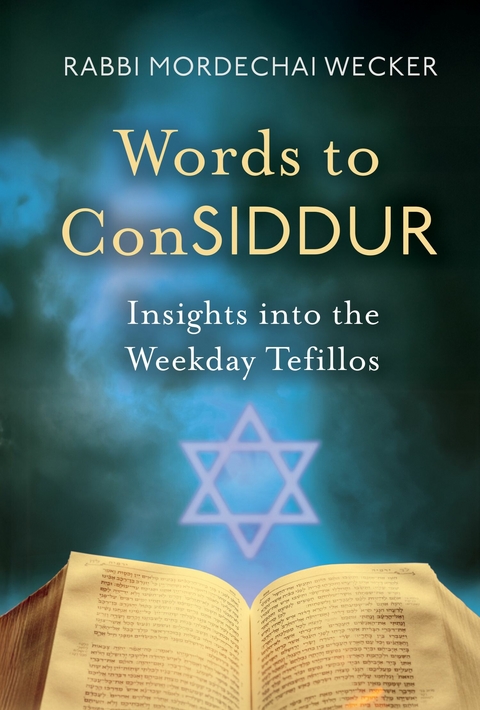
Words to ConSIDDUR (eBook)
292 Seiten
Bookbaby (Verlag)
979-8-3178-0809-9 (ISBN)
About the Author Rabbi Mordechai Wecker grew up in Silver Spring, Maryland. He is a graduate of the Hebrew Academy of Greater Washington and Yeshiva High School of Greater Washington. He studied in yeshivos for many years and was awarded Yoreh Yoreh Yadin Yadin semicha by Rav Moshe Feinstein, Zecher Tzadik L'V'racha. He has served as a Jewish educator for fifty years. In addition, he has served as head of school at Jewish day schools in Massachusetts, Pennsylvania, Virginia and Maryland. He has given shiurim on the weekly parshah and the siddur throughout his career. He co-authored a book, Therapy According to G-d, published by Mosaica Press in 2019.
Using Traditional Texts to Create a Personal Connection with HashemTefillah is thus meant to be a deep personal, emotional and spiritual experience. Rav Soloveitchik writes (Reflections of the Rav, vol. 1, 1979, p. 74): "e;This being so, how can such an experience be prescribed and controlled by the Halacha, which seeks to impose precise regulatory controls governing time and manner? How can the Halacha be reconciled with spontaneous emotionality?... The answer is that the norm creates the mood and setting which allow for the spontaneous overflow of emotions. The norm is an educational tool, a guide which organizes our personalities and heightens our sensitivity. It does not dictate emotion; it molds man and his circumstances and thereby stimulates the emotional outpouring."e;The question arises as to the propriety of approaching Hashem in prayer. Is it not presumptuous of us to glorify Him or solicit requests of Him? The answer to that question is straightforward. Most of the texts of our tefillos were arranged by the Anshe Knesses HaGedolah which included many prophets. Thus, His very words are often used in praise of and supplication to Him. These texts allow for multiple interpretations (no, not every interpretation), offering us an opportunity to express a range of ideas, all of which have passed the litmus test of suitability in prayer. Tefillah DefinedChief Rabbi of Britain Sir Jonathan Sacks zt"e;l wrote in the introduction to his siddur translation: "e;Prayer is the language of the soul in conversation with G-d. It is the most intimate gesture of religious life, and the most transformative. The very fact that we can pray testifies to the deepest elements of Jewish faith: that the universe did not come into existence accidentally, nor are our lives destined to be bereft of meaning."e; Personal NotesThe completion of this book caps fifty years of study and teaching the siddur. It is my hope, G-d willing, that my words will be educational, instructive and, hopefully, even inspiring. Do not be misled by the title, Words to ConSIDDUR! It is simply a concession to my predilection for puns. This sefer deals with serious matters, indeed, with our very relationship with Hashem Yisborach. I have focused my efforts on those prayers that are recited individually rather than communally. The former presumably allows more time for reflection. My target audience for this work is you! It is aimed at the entire spectrum of Jews, from novices to accomplished Torah scholars and everyone in between. Comments on CommentatorsEven a cursory perusal of the text shows that I often quote the Gra's comments. This is due to the high esteem in which he was/ is held by my rebbeim and my ancestors zt"e;l, and my heritage as a Litvak. Please Note
Shacharis Prayer Service
Birchos HaShachar:
Preliminary Morning Prayers
Mah Tovu
Most siddurim begin the morning prayers with Mah Tovu, “How goodly are your tents, Yaakov” and four other verses from Tanach. Maharshal zt”l (Responsa 64) was opposed to reciting the first verse (Bamidbar 24: 5) because it quotes the words of the evil prophet Balaam. He also omitted the last verse (Tehillim 69: 14) which states, “As for me, may my prayer come to You, Hashem, at an opportune time, G-d, in Your great kindness, answer me with Your faithful salvation.” That verse, according to tradition, applies only to the Mincha prayer on Shabbos. (See Tanya Rabasi, ch. 20, quoting Rashi.)
Yigdal
Rav Yitzchak Luria zt”l was opposed to the recital of Yigdal, “Exalted is the Living G-d”. (See Nefesh HaRav, p. 165.) Yigdal describes in poetic form the thirteen principles of faith enunciated by the Rambam (commentary on the Mishnah, Sanhedrin, ch. 10). Rav Yosef Dov Soloveitchik explained that there is no basis in Jewish tradition to commence prayer with an exposition of the faith. It is also notable that Yigdal does not appear in the Siddur of the Gra.
Formulation of the Bracha
Brachos connected with mitzvos performance begin with, “Blessed are You, Hashem, our G-d, King of the universe, Who has sanctified us with His mitzvos, and commanded us….” Why does the formulation of the bracha switch from second person to third person?
Rambam (beginning of Hilchos Avodah Zarah) states that idolatry started out of a misplaced sense of humility. People reasoned that Hashem is too exalted for us to dare to approach in prayer. Instead, they decided to worship His great creations-- the celestial bodies-- and thereby honor Hashem. Soon thereafter, people forgot about serving Hashem entirely and focused on idolatry. To refute this doctrine, we begin our bracha by addressing Hashem in second person. We then switch to third person out of reverence for Him.
Gra zt”l (Maaseh Rav, Cincinnati manuscript, item 37) held that we should recite, “Blessed are You, Hashem, our G-d….” without pausing to reaffirm our belief in His Oneness.
What is the purpose of a bracha? How can we possibly bestow to Hashem? Gra (see Chayai Odom 6: 1) claims that baruch does not mean that Hashem is blessed. Instead, it means that Hashem should be blessed.
Presumably based upon that idea, Rav Chaim Brisker zt”l noted that there is one thing that Hashem does not have presently, and that is the respect of humanity. We pray that humanity will offer Hashem the proper honor and respect that is His right.
Rashi zt”l (Talmud, Sotah 10a) suggests that the term bracha means, “to increase.” Thus, the meaning of baruch is: “May Hashem in His great mercy continue to shower us with an abundance of good.”
Hashem Elokanu- “Hashem, Our G-d”- The Name “Hashem” refers to His unknowable essence. “Our G-d,” by contrast, refers to His infinite abilities which we can grasp to some extent. (Gra, Aderes Eliyahu Devorim 1: 6)
Asher Kidshanu B’Mitzvosav V’Tzivanu- “Who Has Sanctified Us with His Mitzvos and Commanded Us….” We recite this bracha before performing many mitzvos, including those that are rabbinical enactments. Hashem has also commanded us to abide by rabbinical legislation.
Baruch Atah… Asher Kidshanu B’Mitzvosav- “Blessed Are You… Who Has Sanctified Us with His Mitzvos”: We refer to G-d in second person and then switch to third person since He may be understood (somewhat) by His interaction with His creations (hence, the second person), but His essence is beyond our comprehension (thus, the abrupt transition to third person). (Rav Chaim of Volozhin, Nefesh HaChaim 2: 3)
Baruch Atah- “Blessed Are You”: We begin by referring to Him in second person since it is only due to His will that He interact with His creations that we may approach Him in tefillah (ibid 2: 4).
Al Netilas Yadayim
This bracha is recited only after handwashing. Although usually one makes a bracha before performing the mitzvah, this case is an exception. Before handwashing, our hands may not be clean, and it would be improper to recite a bracha then. This bracha is recited before praying in the morning before Shacharis (according to Rambam and Gra, it is recited before Mincha and Maariv as well), and before eating a meal with bread.
Asher Yatzar
The next bracha, Asher Yatzar, offers thanks to Hashem for the wonders of the human body. It is recited after the discharge of bodily functions. We thank Hashem “Who formed man in wisdom and created in him many openings and cavities. It is revealed and known before Your throne of glory that if one of them ruptured or was blocked, it would be impossible to survive and stand before You. Blessed are You, Hashem, Healer of all flesh Who acts wondrously.”
Why do we make mention of “Your throne of glory” in this seemingly unsuitable context? The answer is that Hashem directs and sustains everything in the universe, including mundane aspects of this material world. (Gra, Imrei Noam, Brachos 60b)
Ramah zt’l (Tur Shulchan Aruch 6, Darchei Moshe 2) notes that the bracha ends with, “Who acts wondrously.” This miraculous achievement refers to the fusion of the body and the soul. That the materialistic body abides harmoniously with the spiritual soul is astounding.
Elokai Neshama
Contrary to its placement in some siddurim, the next bracha recited is Elokai Neshama, “Hashem, the soul that You have given me is pure….” Rabbi Dr. Elie Munk zt”l explains that the physical hulk of Adam was created first by Hashem and only subsequently was the soul infused in it. Similarly, we first thank Hashem for the wondrous human body and only thereafter do we praise Him for our pure and holy soul. Since this bracha directly follows the previous one of Asher Yatzar, it does not begin with Baruch.
This bracha negates the doctrine of original sin held by other religions. It also makes mention of the future resurrection of the dead in the messianic era (Techias Hamaysim), a doctrine that many Greek and Roman philosophers rejected.
Just as our soul was given to us in a state of taharah (purity), so it must be returned to Hashem when we pass away. (Gra, Imrei Noam Brachos 60b)
The Talmud (Brachos 57b) states that “sleep is one-sixtieth of death,” thus establishing a connection between the future resurrection of the dead and awakening every morning.
Birkos HaTorah
Some rabbis (Tosafos Pesachim 104b, Tosafos Kesuvos 8a) maintain that there are two brachos made daily on Torah study: one to cover the written Torah the other to cover the oral Torah. Other rabbis (Rambam Hilchos Tefillah 7:10 and others) claim that there are three brachos made daily on Torah study: one for the written Torah, another for Mishnah, and a third for Talmud.
The bracha begins with Baruch Atah Hashem Elokaynu Melech HaOlam Asher Kid’shanu B’Mitzvosav V’Tzivanu LaAsok B’Divray Sorah- “Blessed Are You, Hashem, Our G-d, King of the Universe, Who has Sanctified us with His mitzvos, and Has Commanded Us to Engage in Torah Study.” This refers to the oral Torah. Why do we not refer to the written Torah first? The answer is that historically many people have denied the legitimacy of the oral Torah. We counter that heresy by mentioning the oral Torah first. Rabbi Dr. Elie Munk observed: “Today, as 1500 years ago, it is principally the traditional elaboration of the Scripture which bears the brunt of attacks of the critics of our Toah.”
The bracha text continues: Kulanu Yod’ay Sh’mecha V’Lomday Sorasecha Lishmah- “May We All Know Your Name and study Torah for Its Own Sake (without ulterior motives).” What is meant by, “Know Your Name”? The Gra explains that it refers to the study of the mystical parts of Torah. As youngsters, we study the “revealed” sections of Torah and as adults many study the mystical parts of Torah. Once we have achieved that perspective, we must restudy the “revealed” Torah considering our knowledge of the mystical parts of Torah.
Normally, after one makes a bracha to perform a mitzvah, he must accomplish the mitzvah immediately thereafter. Although an exception is made here (Tosafos, Talmud, Brachos 11b) and job-related or other activities are permitted even if Torah study is delayed for many hours, the siddur adds minimal texts of Torah study at this point.
After reciting Birkos HaTorah, it is customary to recite the verses (Bamidbar 6:24-26) of the blessing of the kohanim (“May Hashem Bless You”), selections from the Mishnah (Peah 1: 1: “These are the mitzvos for which no limit is imposed”), korbanos, and the introduction to Midrash Sifra (“Rebbe Yishmael says: The Torah is interpreted by means of thirteen rules”).
Brachos on Activities
The following brachos are recited by the Sheliach Tzibur. The congregation responds “Amen” after each bracha.
- Who has given the human heart (alternatively, the rooster) the intelligence to distinguish between day and night
- Who has not made me a gentile
- Who has not made me a slave
- Who has not made me a woman
- Women say: Who has created me to His satisfaction
- Who opens the eyes of the blind
- Who clothes the naked
- Who sets captives free
- Who raises up those who are bowed down
- Who spreads forth the dry land...
| Erscheint lt. Verlag | 19.8.2025 |
|---|---|
| Sprache | englisch |
| Themenwelt | Geisteswissenschaften ► Religion / Theologie ► Judentum |
| ISBN-13 | 979-8-3178-0809-9 / 9798317808099 |
| Informationen gemäß Produktsicherheitsverordnung (GPSR) | |
| Haben Sie eine Frage zum Produkt? |
 EPUB (Ohne DRM)
Größe: 3,9 MB
Digital Rights Management: ohne DRM
Dieses eBook enthält kein DRM oder Kopierschutz. Eine Weitergabe an Dritte ist jedoch rechtlich nicht zulässig, weil Sie beim Kauf nur die Rechte an der persönlichen Nutzung erwerben.
Dateiformat: EPUB (Electronic Publication)
EPUB ist ein offener Standard für eBooks und eignet sich besonders zur Darstellung von Belletristik und Sachbüchern. Der Fließtext wird dynamisch an die Display- und Schriftgröße angepasst. Auch für mobile Lesegeräte ist EPUB daher gut geeignet.
Systemvoraussetzungen:
PC/Mac: Mit einem PC oder Mac können Sie dieses eBook lesen. Sie benötigen dafür die kostenlose Software Adobe Digital Editions.
eReader: Dieses eBook kann mit (fast) allen eBook-Readern gelesen werden. Mit dem amazon-Kindle ist es aber nicht kompatibel.
Smartphone/Tablet: Egal ob Apple oder Android, dieses eBook können Sie lesen. Sie benötigen dafür eine kostenlose App.
Geräteliste und zusätzliche Hinweise
Buying eBooks from abroad
For tax law reasons we can sell eBooks just within Germany and Switzerland. Regrettably we cannot fulfill eBook-orders from other countries.
aus dem Bereich