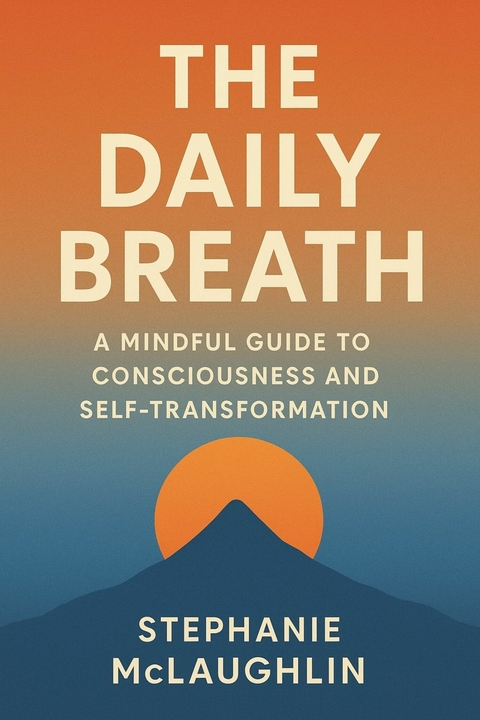
The Daily Breath (eBook)
197 Seiten
Seahorse Pub (Verlag)
978-0-00-102167-9 (ISBN)
Transform Your Life One Breath at a Time - The Science-Backed Path to Lasting Change
What if the key to overcoming anxiety, unlocking peak performance, and accessing profound inner peace was as close as your next breath?
In this groundbreaking guide, discover how conscious breathing can rewire your nervous system, liberate trapped emotions, and unleash your full potential. Unlike superficial breathing techniques, this comprehensive system reveals the deep science behind breath-based transformation and provides practical tools that work in real-world situations.
You'll Master:
Nervous System Reset - Instantly shift from stress to calm using research-proven protocols
Emotional Liberation - Process and release years of stored tension and trauma safely
Mental Clarity & Focus - Enhance cognitive performance and decision-making under pressure
Energy Optimization - Access sustainable vitality without stimulants or burnout
Drawing from neuroscience, trauma therapy, and ancient wisdom traditions, each chapter builds systematically toward lasting transformation. Real case studies show how executives, healthcare workers, parents, and students have used these techniques to overcome panic attacks, improve relationships, boost creativity, and find their authentic purpose.
Whether you're seeking stress relief, peak performance, or spiritual growth, this isn't just another wellness book - it's a complete operating system for conscious living. The four foundational pillars work synergistically to create changes that compound over time, making transformation feel natural rather than forced.
Special Features:
✓ Trauma-informed approaches for safe practice
✓ Integration strategies for busy lifestyles
✓ Troubleshooting guide for common challenges
✓ Progressive techniques from beginner to advanced
Stop letting unconscious breathing patterns limit your life. Your breath is your birthright of vitality, presence, and authentic power.
Start your transformation today - your future self will thank you.
Chapter 1
The Unconscious Breath - Breaking Free From Autopilot
You've taken over 600 million breaths in your lifetime. How many were intentional?
If you're like most people, the answer is shockingly few. Perhaps a handful during yoga classes, a few during meditation attempts, or those conscious deep breaths you take when someone reminds you to "just breathe" during stressful moments. The vast majority of your breaths—the very mechanism that keeps you alive and influences every cell in your body—have happened completely outside your awareness.
This isn't just a curious fact about breathing. It's a mirror reflecting how much of your entire life runs on autopilot. Think about your morning routine: you probably brushed your teeth, made coffee, and checked your phone without conscious intention. Your commute likely involved familiar routes navigated while your mind wandered elsewhere. At work, you responded to emails, attended meetings, and completed tasks in patterns so automatic you could do them while half-asleep.
Your unconscious breathing is both a symptom and a cause of this autopilot existence. When you breathe unconsciously, you're literally programming your nervous system to operate below its potential. Those shallow, restricted breaths signal your brain that you're in subtle danger, keeping you in a state of low-level stress activation that colors every experience. Meanwhile, your unconscious breathing patterns reinforce unconscious life patterns—reactive relationships, stress-driven decisions, and a persistent sense of being disconnected from your own life.
Consider this: if you're breathing unconsciously while having important conversations, your nervous system is likely in a state that makes you less present, less empathetic, and more reactive. If you're breathing unconsciously while working, you're probably accessing only a fraction of your creative and cognitive potential. If you're breathing unconsciously while parenting, exercising, or making love, you're missing the full richness and aliveness available in those moments.
The staggering reality is that most people are living their entire lives in a state of mild suffocation—not dramatic enough to create emergency, but restrictive enough to limit vitality, clarity, and authentic connection. Your unconscious breath is quietly stealing your life force, one restricted inhale at a time.
The Autopilot Epidemic
Your breathing patterns are a perfect reflection of how you approach life itself. Rushed, shallow breathing mirrors rushed, shallow living. Breath-holding during stress reflects emotional holding and resistance to life's natural flow. Irregular, erratic breathing patterns often correspond to chaotic, reactive approaches to daily challenges.
When I work with clients, I can often predict their life patterns simply by observing how they breathe. The executive who holds her breath during phone calls also holds back her authentic communication in relationships. The father who breathes only into his upper chest while disciplining his children is literally operating from his fight-or-flight response, making connection and effective parenting nearly impossible. The college student whose breathing becomes rapid and shallow during studying is training his nervous system to associate learning with stress rather than curiosity and engagement.
These patterns don't develop overnight. They're learned responses that become so automatic we forget they're choices. The child who learned to breathe quietly to avoid attracting attention in a chaotic household carries that restricted breathing into adulthood, wondering why she feels invisible in meetings. The teenager who held his breath during his parents' arguments now finds himself breath-holding during any conflict, unable to stay present for difficult conversations with his partner.
Unconscious breathing patterns create unconscious life patterns because your breath directly influences your nervous system state, and your nervous system state determines how you perceive and respond to reality. When you're breathing in ways that signal danger to your brain, you'll interpret neutral situations as threats, respond to minor stress as emergencies, and miss opportunities for connection, creativity, and growth that require a calm, open nervous system to recognize.
The hidden cost of this autopilot existence is enormous. You're not fully present for your own life. Important moments—conversations with loved ones, beautiful sunsets, professional achievements, quiet mornings—pass by unwitnessed because your consciousness is scattered and your nervous system is stuck in survival mode. You're reacting rather than responding, defending rather than connecting, surviving rather than thriving.
Most people accept this diminished state as normal adult life. They assume the chronic tension, the persistent background anxiety, the sense of being rushed and overwhelmed are simply the price of modern living. They don't realize that these experiences are largely created and maintained by unconscious breathing patterns that can be changed immediately once you develop awareness.
The cycle perpetuates itself: unconscious breathing creates stress responses, stress responses trigger more unconscious breathing, and gradually your baseline shifts toward chronic activation. What once felt stressful becomes your new normal, and your breathing patterns adapt to maintain this state. You're literally training yourself to live in a constant state of subtle emergency, missing the peace, clarity, and aliveness that are your natural birthright.
Stress Physiology and Breathing
To understand why conscious breathing is so transformative, you need to understand the intimate relationship between your breath and your nervous system. Every breath you take sends direct signals to your brain about whether you're safe or in danger. These signals trigger automatic responses that affect every aspect of your physiology and psychology.
When you breathe in short, shallow breaths confined to your upper chest, you're activating what's called the sympathetic nervous system—your body's alarm system. This triggers the release of stress hormones like cortisol and adrenaline, increases your heart rate, tenses your muscles, and shifts your brain into hypervigilant scanning for threats. This response served our ancestors well when facing immediate physical dangers, but it's devastating when activated chronically by unconscious breathing patterns.
The problem is that your primitive brain can't distinguish between running from a predator and sitting in traffic while breathing shallowly. Both signal danger, both trigger the same stress cascade. When you spend most of your day breathing in ways that activate your alarm system, you're literally living in a state of chronic stress activation that affects every system in your body.
This explains why so many people feel "wired but tired"—their nervous systems are constantly activated by their breathing patterns, but there's no actual threat to discharge this activation against. The stress hormones circulate through their systems, creating feelings of anxiety, restlessness, and overwhelm without any clear external cause. Their bodies are prepared to fight or flee, but they're sitting at desks, stuck in meetings, or lying in bed trying to sleep.
Chronic shallow breathing also reduces oxygen delivery to your brain and tissues. When you breathe only into your upper chest, you're using the least efficient part of your lungs. The lower portions of your lungs, where gas exchange is most effective, remain largely unused. This creates a subtle but persistent state of oxygen deprivation that affects cognitive function, emotional regulation, and physical energy.
The physiological impacts extend far beyond immediate stress responses. Chronic unconscious breathing patterns contribute to digestive issues (stress diverts energy from digestion), sleep problems (activated nervous system prevents deep rest), immune system suppression (chronic stress hormones weaken immune function), and accelerated aging (oxidative stress from chronic activation damages cells).
Perhaps most significantly, unconscious breathing patterns lock you into reactive rather than responsive ways of being. When your nervous system is chronically activated, your brain operates primarily from its primitive survival centers rather than its higher-order thinking and creative centers. This means you're more likely to react with anger, fear, or defensiveness rather than responding with wisdom, compassion, or creativity.
The remarkable news is that this entire cascade can be reversed immediately through conscious breathing. When you breathe slowly and deeply, engaging your diaphragm and filling your lower lungs, you activate the parasympathetic nervous system—your body's rest-and-restore response. This triggers the release of calming neurotransmitters, reduces stress hormone production, lowers heart rate and blood pressure, and shifts your brain into states conducive to learning, creativity, and connection.
The Transformation Gateway
Your breath is the most direct and immediate tool for transformation available to you because it's the only function of your autonomic nervous system that's both automatic and consciously controllable. You can't directly control your heart rate, blood pressure, or stress hormone levels, but you can control your breathing—and through your breathing, you can influence all these other systems.
This makes conscious breathing the gateway between your conscious and unconscious mind, between your voluntary and involuntary systems, between your current state and your desired state. When you change how you breathe,...
| Erscheint lt. Verlag | 17.8.2025 |
|---|---|
| Sprache | englisch |
| Themenwelt | Geisteswissenschaften ► Psychologie |
| ISBN-10 | 0-00-102167-2 / 0001021672 |
| ISBN-13 | 978-0-00-102167-9 / 9780001021679 |
| Informationen gemäß Produktsicherheitsverordnung (GPSR) | |
| Haben Sie eine Frage zum Produkt? |
 EPUB (Adobe DRM)
Größe: 1,2 MB
Kopierschutz: Adobe-DRM
Adobe-DRM ist ein Kopierschutz, der das eBook vor Mißbrauch schützen soll. Dabei wird das eBook bereits beim Download auf Ihre persönliche Adobe-ID autorisiert. Lesen können Sie das eBook dann nur auf den Geräten, welche ebenfalls auf Ihre Adobe-ID registriert sind.
Details zum Adobe-DRM
Dateiformat: EPUB (Electronic Publication)
EPUB ist ein offener Standard für eBooks und eignet sich besonders zur Darstellung von Belletristik und Sachbüchern. Der Fließtext wird dynamisch an die Display- und Schriftgröße angepasst. Auch für mobile Lesegeräte ist EPUB daher gut geeignet.
Systemvoraussetzungen:
PC/Mac: Mit einem PC oder Mac können Sie dieses eBook lesen. Sie benötigen eine
eReader: Dieses eBook kann mit (fast) allen eBook-Readern gelesen werden. Mit dem amazon-Kindle ist es aber nicht kompatibel.
Smartphone/Tablet: Egal ob Apple oder Android, dieses eBook können Sie lesen. Sie benötigen eine
Geräteliste und zusätzliche Hinweise
Buying eBooks from abroad
For tax law reasons we can sell eBooks just within Germany and Switzerland. Regrettably we cannot fulfill eBook-orders from other countries.
aus dem Bereich