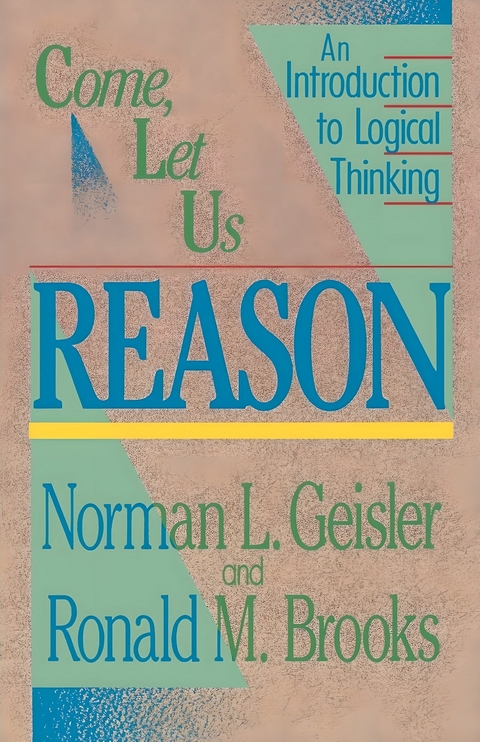
Come, Let Us Reason (eBook)
182 Seiten
Publishdrive (Verlag)
978-0-00-101651-4 (ISBN)
The perfect introductory textbook, this simplified study of logic prepares readers to reason thoughtfully and to spot illogic in an argument.
1. The Whats and Whys of Logic
It is the function of the wise man to know
order.—Aristotle
What is logic? And why in the world would anyone want to study it? Isn’t it just a bunch of incomprehensible and arbitrary rules that no one really follows anyway? What good does it do? To most people, logic is an unknown language about an unknown realm, where everything is turned upside down and no one with an IQ below 300 is allowed. You can see it in the panic on their faces when you just mention the word—LOGIC!
Despite all the bad press, logic is not so tough. In fact, it is one of the simplest things to use because you use it all the time, though you may not realize it. We don’t mean that you put all of your thoughts into logical form and do a formal analysis of each thought. But when you are at the supermarket and one brand of sugar is 3 cents per ounce but another is 39 cents per pound, it doesn’t take long for you to pull out your calculator and settle the issue. Why do you do that? Because you recognize that those ounces and pounds have to be put in the same category to be compared. That’s logic. You use logic to do ‘most everything. When you decide to take your shower after you work out instead of before, you don’t necessarily go through all the formal steps it takes to reach that conclusion validly, but your decision rests on logic nonetheless. Logic really means putting your thoughts in order.
What Is Logic?
Order is the key word. It applies to all kinds of different disciplines. In nature, there is an order that reason discovers but does not produce. The patterns of quartz crystals, the regularity of natural laws, the movements of the planets, the complex information in a single strand of DNA—all these show us an order that we can see but that we did nothing to put there, just as you can read this book, but you didn’t put the words on the pages.
In art, however, we do produce order. The artist, whether a painter, sculptor, composer, actor, or writer, imposes order on the things around him. He crafts the lines he wants to see. He bends the steel to suit his purpose. He arranges the rhythms, the melodies, and the harmonies to express a certain feeling. Art is created by a person imposing order on the things of the external world.
In philosophical thinking there is order also. Ethical order is order that reason produces in acts of the will. In other words, it is the ordering of our thoughts about the right and wrong of the things we choose. That doesn’t mean that there is no absolute right or wrong; it only means that the way we think about it is something that we produce. Whenever we ask a question about what we ought to do, we are ordering our choices by an ethical standard. That order tells us what we really think is good. It shows us what our values really are. Should I lie to save twenty bucks? Should I help the lady stranded on the freeway, or hurry home to watch football? How we answer depends on an ethical order that we produce about the choices we make. The best system of ethics is the one that best expresses the way things ought to be, i.e., what really is good and valuable.
The order of logic is very similar. It, too, is an ordering that we produce, but it is concerned with ordering our thoughts. Logic is reason looking at itself to see how good reason works. It studies the methods that we use to analyze information and draw valid conclusions. It puts all of these methods into an order that gives us the right way to draw conclusions. The best system of logic is the one that is best suited to drawing proper conclusions from the premises.
To state this as a formal definition we might say, “Logic is the study of right reason or valid inferences and the attending fallacies, formal and informal.” If you are reading this book for a class, no doubt that is the definition your teacher will make you memorize. Let’s break it up and simplify it some.
Logic is the study of right reason. … That is the main point. Logic is a study, an ordering, of how to think rightly, or how to find truth. Paraphrasing this, we might say, logic is a way to think so that we come to correct conclusions.
… or valid inferences. … That means implications. Part of studying logic is recognizing when A implies B and when it does not. There are clear-cut rules to help us with this.
… and the attending fallacies, formal and informal. A fallacy is a mistake. Sometimes we make mistakes in the way we set up our thinking, or by using an implication that is not true. These are called formal fallacies, because they have to do with the form of the argument (more about that later). Other times the mistakes are in the meanings of the terms we use. They might be unclear or misleading. Or, they might just not have anything to do with the subject at hand. Mistakes like these are called informal fallacies. Knowing the kinds of mistakes we can make helps us to avoid them.
If we put all of our paraphrases together, we get a simplified definition: Logic is a way to think so that we can come to correct conclusions by understanding implications and the mistakes people often make in thinking.
Why Study Logic?
Simply put, you can’t avoid studying logic, so you might as well know what you’re doing. It is the basis for all other studies. It is the basis for all math and science. Even music, from Bach to the Beach Boys, is based on logic. Without it, there could be no rational discussion of anything; writing would be impossible. How can you put a sentence together without a logical order?
Even interpretation requires logic. We have to assume that the author tried to communicate a logical thought, and the only way we have to find that thought is to put all the clues together and set them in logical order. This is as true for English literature as for Bible study. Biblical theology and systematic theology involve imposing an order on the data of their fields. And giving a reason for your faith would be useless if it were not a logical reason that you expected others to accept on rational grounds. The only way to avoid logic is to quit thinking, because logic is the basis for all thought.
Now, there are lots of complaints about studying logic, especially as it applies to God. So before we go any farther, we’d better clear the air and answer some of those questions, which, if you haven’t heard yet, you will hear someday.
There are many kinds of logic. Why choose only Aristotelian (Western) logic? True, there are other kinds of logic that we might study, and maybe you will go on to read about non-Aristotelian logic, but the basic laws of logic are the same for all logic. They are necessary and undeniable, not just arbitrary rules that someone made up. Aristotle didn’t invent logic; he only helped to discover it. These undeniable laws are the same for all thinking; once you know them, you can go on to look at other kinds of philosophies.
People are not logical. Why bother? Often people are not moral either; does that mean that we should close down all the churches and fire the police force? People may not act morally, but they ought to; and we should use every means to teach them how and remind them of proper behavior. Likewise, people may not think logically at times, but still, they ought to. If logic is a way to think so that we find truth, then we always ought to be logical so that we know the truth.
Logic doesn’t work. People don’t respond to it. Logic does work on reasonable people, and everyone should be reasonable. On unreasonable people, nothing works. So why not try to be reasonable and let the other fellow be unreasonable? Besides, something is not true or right because it works. The idea that it is, is called pragmatism. If you were taking a true/false exam and wrote for your answer to one question, “It works,” what would the teacher do? Whether it works or not is a totally different question from whether it is true or false. It has nothing to do with true and false, or right and wrong. All it tells you is that it works. If that is the criterion for truth, then you could never know that anything was true unless you knew that every time you tried it in the future it would work. Can you imagine a witness taking the stand in a courtroom and pledging “to tell the expedient, the whole expedient, and nothing but the expedient, so help me future experience”? Pragmatism is no test for truth.
Not everything is subject to logic. That is true. Only questions of truth are subject to logic. Logic gives us rules for rational judgments and inferences, but it says nothing about some kinds of statements. For example, it says nothing about emotive expressions, that is, expressions of feelings. When you touch a hot stove and say, “Ouch,” that expression is neither true nor false.
It is simply an expression of your feeling. A housewife in tears over the way her preschoolers have abused her all day is totally in the realm of the subjective, and logic has nothing to do with the way she feels. Of course, we could make logical statements about the way she feels, like, “She either feels bad or she doesn’t.” But her emotive outburst, “Good grief!” is neither true nor false and is not subject to logic. Likewise, aesthetic expressions are not true or false. They are beautiful. They are to be appreciated, not analyzed. Moral judgments are right or wrong, not true or false. No one asks, “Is abortion true or false?” That is like asking, “What does blue smell like?”...
| Erscheint lt. Verlag | 19.8.2025 |
|---|---|
| Sprache | englisch |
| Themenwelt | Geisteswissenschaften ► Philosophie ► Logik |
| ISBN-10 | 0-00-101651-2 / 0001016512 |
| ISBN-13 | 978-0-00-101651-4 / 9780001016514 |
| Informationen gemäß Produktsicherheitsverordnung (GPSR) | |
| Haben Sie eine Frage zum Produkt? |
 EPUB (Adobe DRM)
Größe: 2,0 MB
Kopierschutz: Adobe-DRM
Adobe-DRM ist ein Kopierschutz, der das eBook vor Mißbrauch schützen soll. Dabei wird das eBook bereits beim Download auf Ihre persönliche Adobe-ID autorisiert. Lesen können Sie das eBook dann nur auf den Geräten, welche ebenfalls auf Ihre Adobe-ID registriert sind.
Details zum Adobe-DRM
Dateiformat: EPUB (Electronic Publication)
EPUB ist ein offener Standard für eBooks und eignet sich besonders zur Darstellung von Belletristik und Sachbüchern. Der Fließtext wird dynamisch an die Display- und Schriftgröße angepasst. Auch für mobile Lesegeräte ist EPUB daher gut geeignet.
Systemvoraussetzungen:
PC/Mac: Mit einem PC oder Mac können Sie dieses eBook lesen. Sie benötigen eine
eReader: Dieses eBook kann mit (fast) allen eBook-Readern gelesen werden. Mit dem amazon-Kindle ist es aber nicht kompatibel.
Smartphone/Tablet: Egal ob Apple oder Android, dieses eBook können Sie lesen. Sie benötigen eine
Geräteliste und zusätzliche Hinweise
Buying eBooks from abroad
For tax law reasons we can sell eBooks just within Germany and Switzerland. Regrettably we cannot fulfill eBook-orders from other countries.
aus dem Bereich