


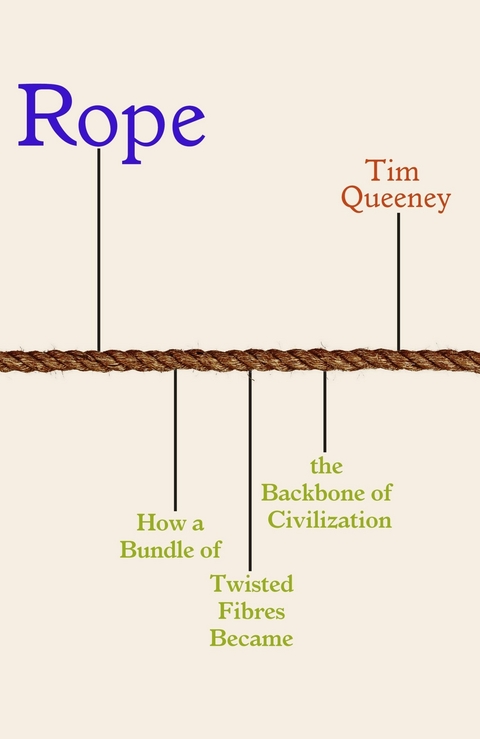
Rope (eBook)
336 Seiten
Icon Books (Verlag)
978-1-83773-330-9 (ISBN)
Tim Queeney is the former editor of Ocean Navigator, a magazine for offshore voyagers. A life-long sailor, he has taught celestial navigation, radar navigation and coastal piloting both ashore and aboard tall ships at sea - where he tied plenty of knots and handled many a rope.
STRAND ONE
WE ALL PULL TOGETHER
MORE THAN 5,100 YEARS AGO a man clad in a woven grass cloak and animal skins, carrying all his possessions in a simple backpack, hurried up a mountain in the Alps. The reason for his haste was obvious when he stopped briefly and looked downslope. A group of men pursued him, and they were climbing fast. His chest tightened and he started upward again. Above him lay a glacial tongue of ice leading higher into a cleft in the mountains. And slowly moving across that ice field was a snow squall—a swirl of flakes that could be his salvation. If he could get into that whiteout his pursuers would lose track of him and perhaps give up the chase. He could hear from their shouts that they were closing the gap but not near enough to lay their hands on him. If he kept hustling, he could beat them to the storm.
One of the men giving chase must have seen this, too, realizing that the man they pursued might soon disappear from sight. The fleeing man was likely at the limit of a bow’s range, but the pursuer knew it was their last chance. He grabbed an arrow from his woven quiver of missiles. He stopped, nocked the arrow onto the tightly twisted string of his bow, and quickly took aim. Then he loosed the arrow, sending it flying in a shallow arc.
Meanwhile, the fleeing man felt snowflakes landing on his face. His fear ebbed; he had made his escape. Just as the snow embraced him, however, he felt a penetrating jab in his upper back. The arrow had found its mark. The pain was terrible, but he was strong and he kept up his pace for a few steps. Soon, however, the strength drained from his legs and his vision weakened. He stumbled to his knees before falling over onto the ice, the heavy snow covering his body as he rattled his last breath.
This imagined chase and killing high in the Alps is based on a discovery of human remains made in 1991 that shows us how the technology of twisted fibers, the essence of rope, was allowing humanity to reshape the world around us even thousands of years ago.
EVANESCENT EVIDENCE
Finding evidence of the earliest ropes used by humans is a challenge. The reason is maddeningly simple: early rope was organic. The plant or animal fibers used to make it just didn’t last. Over time they decomposed and disappeared as if they never existed. The time in deep history when some human formed the first length of cordage will forever be a mystery, known only to that inventive Neanderthal with a mind for braiding and the manual dexterity to twist fibers together.
The knowledge to do this—to make string, cordage, and rope—had a profound effect on humans’ ability to manipulate the world. With rope we can organize reality by tying like things together in bundles to then carry them more easily; can keep something safely in one place by tying it to a tree; and can affect objects at a distance by tying a long rope to, say, a spear, so we can pull the spear back after throwing it at a dangerous animal. We can also think of the length of a rope as a metaphor for linear thinking, for timelines, perhaps even the first idea of a clock: we start at one end of a stretched length of rope, and it takes time to get to the other end. In her book Women’s Work: The First 20,000 Years, archaeologist Elizabeth Wayland Barber called the idea of twisted fiber humanity’s secret weapon. “We don’t know how early to date this great discovery—of making string as long and as strong as needed by twisting short filaments together. But whenever it happened, it opened the door to an enormous array of new ways to save labor and improve the odds of survival. . . . From these notions come snares and fishlines, tethers and leashes, carrying nets, handles, and packages. . . . So powerful, in fact, is simple string in taming the world to human will and ingenuity that I suspect it to be the unseen weapon that allowed the human race to conquer the earth. . . . We could call it the String Revolution.”1
The role that rope played in lifting civilization was central. Master ropemaker for the U.S. Navy David Himmelfarb put it like this: “Man’s civilization and social progress has been linked directly to the ropemaker. . . . Rope, then, can justifiably be considered the first appliance developed by man’s ingenuity.”2
Certainly Neanderthals had some name for their invention that we’ll never know. In English we call it “rope.” But where does the word “rope” come from? In modern English the word hails from Middle English: rōp. That came from the Old English word rāp. Delving further back we get to the English parent language German and the Proto-West Germanic raip. Before that is something called Proto-Germanic, in which the word is raipazor raipa (rope, cord, band, or ringlet). Even Proto-Germanic, as creaky as that name sounds to non-historians of languages, is not the oldest language through which we can trace the line of rope. It extends further back to Proto-Indo-European (abbreviated PIE).
This is where things get a bit hazy as no direct record of PIE actually exists. Historical linguists pored over ancient texts and reconstructed PIE based on what they found. It is considered the common ancestor of the Indo-European language family, which is a big group of more than 440 languages—roughly 46 percent of the world’s population speaks an Indo-European language. In PIE the word for rope is roypnos, which is derived from reyp—to peel off, tear, border, edge, or strip. Now we’ve reached the essential meaning of the word, which relates to how early humans made rope.
As an indispensable tool for most of human existence, the idea of rope has worked its way deep into the language. Its cultural significance is revealed by a parade of expressions: “roped me in,” “rope it off,” “tied in knots,” “rope-a-dope,” “roped and branded,” “give him/her enough rope,” “at the end of my rope,” “throw me a rope,” “give me some slack,” “on the ropes,” “go piss up a rope,” “learn the ropes,” “a rope of sand.” This incomplete list of everyday sayings just shows how deeply into our consciousness rope has entwined itself.
PIVOTAL TOOLS
As important as rope is, however, there is good evidence that it wasn’t the absolute first of humanity’s world-changing tools. We’ll never know, but the sequence probably goes something like this: fire, stone tools, and then the twisted strands of the first ropes.
In many cultural traditions the fire giver of myth is openly branded as a thief. The gods don’t bestow fire on lowly humanity freely as a gift; special beings must “steal” the fire for mankind’s use. In Native American Cherokee myth, after possum and buzzard fail in their attempts to bring fire to humanity, grandmother spider gives it a try. Small and overlooked, she brings a clay pot with her and snatches up fire from the sun, hides it in the pot, and follows her web back from the other side of the world to where the people live.
In the Greek version, the fire stealer is the Titan Prometheus. Zeus, the king of the gods, learns of Prometheus’s theft and in punishment has him chained to a rock where every day his liver is eaten by a hungry eagle, and every night it grows back.
The thief Prometheus brings fire and with it comes technology, transforming humans into creative builders of their world. The idea of Prometheus as transformer continues well past Greek storytellers. Mary Shelley cites the Titan for her novel Frankenstein; or, The Modern Prometheus. And in a 2005 biography by Kai Bird and Martin J. Sherwin, the chief architect of the atomic bomb, J. Robert Oppenheimer, is dubbed American Prometheus, the bearer of nuclear fire.
For early humans the sun provided heat and light and acted as a celestial clock with its rising and setting, dividing day from night. When humans devised how to make fire, it seemed a theft of heavenly power. With this knowledge humans had a portable source of warmth and a way to set their own clock by extending daylight into the nighttime hours. And with the ability to cook the protein-rich meat hard won from hunting, fire helped humans prosper.
What came next? The earth provided a ready material for making simple, sharp, and durable tools. Enter the Stone Age.
The Stone Age encompasses the use of a wide variety of stone tools and methods across 3.4 million years. Naturally, this long extent is a bit messy and cries out for detailed classification, so archeologists have drawn up some boundaries. The Stone Age is generally divided into three major periods: the Paleolithic, or old Stone Age; the Mesolithic, or middle period; and the Neolithic, or new period, when agriculture blossomed. The Stone Age ended when metals like copper came into widespread use.
Stone tools were developed because early humans were keen observers of their environment and noticed that some types of rock could be fashioned into sharp-edged implements. Using a sandstone or limestone striking tool called a hammerstone, humans learned to fashion stone-cutting tools from crystalline sedimentary rocks like flint and chert. The great characteristic of flint is its ability to fracture into shapes with razor-sharp edges—as sharp as any metal blade.
The first of these scallop-edged pieces of flint that was used as a tool was something called a hand axe. With their hardness and developed edges, hand axes were likely used for slicing...
| Erscheint lt. Verlag | 14.8.2025 |
|---|---|
| Sprache | englisch |
| Themenwelt | Geschichte ► Teilgebiete der Geschichte ► Technikgeschichte |
| ISBN-10 | 1-83773-330-9 / 1837733309 |
| ISBN-13 | 978-1-83773-330-9 / 9781837733309 |
| Informationen gemäß Produktsicherheitsverordnung (GPSR) | |
| Haben Sie eine Frage zum Produkt? |
 EPUB (Adobe DRM)
Kopierschutz: Adobe-DRM
Adobe-DRM ist ein Kopierschutz, der das eBook vor Mißbrauch schützen soll. Dabei wird das eBook bereits beim Download auf Ihre persönliche Adobe-ID autorisiert. Lesen können Sie das eBook dann nur auf den Geräten, welche ebenfalls auf Ihre Adobe-ID registriert sind.
Details zum Adobe-DRM
Dateiformat: EPUB (Electronic Publication)
EPUB ist ein offener Standard für eBooks und eignet sich besonders zur Darstellung von Belletristik und Sachbüchern. Der Fließtext wird dynamisch an die Display- und Schriftgröße angepasst. Auch für mobile Lesegeräte ist EPUB daher gut geeignet.
Systemvoraussetzungen:
PC/Mac: Mit einem PC oder Mac können Sie dieses eBook lesen. Sie benötigen eine
eReader: Dieses eBook kann mit (fast) allen eBook-Readern gelesen werden. Mit dem amazon-Kindle ist es aber nicht kompatibel.
Smartphone/Tablet: Egal ob Apple oder Android, dieses eBook können Sie lesen. Sie benötigen eine
Geräteliste und zusätzliche Hinweise
Buying eBooks from abroad
For tax law reasons we can sell eBooks just within Germany and Switzerland. Regrettably we cannot fulfill eBook-orders from other countries.
aus dem Bereich


