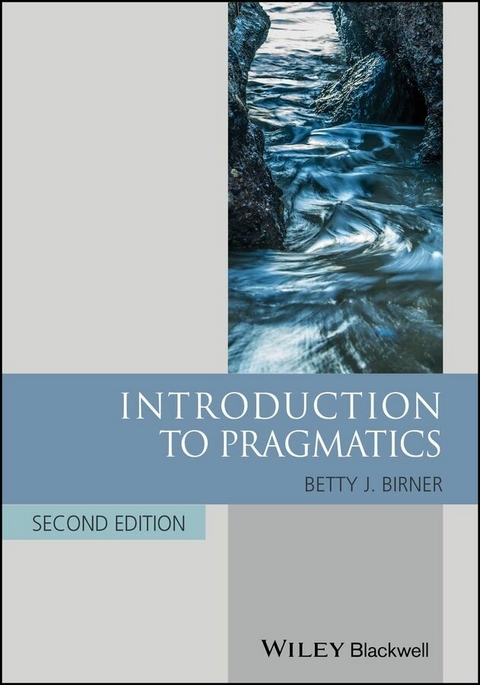
Introduction to Pragmatics (eBook)
639 Seiten
Wiley-Blackwell (Verlag)
978-1-394-19678-4 (ISBN)
A new edition of an essential pragmatics textbook, updated for a new generation of students
Introduction to Pragmatics equips students with a comprehensive understanding of how context shapes language, covering both foundational concepts and cutting-edge issues with an interdisciplinary approach. Assuming no previous background in the subject, this student-friendly textbook describes how meaning is created and interpreted.
This fully revised new edition addresses contemporary questions surrounding language in society, with increased focus on technological trends and real-world applications of pragmatics. Updated chapters explore politeness theory, presupposition, the boundary between semantics and pragmatics, the pragmatics of linguistic diversity and speech communities, the philosophical background of pragmatics, and the role of language in law, advertising, and politics. Two entirely new chapters on social pragmatics and artificial intelligence (AI) are accompanied by expanded material on noncanonical syntax, information structure, and lexical pragmatics.
Offering an ideal balance between theoretical foundations and practical applications, Introduction to Pragmatics, Second Edition:
- Provides clear and accessible explanations of complex concepts such as presupposition, implicature, inference, and optimality theory
- Engages with AI and machine communication, exploring the implications for human-language interaction
- Offers fresh examples, comprehension exercises, and discussion questions to engage students in real-world language analysis
- Features new case studies that focus on contemporary issues such as politics and propaganda
Introduction to Pragmatics, Second Edition, is the ideal textbook for undergraduate and graduate courses in pragmatics and semantics as well as related courses in linguistics and language education.
BETTY J. BIRNER is Professor Emeritus at Northern Illinois University, where she taught Linguistics and Cognitive Science for 24 years. She has published widely on the subjects of pragmatics, semantics, and information structure, particularly on noncanonical syntactic constructions. Her recent publications include Meaning: Semantics, Pragmatics, Cognition and Pragmatics: A Slim Guide.
1
Defining Pragmatics
What did they mean by that? It's a relatively common question, and it's precisely the subject of the field of pragmatics. In order to know what someone meant by what they said, it's not enough to know the meanings of the words (semantics) and how they have been strung together into a sentence (syntax); we also need to know who uttered the sentence and in what context, and to be able to make inferences regarding why they said it and what they intended us to understand. There's one piece of pizza left can be understood as an offer (“would you like it?”) or a warning (“it's mine!”) or a scolding (“you didn't finish your dinner”), depending on the situation, even if the follow‐up comments in parentheses are never uttered. People commonly mean quite a lot more than they say explicitly, and it's up to their addressees to figure out what additional meaning they might have intended. A psychiatrist asking a patient Can you express deep grief? would not be taken to be asking the patient to engage in such a display immediately, but a movie director speaking to an actor might well mean exactly that. The literal meaning is a question about an ability (“are you able to do so?”); the additional meaning is a request (“please do so”) that may be inferred in some contexts but not others. The literal meaning is the domain of semantics; the “additional meaning” is the domain of pragmatics.
This chapter will largely consider the difference between these two types of meaning – the literal meaning and the intended and/or inferred meaning of an utterance. We will begin with preliminary concepts and definitions, in order to develop a shared background and vocabulary for later discussions. A section on methodology will compare the corpus‐based methodology favored by much current pragmatics research with the use of introspection, informants, and experimental methods. A brief survey of the philosophical background for pragmatics will be presented. Then, since no discussion of pragmatics can proceed without a basic understanding of semantics and the proposed theoretical bases for distinguishing between the two fields, the remainder of the chapter will be devoted to sketching the domains of semantics and pragmatics. A discussion of truth tables and truth‐conditional semantics will both introduce the logical notation that will be used throughout the text and provide a jumping‐off point for later discussions of the role of truth‐conditions in drawing the semantics/pragmatics boundary. The discussion of the domain of semantics will be followed by a parallel discussion of the domain of pragmatics, including some of the basic tenets of pragmatic theory, such as discourse model construction and mutual beliefs. The chapter will close with a comparison of competing models of the semantics/pragmatics boundary and an examination of some phenomena that challenge our understanding of this boundary.
1.1 Pragmatics and Natural Language
1.1.1 Introduction and preliminary definitions
Linguistics is the scientific study of language, and the study of linguistics typically includes, among other things, the study of our knowledge of sound systems (phonology), word structure (morphology), and sentence structure (syntax). It is also commonly pointed out that there is an important distinction to be made between our competence and our performance. Our competence is our (in principle flawless) knowledge of the rules of our idiolect – our own individual internalized system of language that has a great deal in common with the idiolects of other speakers in our community but almost certainly is not identical to any of them. (For example, it's unlikely that any two speakers share the same set of lexical items.) Our performance, on the other hand, is what we actually do linguistically – including all of our hems and haws, false starts, interrupted sentences, and speech errors, as well as our frequently imperfect comprehension: Linguists commonly point to sentences like The horse raced past the barn fell as cases in which our competence allows us – eventually – to recognize the sentence as grammatical (having the same structure as The soldiers injured on the battlefield died), even though our imperfect performance in this instance initially causes us to mis‐parse the sentence. (Such sentences are known as garden‐path sentences, since we are led “down the garden path” toward an incorrect interpretation and have to retrace our steps in order to get to the right one.)
Pragmatics may be roughly defined as the study of language use in context – as compared with semantics, which is the study of literal meaning independent of context (although these definitions will be revised below). If I'm having a hard day, I may tell you that my day has been a nightmare – but of course I don't intend you to take that literally; that is, the day hasn't in fact been something I've had a bad dream about. In this case the semantic meaning of nightmare (a bad dream) differs from its pragmatic meaning – that is, the meaning I intended in the context of my utterance. Given this difference, it might appear at first glance as though semantic meaning is a matter of competence, while pragmatic meaning is a matter of performance. However, our knowledge of pragmatics, like all of our linguistic knowledge, is rule‐governed. The bulk of this book is devoted to describing some of the principles we follow in producing and interpreting language in light of the context, our intentions, and our beliefs about our interlocutors and their intentions. Because speakers within a language community share these pragmatic principles concerning language production and interpretation in context, they constitute part of our linguistic competence, not merely matters of performance. That is to say, pragmatic knowledge is part of our knowledge of how to use language appropriately. And as with other areas of linguistic competence, our pragmatic competence is generally implicit – known at some level, but not usually available for explicit examination. For example, it would be difficult for most people to explain how they know that My day was a nightmare means that my day (like a nightmare) was very unpleasant, and not, for example, that I slept through it. Nightmares have both properties – the property of being very unpleasant and the property of being experienced by someone who is asleep – and yet only one of these properties is understood to have been intended by the speaker of the utterance My day was a nightmare. The study of pragmatics looks at such interpretive regularities and tries to make explicit the implicit knowledge that guides us in selecting interpretations.
Because this meaning is implicit, it can be tricky to study – and people don't even agree on what is and isn't implicit. One could make a strong argument that a nightmare in My day was a nightmare is actually explicit, that this metaphorical meaning has been fully incorporated into the language, and that it should be considered literal, not inferential (i.e., semantic rather than pragmatic). This in itself is a very interesting question: Every figure of speech began as a brand‐new but perfectly interpretable utterance – one could say My day was one long, painful slide down an endless sheet of coarse‐grain sandpaper – that eventually became commonplace. Upon their first utterance, such figures of speech require pragmatic inference for their interpretation; the hearer must (whether consciously or subconsciously) work out what was intended. It's possible that this is still what's done when the figure of speech becomes commonplace; it's also possible that it becomes more like a regular word, whose meaning is simply conventionally attached to that string of sounds. If the latter is the case, it's obviously impossible to say precisely when its status changed, since there was no single point at which that happened – which is to say, the shift from pragmatic meaning to semantic meaning, if and when it occurs, is a continuum rather than a point.
One might ask why it matters – but in fact there are a great many reasons why it matters. Just consider a court of law: It matters enormously what counts as “the truth, the whole truth, and nothing but the truth.” Does inferential meaning count as part of that truth? Courts have frequently found that for legal purposes, only literal truth matters; that is, in saying There's one piece of pizza left, you can be held responsible for the number of pieces of pizza left, but not for any additional meaning (such as “offer” vs. “scolding”). On the other hand, we'll see in Chapter 9 that the courts haven't been entirely consistent on this issue. More generally, most people can think of cases within their own relationships in which what the speaker intended by an utterance and what the hearer took it to mean have been two entirely different things; rather sizeable arguments are sometimes due to a difference in pragmatic interpretation, with each party insisting that their interpretation constitutes what was “said.”
Pragmatics, then, has to do with a rather slippery type of meaning, one that isn't found in dictionaries and which may vary from context to context. The same utterance will mean...
| Erscheint lt. Verlag | 8.8.2025 |
|---|---|
| Reihe/Serie | Blackwell Textbooks in Linguistics |
| Sprache | englisch |
| Themenwelt | Geisteswissenschaften ► Sprach- / Literaturwissenschaft ► Sprachwissenschaft |
| Schlagworte | communication theory textbook • graduate linguistics • language theory introduction • language use textbook • linguistic communication textbook • pragmatics semantics introduction • pragmatics textbook • semantic textbooks • TESOL • undergraduate linguistics |
| ISBN-10 | 1-394-19678-4 / 1394196784 |
| ISBN-13 | 978-1-394-19678-4 / 9781394196784 |
| Informationen gemäß Produktsicherheitsverordnung (GPSR) | |
| Haben Sie eine Frage zum Produkt? |
 EPUB (Adobe DRM)
Kopierschutz: Adobe-DRM
Adobe-DRM ist ein Kopierschutz, der das eBook vor Mißbrauch schützen soll. Dabei wird das eBook bereits beim Download auf Ihre persönliche Adobe-ID autorisiert. Lesen können Sie das eBook dann nur auf den Geräten, welche ebenfalls auf Ihre Adobe-ID registriert sind.
Details zum Adobe-DRM
Dateiformat: EPUB (Electronic Publication)
EPUB ist ein offener Standard für eBooks und eignet sich besonders zur Darstellung von Belletristik und Sachbüchern. Der Fließtext wird dynamisch an die Display- und Schriftgröße angepasst. Auch für mobile Lesegeräte ist EPUB daher gut geeignet.
Systemvoraussetzungen:
PC/Mac: Mit einem PC oder Mac können Sie dieses eBook lesen. Sie benötigen eine
eReader: Dieses eBook kann mit (fast) allen eBook-Readern gelesen werden. Mit dem amazon-Kindle ist es aber nicht kompatibel.
Smartphone/Tablet: Egal ob Apple oder Android, dieses eBook können Sie lesen. Sie benötigen eine
Geräteliste und zusätzliche Hinweise
Buying eBooks from abroad
For tax law reasons we can sell eBooks just within Germany and Switzerland. Regrettably we cannot fulfill eBook-orders from other countries.
aus dem Bereich