


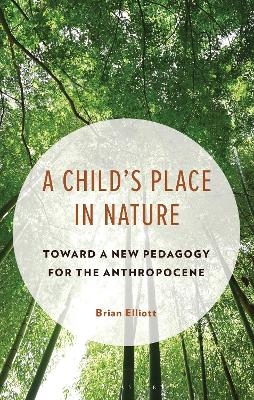
A Child's Place in Nature
Toward a New Pedagogy for the Anthropocene
Seiten
2026
Rowman & Littlefield (Verlag)
978-1-6669-6653-4 (ISBN)
Rowman & Littlefield (Verlag)
978-1-6669-6653-4 (ISBN)
- Titel nicht im Sortiment
- Artikel merken
Outlines a transformational pedagogical philosophy that seeks to foster strong and meaningful bonds to the natural environment forged in childhood.
Outlining a transformational pedagogical philosophy that seeks to foster strong and meaningful bonds to the natural environment forged in childhood, this book targets some of the central social challenges entailed by planetary climate disturbance.
In recent decades, social scientists have been studying and drawing attention to what has been labelled “nature-deficit disorder,” a psychological condition in which the young child is deprived of meaningful contact with the natural environment and suffers a diminution of well-being. Brian Elliott brings together the ideas of love of place (topophilia) and love of living nature (biophilia) to propose a radically transformed approach to pedagogical theory and practice that would counter the widespread nature deficit typically experienced by children in more affluent countries. The need for this transformation is especially pressing in the age of the Anthropocene, in which it is confidently predicted that systematic climatic disturbance will begin to become relentlessly severe within the next two decades. The pedagogical approach is also predicated on young learners’ inherent interest in leading happy, meaningful lives, a goal furthered by unsupervised time in the physical world around them, especially in middle childhood. Drawing a wide variety of literary, scientific, ecological, and philosophical sources, Elliott makes a passionate and compelling case to stop confining our childing within the classroom and get them back into the open air of the natural environment.
Outlining a transformational pedagogical philosophy that seeks to foster strong and meaningful bonds to the natural environment forged in childhood, this book targets some of the central social challenges entailed by planetary climate disturbance.
In recent decades, social scientists have been studying and drawing attention to what has been labelled “nature-deficit disorder,” a psychological condition in which the young child is deprived of meaningful contact with the natural environment and suffers a diminution of well-being. Brian Elliott brings together the ideas of love of place (topophilia) and love of living nature (biophilia) to propose a radically transformed approach to pedagogical theory and practice that would counter the widespread nature deficit typically experienced by children in more affluent countries. The need for this transformation is especially pressing in the age of the Anthropocene, in which it is confidently predicted that systematic climatic disturbance will begin to become relentlessly severe within the next two decades. The pedagogical approach is also predicated on young learners’ inherent interest in leading happy, meaningful lives, a goal furthered by unsupervised time in the physical world around them, especially in middle childhood. Drawing a wide variety of literary, scientific, ecological, and philosophical sources, Elliott makes a passionate and compelling case to stop confining our childing within the classroom and get them back into the open air of the natural environment.
Brian Elliott is Associate Professor in the Philosophy Department at Portland State University, USA. He has published seven books, most recently The Roots of Populism (2021) and Landscape and Labour: Work, Place, and the Working Class in Eliot, Hardy, and Lawrence (2021). His work is situated at the intersection of social, political, and aesthetic theory.
Introduction
Chapter 1: The nature of childhood: Person and place in English Romanticism
Chapter 2: The spirit of nature: A Transcendentalist childhood
Chapter 3: Love of place: The ecological self in childhood
Chapter 4: Love of life: Biophilia and child development
Chapter 5: Love of learning: Rewilding pedagogy in the age of climate change
Conclusion
Bibliography
Index
| Erscheint lt. Verlag | 30.4.2026 |
|---|---|
| Reihe/Serie | Philosophy of Childhood |
| Sprache | englisch |
| Maße | 152 x 229 mm |
| Themenwelt | Geisteswissenschaften ► Psychologie ► Entwicklungspsychologie |
| Naturwissenschaften ► Biologie ► Ökologie / Naturschutz | |
| Sozialwissenschaften ► Pädagogik ► Allgemeines / Lexika | |
| Sozialwissenschaften ► Pädagogik ► Bildungstheorie | |
| ISBN-10 | 1-6669-6653-3 / 1666966533 |
| ISBN-13 | 978-1-6669-6653-4 / 9781666966534 |
| Zustand | Neuware |
| Informationen gemäß Produktsicherheitsverordnung (GPSR) | |
| Haben Sie eine Frage zum Produkt? |
Mehr entdecken
aus dem Bereich



aus dem Bereich
Vormals Oerter & Montada
Buch | Hardcover (2018)
Julius Beltz GmbH & Co. KG (Verlag)
CHF 89,60
Buch | Softcover (2024)
Springer (Verlag)
CHF 55,95
entwicklungspsychiatrische, sexual- und kulturwissenschaftliche …
Buch | Hardcover (2024)
Kohlhammer (Verlag)
CHF 37,80


