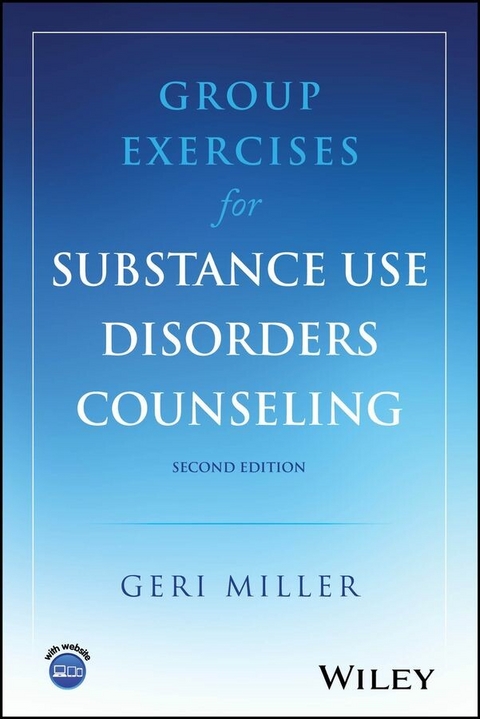
Group Exercises for Substance Use Disorders Counseling (eBook)
178 Seiten
Wiley (Verlag)
978-1-394-28006-3 (ISBN)
An expertly curated collection of effective group exercises for patients with addictions
In the newly revised second edition of Group Exercises for Substance Use Disorders Counseling, experienced addiction counselor, Geri Miller, delivers a practical collection of group therapy exercises for patients struggling with substance addictions. The author has drawn on over four decades of frontline experience treating addicted patients, as well as the latest research, evidence, and best practices, to curate a selection of group exercises that improve health outcomes among a wide variety of patient populations.
You#ll find useful group exercises accompanied by easy-to-understand instructions in an intuitively organized format. These exercises assist patients in the development of self-awareness of harmful behaviors and patterns and realistic strategies they can apply immediately to help address them. They also help patients identify stressors and triggers and offer techniques to avoid or resist them.
Inside the book:
- Practical group counseling exercises that work with patients from myriad backgrounds, including those belonging to especially vulnerable groups
- Easy-to-follow instructions for clinical practitioners, counselors, social workers, and other professionals conducting group therapy for addiction
- Complimentary PowerPoint resources to help educators in a classroom setting, as well as counselor supervisors conducting training
An essential and updated resource for mental health and addiction counselors, Group Exercises for Substance Use Disorders Counseling is an invaluable book for anyone involved in or studying substance abuse counseling and treatment.
Geri Miller, Ph.D., ABPP, LP (NC), LCAS (NC), CCS (NC), MAC (NCCAP) is a Human Relations Trainer/Consultant. She taught in higher education from 1990 until she retired as Professor in 2022. Dr. Miller has worked in the mental health counseling field since 1976 and the SUD counseling field since 1979. In both fields she has been a counselor, educator, trainer, and researcher. She worked as a volunteer psychologist at the Watauga County Health Department for 25 years through December 2020. Since 2001, she has a history of working as a volunteer with the American Red Cross Disaster Mental Health Services. Dr. Miller has published and presented research on counseling. She has published 8 books with Wiley, Inc.: 'Incorporating Spirituality in Counseling and Psychotherapy' (2003), 'Fundamentals of Crisis Counseling' (2011), 'Group Exercises for Addiction Counseling' (2012), and 'Learning the Language of Addiction Counseling (5th Edition)' (2021). She is a member of the American Counseling Association's divisions of the Association for Spiritual, Ethical, and Religious Values in Counseling (ASERVIC) and the International Association of Addictions and Offender Counselors (IAAOC). Dr. Miller has served on the North Carolina Addictions Specialist Professional Practice Board.
An expertly curated collection of effective group exercises for patients with addictions In the newly revised second edition of Group Exercises for Substance Use Disorders Counseling, experienced addiction counselor, Geri Miller, delivers a practical collection of group therapy exercises for patients struggling with substance addictions. The author has drawn on over four decades of frontline experience treating addicted patients, as well as the latest research, evidence, and best practices, to curate a selection of group exercises that improve health outcomes among a wide variety of patient populations. You#ll find useful group exercises accompanied by easy-to-understand instructions in an intuitively organized format. These exercises assist patients in the development of self-awareness of harmful behaviors and patterns and realistic strategies they can apply immediately to help address them. They also help patients identify stressors and triggers and offer techniques to avoid or resist them. Inside the book: Practical group counseling exercises that work with patients from myriad backgrounds, including those belonging to especially vulnerable groups Easy-to-follow instructions for clinical practitioners, counselors, social workers, and other professionals conducting group therapy for addiction Complimentary PowerPoint resources to help educators in a classroom setting, as well as counselor supervisors conducting training An essential and updated resource for mental health and addiction counselors, Group Exercises for Substance Use Disorders Counseling is an invaluable book for anyone involved in or studying substance abuse counseling and treatment.
1
Introduction
PERSONAL REFLECTIONS
The first and second editions of this book have a lot of meaning for me personally as well as professionally. I believe that group therapy, as practiced by experienced, trained counselors, saved my life—which is why I am writing a book about it. In group therapy, I learned, in the moment when I was engaging in specific behaviors, exactly which behaviors were inhibiting my ability to connect effectively with others and to set up a community of support with others. That is a nice way of saying that counselors and fellow clients confronted me on destructive behavior when I was doing it, and I could hear, see, and feel the impact of that behavior on others through their confrontation of me. I hated group therapy because I lived in fear of it. I was terrified of learning about my blind spots and hidden spots and having them pointed out in front of others. However, I also felt cared about in group therapy. Counselors and other clients cared enough about me to tell me hard things—hard things for them to say, hard things for me to hear. People took risks to tell me things that I did not want to hear and cared enough about me to extend their own vulnerability as expressed in their honesty. They also nurtured me and supported me after the confrontation and reminded me that progress, not perfection, is important in living.
I learned a lot about myself in group therapy that has helped me immeasurably to live and work with others in the world. I came out of the experience knowing my flaws as well as my strengths. I believe it is easier for me to live in the world and, hopefully, easier for others to live with me after the experience of group therapy. That is why I believe in the importance of this book. My hope is that counselors can find in these tried‐and‐true group exercises ways to help their clients understand themselves better, thereby offering them more choices about how they can live their lives and break out of dysfunctional interaction patterns with others. My simple hope is that the techniques may be used by counselors to help their clients live better.
Prior to a discussion of the main points of this chapter, I would like to make comments about two populations and two approaches that I have chosen a few to highlight here because of my experience in working in the substance use disorders (SUD) field. With regard to populations, specific SUD‐related issues may arise in terms of population (e.g., transgender; trauma survivors) and approaches (e.g., yoga; music).
Regarding the transgender population, specific comments on working with this population are made in Sections 2, 3, and 4 of this book. In Section 4, transgender resources are listed. An example from the transgender resource section and how counselors may use this resource follows. The Substance Abuse and Mental Health Services Administration (SAMHSA, 2024) published “Behavioral Health of Adolescents across Sexual Identities” that summarized the results from the 2023 National Survey on Drug Use and Health. This publication highlights the struggles of LGB+ adolescents. While there is public support for LGB+ individuals, there continues to be mental health and substance use disparities for LGB+ youth. This population has more behavioral health issues when compared to their heterosexual (straight) peers that include depression, suicidality, and substance use. They also experience bullying and discrimination that can contribute to their substance use and mental health status. Social support and strategies for coping can enhance their resilience.
Counselors can use the information in this resource to assist their LGB+ adolescents in understanding the common struggles they may experience (e.g., mental health, substance use). They can also provide them with social support and coping strategies that can assist them in becoming and staying sober as well as improving their mental health.
Because many SUD clients are trauma survivors, I want to make a few comments about working in this area. First, trauma survivors may be sensitive to criticism, concerned about upsetting others, fearful that those individuals they are close to may leave them, and struggle with not feeling as though they are enough. Second, when their trauma is triggered, they may want to use; want to hurt themselves or others; have strong overwhelming emotional reactions of fear/anger/guilt/shame; and be unable to make themselves feel safe. The “solution” may be to help them feel safe, calm themselves down through their senses, and talk out their trauma reaction with someone they trust (e.g., counselor, self‐help group sponsor) who understands their trauma and can reassure them it will not last forever. Spirituality, in terms of one’s existence, may help empower sexual abuse trauma survivors move on from the trauma (Skalski‐Bednarz & Toussaint, 2024). For example, spiritual practices such as contemplative/meditative ones can result in a healing that is deeper than the wounds of their trauma (Adams, 2025). Overall, however, counselors need to also be aware that their clients may have experienced religious/spiritual trauma that impacts their self‐identity, core beliefs/values, and sense of safety in the world along with their sense of the sacred (Walsh & Koch, 2023). Exercises used to work with them need to be chosen thoughtfully and carefully always respecting their limits and yet asking them to “stretch” themselves. Motivational interviewing theory and techniques may be especially helpful in working with them.
There are two approaches highlighted here, yoga and 12‐step recovery and music therapy. These two approaches can serve as an example of approaches the clinician may use in conjunction with the exercises provided in this book.
Yoga and 12‐Step Recovery
In the research domain, for twenty years, there has been an increase in yoga for health research while in the general public domain there has been an increased interest in and involvement with yoga (Wasson et al., 2024). Such research and public interests require the inclusion of yoga in a discussion of SUD recovery.
The following paragraphs are a summary of Greene’s (2021) article pertaining to the use of yoga as an increasingly used approach in SUD treatment and recovery. Yoga is a holistic practice that involves the integration of the body, mind, and spirit (e.g., breath, life force).
In terms of 12‐step recovery, SUD is described as a biopsychosocial‐spiritual disorder in mutual aid recovery communities such as Alcoholics Anonymous (AA) and Narcotics Anonymous (NA). A reality for SUD clients in early recovery is that they need to let go of their substance‐using social networks that they had when actively using substances; they need to establish a new recovery social network through groups such as AA and NA. A part of a new recovery social network, augmenting the 12‐step recovery groups, could include the yoga community of practice.
Yoga is showing promising research results in the treatment of SUD. Systematic research reviews have been done to examine yoga’s impact on SUD recovery and have shown promising results in terms of a decrease in both cravings (the most powerful relapse risk factor) and negative mood states that are a part of the disease. This main impact on cognition (e.g., cravings, negative mood states) may be related to the mindfulness encouraged in the practice of yoga.
Music Therapy and SUD Treatment
Music is enjoyable and has been shown in the research that it is good for one’s mind, heart, and soul (Mehegan & Rainville, 2020). Specifically, it:
- provides fun and pleasure;
- increases a sense of well‐being;
- reduces stress;
- modulates the cardiovascular system;
- improves balance;
- boosts the immune system; and
- enhances interpersonal connections (Global Council on Brain Health, 2020).
The Global Council on Brain Health (2020) suggests tapping the healing power of music whether through dancing, singing, or movement‐these activities will reduce stress, provide physical activity, and create opportunities to socialize. The link for their publication is included at the end of this chapter and in Section 4 of this book.
In 2021, the American Music Therapy Association, Inc. (AMTA) published an article on music therapy and SUD treatment. The link for this article is included in Section 4 of this book. AMTA states that music can be a part of an integrated approach to SUD treatment and used in the context of the therapeutic relationship. Also, music has been shown to activate dopaminergic pathways in a similar manner to alcohol/drugs.
The benefits that SUD clients may experience from music include the following:
- promoting connection within themselves and motivating them to stay sober;
- reducing cravings and improving mood; and
- encouraging relaxation and decreasing anxiety.
However, contraindications of the use of music include triggering trauma and/or alcohol/drug use as well as increasing cravings for alcohol/drugs.
In summary, counselors need to remember to practice in their area of competence. First, that means that unless the counselor is also a music therapist, music needs to be integrated into the therapeutic relationship the counselor has with each member of the group in the group setting as well as the entire...
| Erscheint lt. Verlag | 6.8.2025 |
|---|---|
| Sprache | englisch |
| Themenwelt | Geisteswissenschaften ► Psychologie ► Klinische Psychologie |
| Schlagworte | Addictions counseling • addictions treatments • Substance Abuse Counseling • substance abuse exercises • substance abuse group exercises • substance abuse group treatment • substance abuse treatment • substance abuse treatment group exercises |
| ISBN-10 | 1-394-28006-8 / 1394280068 |
| ISBN-13 | 978-1-394-28006-3 / 9781394280063 |
| Informationen gemäß Produktsicherheitsverordnung (GPSR) | |
| Haben Sie eine Frage zum Produkt? |
 EPUB (Adobe DRM)
Kopierschutz: Adobe-DRM
Adobe-DRM ist ein Kopierschutz, der das eBook vor Mißbrauch schützen soll. Dabei wird das eBook bereits beim Download auf Ihre persönliche Adobe-ID autorisiert. Lesen können Sie das eBook dann nur auf den Geräten, welche ebenfalls auf Ihre Adobe-ID registriert sind.
Details zum Adobe-DRM
Dateiformat: EPUB (Electronic Publication)
EPUB ist ein offener Standard für eBooks und eignet sich besonders zur Darstellung von Belletristik und Sachbüchern. Der Fließtext wird dynamisch an die Display- und Schriftgröße angepasst. Auch für mobile Lesegeräte ist EPUB daher gut geeignet.
Systemvoraussetzungen:
PC/Mac: Mit einem PC oder Mac können Sie dieses eBook lesen. Sie benötigen eine
eReader: Dieses eBook kann mit (fast) allen eBook-Readern gelesen werden. Mit dem amazon-Kindle ist es aber nicht kompatibel.
Smartphone/Tablet: Egal ob Apple oder Android, dieses eBook können Sie lesen. Sie benötigen eine
Geräteliste und zusätzliche Hinweise
Buying eBooks from abroad
For tax law reasons we can sell eBooks just within Germany and Switzerland. Regrettably we cannot fulfill eBook-orders from other countries.
aus dem Bereich