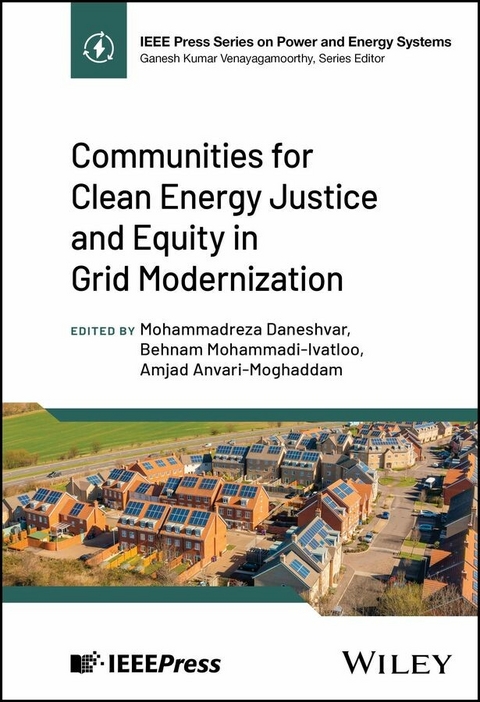
Communities for Clean Energy Justice and Equity in Grid Modernization (eBook)
1094 Seiten
Wiley-IEEE Press (Verlag)
978-1-394-26572-5 (ISBN)
Comprehensive blueprint to understand, develop, and implement clean energy initiatives and achieve energy justice and equity worldwide
Communities for Clean Energy Justice and Equity in Grid Modernization presents fundamental theories, technologies, and solutions for real-world problems in the operation and planning of clean, safe, resilient, and efficient energy communities that deliver energy justice and equity.
The initial chapters of the book focus on conceptual requirements, emphasizing the definition, structure, features, and challenges of promoting energy justice and equity through the coordinated operation of clean energy communities. Subsequent chapters explore potential technologies and systems to achieve these objectives, examining functionalities in modern energy grids, including self-healing systems, sustainable energy networks, and intelligent, multidimensional communities of agents.
Edited by a team of highly qualified experts, the book explores additional topics including:
- Decision-making tools for optimized operation and planning of multi-energy communities
- Holistic energy availability frameworks capable of dealing with changes and interactions in modern energy grids
- The role of artificial intelligence, machine learning, citizenship, and democracy in realizing energy justice and equity
- Hybrid transitional energy markets, energy policy strategies, and business models related to localization of energy technologies
- Energy storage and trading solutions, hybrid energy technologies, and grid-edge solutions
Communities for Clean Energy Justice and Equity in Grid Modernization is an essential reference on the subject for electrical, mechanical, civil, architectural, and environmental engineers, along with professionals working in power and energy utility companies and policy makers seeking a holistic understanding of the subject.
Mohammadreza Daneshvar, PhD, is an Assistant Professor and Head of the Laboratory of Multi-Carrier Energy Networks Modernization in the Faculty of Electrical and Computer Engineering at the University of Tabriz, Iran.
Behnam Mohammadi-Ivatloo, PhD, is a Professor in the School of Energy Systems, LUT University, Lappeenranta, Finland.
Amjad Anvari-Moghaddam, PhD, is an Associate Professor in the Department of Energy (AAU Energy) at Aalborg University, Denmark.
Comprehensive blueprint to understand, develop, and implement clean energy initiatives and achieve energy justice and equity worldwide Communities for Clean Energy Justice and Equity in Grid Modernization presents fundamental theories, technologies, and solutions for real-world problems in the operation and planning of clean, safe, resilient, and efficient energy communities that deliver energy justice and equity. The initial chapters of the book focus on conceptual requirements, emphasizing the definition, structure, features, and challenges of promoting energy justice and equity through the coordinated operation of clean energy communities. Subsequent chapters explore potential technologies and systems to achieve these objectives, examining functionalities in modern energy grids, including self-healing systems, sustainable energy networks, and intelligent, multidimensional communities of agents. Edited by a team of highly qualified experts, the book explores additional topics including: Decision-making tools for optimized operation and planning of multi-energy communitiesHolistic energy availability frameworks capable of dealing with changes and interactions in modern energy gridsThe role of artificial intelligence, machine learning, citizenship, and democracy in realizing energy justice and equityHybrid transitional energy markets, energy policy strategies, and business models related to localization of energy technologies Energy storage and trading solutions, hybrid energy technologies, and grid-edge solutions Communities for Clean Energy Justice and Equity in Grid Modernization is an essential reference on the subject for electrical, mechanical, civil, architectural, and environmental engineers, along with professionals working in power and energy utility companies and policy makers seeking a holistic understanding of the subject.
1
Energy Justice and Equity for the Sustainable Development of Modern Energy Grids
Mohammadreza Daneshvar1*, and Amjad Anvari‐Moghaddam2
1Laboratory of Multi‐Carrier Energy Networks Modernization, Faculty of Electrical and Computer Engineering, University of Tabriz, Tabriz, Iran
2Department of Energy (AAU Energy), Aalborg University, Aalborg, Denmark
1.1 Introduction
Nowadays, global development has found energy to be a vital requirement for realizing scheduled plans in different areas. This trend highlights a necessary alarm of the critical need for purposeful upgrading of energy networks due to the day‐by‐day growth of energy demand in its various carriers [1]. How this change needs to be conducted that not only caters to the multi‐energy load but also delivers carbon‐free and affordable energy to the consumer side is a key question in the expansion pass of modern energy grids. To address it, diverse endeavors are formed around the world to assess practical plans for the successful switching from the current centralized traditional systems to the modern zero‐emission and cost‐effective energy units [2]. In this respect, the universal trend toward clean energy is solidified by unveiling the importance of reliable access to environmentally friendly energy. The prominence of this issue was mostly identified when 193 members of the United Nations signed the agreement for sustainable development in 2015 [3]. In the seventh goal of sustainable development, the main motivation is “to ensure access to affordable, reliable, sustainable and modern energy for all” by 2030 [3]. However, the realization of this commitment is back to the availability of the financial budgets and accessibility to the required technologies [4]. The absence of the mentioned two key factors has deprived some countries of this development. Hence, how sustainable development in the energy world can be feasible for all countries, particularly for those that just have limited access to the required budgets and technologies, is an uncertain issue in the process of implementation of the United Nations pledge. Herein, another issue is properly distinguishing sustainable development efforts and endeavors for reinforcing energy privilege [5]. What can be done here is to explore the different dimensions of energy justice and equity in various layers of sustainable development. In this respect, recent literature has various perspectives on the effects of energy justice and equity in the transition to renewable energy. For instance, energy justice and equity are crucial for human development in [6] given its necessity for establishing social justice by procuring efficient and clean energy services for consumers. In another work [7], the impact of community acceptance of the planning of offshore grid connections on energy justice is examined. It is analyzed to find a practical way to rapidly implement renewable energy systems for clean energy supply. How artificial intelligence can improve grid flexibility and energy efficiency and how this improvement can positively affect energy justice and equity were the main questions in [8] that are conducted by exerting different methods to remove the related barriers for automated smart homes. Herein, the key question can be dedicated to the accessibility of various types of energy, which is why some consumers don't have access to reliable and affordable energy. Yet, the technology of multifarious decentralized systems has been mature enough to be deployed in different conditions for supplying energy. This can be known as the prominent dimension of energy justice and equity because it has a direct connection with the convenience of end users. Therefore, the development of modern energy networks is expected to be conducted in line with the realization of energy justice and equity plans in their different dimensions. The current chapter aims to scrutinize the interconnections between the sustainable development of modern multi‐carrier energy networks and the feasibility of energy justice and equity schemes with the aim of providing an appropriate view for the purposeful development of future multi‐energy networks.
1.2 Energy Justice and Equity for Sustainable Development
Recently, most contemporary debates in the energy world have revolved around specific topics in the domain of energy poverty alleviation, climate change decline, security, and reliability in energy access [9]. The practical plans for energy justice and equity can improve the accessibility to different dimensions of energy for all end users, reducing energy poverty and declining climate change by promoting the high usage of carbon‐free energy systems. As the related plans need to be designed to provide better access to energy, it is expected that energy justice and equity enhance the security and reliability of energy delivery in energy grids. Energy has become the undeniable principle of realizing different goals of sustainable development leading to opening new questions in the context of linking sustainable development criteria and energy justice and equity. Herein, the seventh goal of sustainable development is formed to clarify and raise public awareness that access to affordable and clean energy is an important universal right [9]. In this respect, embedded rights refer to those actions that protect communities and individuals from energy‐oriented harms and burdens in equitable access to energy [10]. Social, environmental, and economic rights are taken into account as the three most important domains of such actions, and their features are illustrated in Figure 1.1 [10].
1.2.1 Economic Rights
According to Figure 1.1, from the dimension of economic rights, the protection from energy‐oriented threats is targeted at communities and individuals to provide economic livelihood and well‐being for them. Two criteria can be considered for the assessment of economic rights. The first one refers to the development of energy projects that are not created to intend debt, economic exploitation, and predatory lending schemes as the main objective. This issue is more important for energy justice and equity as there are many energy systems that are basically developed in a way that relies on different payments from consumers [11]. This can be addressed by concentrating on the usage of various technologies of renewable energy systems as decentralized systems in geographical areas to meet the related end users [12]. Such actions will not only be cost‐effective but also will have no harmful effects on the environment. Indeed, decentralized energy systems offer a variety of energy production options that enable the system to act cost‐effectively in managing energy harvesting and serving that increase the system's flexibility in the control and management of energy sources. The distributed nature of decentralized energy systems in generating and supplying energy distinguishes them from centralized systems in terms of clean, affordable, reliable, and flexible energy serving.
Figure 1.1 Three main domains of energy justice and equity as embedded rights.
Source: Ciplet [10]/with permission of Elsevier.
The second important thing in the economic right is the protection of communities and individuals from the displacement of livelihoods through finance and energy projects. The displacement of livelihoods can negatively affect the achievement of some opportunities for special groups, such as women in finding appropriate work in different sectors [13]. Hence, proper distribution of energy systems and purposeful exploitation of diverse energy sources can help protect livelihoods from displacement through finance and energy projects.
1.2.2 Environmental Rights
As Figure 1.1 indicates, from the dimension of environmental rights, the protection from energy‐oriented environmental burdens is targeted at communities and individuals to provide environmentally friendly conditions for them. Similar to economic rights, two criteria can also be intended for scrutinizing environmental rights. The avoidance of exposure to energy‐oriented hazards, emissions, and risks is the first one that especially implies the rights of marginalized social groups as they disproportionately experience such hazards [10]. Indeed, energy development can result in ecological burdens in the form of emissions and different negative health impacts, particularly for marginalized communities that may be affected by various factors, such as indigeneity, age, class, gender, and race [14, 15].
The second issue is the involuntary resettlement of people and communities from local ecologies and land that should not occur due to development plans for energy systems. This concern also encompasses privatization or enclosure of common or public resources that may negatively affect the well‐being and rights of individuals. Relying on decentralized clean energy systems in the sustainable development of modern energy networks can significantly alleviate the need for involuntary resettlement and displacement in the implementation process of energy systems resulting in not violating the environmental rights of communities and realizing energy justice and equity.
1.2.3 Social Rights
From the dimension of social...
| Erscheint lt. Verlag | 31.7.2025 |
|---|---|
| Reihe/Serie | IEEE Press Series on Power and Energy Systems |
| Sprache | englisch |
| Themenwelt | Geisteswissenschaften ► Geschichte |
| Naturwissenschaften ► Physik / Astronomie | |
| Technik ► Elektrotechnik / Energietechnik | |
| Schlagworte | Artificial Intelligence • Clean Energy • Energy Communities • Energy Equity • Energy Justice • Energy Markets • energy paradigms • Green Energy • IEEE • multi-energy networks • multi-energy technologies • power utility • renewable energy |
| ISBN-10 | 1-394-26572-7 / 1394265727 |
| ISBN-13 | 978-1-394-26572-5 / 9781394265725 |
| Informationen gemäß Produktsicherheitsverordnung (GPSR) | |
| Haben Sie eine Frage zum Produkt? |
 EPUB (Adobe DRM)
Kopierschutz: Adobe-DRM
Adobe-DRM ist ein Kopierschutz, der das eBook vor Mißbrauch schützen soll. Dabei wird das eBook bereits beim Download auf Ihre persönliche Adobe-ID autorisiert. Lesen können Sie das eBook dann nur auf den Geräten, welche ebenfalls auf Ihre Adobe-ID registriert sind.
Details zum Adobe-DRM
Dateiformat: EPUB (Electronic Publication)
EPUB ist ein offener Standard für eBooks und eignet sich besonders zur Darstellung von Belletristik und Sachbüchern. Der Fließtext wird dynamisch an die Display- und Schriftgröße angepasst. Auch für mobile Lesegeräte ist EPUB daher gut geeignet.
Systemvoraussetzungen:
PC/Mac: Mit einem PC oder Mac können Sie dieses eBook lesen. Sie benötigen eine
eReader: Dieses eBook kann mit (fast) allen eBook-Readern gelesen werden. Mit dem amazon-Kindle ist es aber nicht kompatibel.
Smartphone/Tablet: Egal ob Apple oder Android, dieses eBook können Sie lesen. Sie benötigen eine
Geräteliste und zusätzliche Hinweise
Buying eBooks from abroad
For tax law reasons we can sell eBooks just within Germany and Switzerland. Regrettably we cannot fulfill eBook-orders from other countries.
aus dem Bereich