


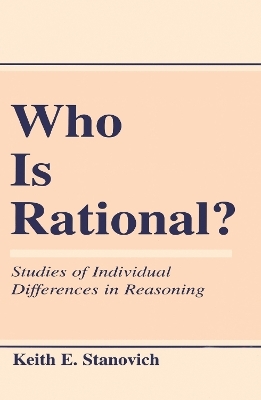
Who Is Rational?
Studies of individual Differences in Reasoning
Seiten
1999
Psychology Press (Verlag)
978-0-8058-2472-8 (ISBN)
Psychology Press (Verlag)
978-0-8058-2472-8 (ISBN)
This volume reviews a body of research on individual differences in thinking and reasoning and brings his conclusions to bear on the longstanding debate over whether people "are" or "are not" rational thinkers. For cognitive scientists and educators.
Integrating a decade-long program of empirical research with current cognitive theory, this book demonstrates that psychological research has profound implications for current debates about what it means to be rational. The author brings new evidence to bear on these issues by demonstrating that patterns of individual differences--largely ignored in disputes about human rationality--have strong implications for explanations of the gap between normative and descriptive models of human behavior. Separate chapters show how patterns of individual differences have implications for all of the major critiques of purported demonstrations of human irrationality in the heuristics and biases literature. In these critiques, it has been posited that experimenters have observed performance errors rather than systematically irrational responses; the tasks have required computational operations that exceed human cognitive capacity; experimenters have applied the wrong normative model to the task; and participants have misinterpreted the tasks.
In a comprehensive set of studies, Stanovich demonstrates that gaps between normative and descriptive models of performance on some tasks can be accounted for by positing these alternative explanations, but that not all discrepancies from normative models can be so explained. Individual differences in rational thought can in part be predicted by psychological dispositions that are interpreted as characteristic biases in people's intentional-level psychologies. Presenting the most comprehensive examination of individual differences in the heuristics and biases literature that has yet been published, experiments and theoretical insights in this volume contextualize the heuristics and biases literature exemplified in the work of various investigators.
Integrating a decade-long program of empirical research with current cognitive theory, this book demonstrates that psychological research has profound implications for current debates about what it means to be rational. The author brings new evidence to bear on these issues by demonstrating that patterns of individual differences--largely ignored in disputes about human rationality--have strong implications for explanations of the gap between normative and descriptive models of human behavior. Separate chapters show how patterns of individual differences have implications for all of the major critiques of purported demonstrations of human irrationality in the heuristics and biases literature. In these critiques, it has been posited that experimenters have observed performance errors rather than systematically irrational responses; the tasks have required computational operations that exceed human cognitive capacity; experimenters have applied the wrong normative model to the task; and participants have misinterpreted the tasks.
In a comprehensive set of studies, Stanovich demonstrates that gaps between normative and descriptive models of performance on some tasks can be accounted for by positing these alternative explanations, but that not all discrepancies from normative models can be so explained. Individual differences in rational thought can in part be predicted by psychological dispositions that are interpreted as characteristic biases in people's intentional-level psychologies. Presenting the most comprehensive examination of individual differences in the heuristics and biases literature that has yet been published, experiments and theoretical insights in this volume contextualize the heuristics and biases literature exemplified in the work of various investigators.
Keith E. Stanovich
Contents: Preface. Conceptualizing Rationality: Some Preliminaries. Performance Errors and Computational Limitations, With R.F. West.The Inappropriate Norm Argument. The Problem of Rational Task Construal. Dual-Process Theories and Evolutionary Adaptation Versus Normative Rationality. Thinking Dispositions and Decontextualized Reasoning, With R.F. West, W.C. Sá.The Fundamental Computational Bias. Has Human Irrationality Been Empirically Demonstrated?
| Erscheint lt. Verlag | 13.5.1999 |
|---|---|
| Verlagsort | Philadelphia |
| Sprache | englisch |
| Maße | 152 x 229 mm |
| Gewicht | 740 g |
| Themenwelt | Geisteswissenschaften ► Psychologie ► Allgemeine Psychologie |
| Geisteswissenschaften ► Psychologie ► Verhaltenstherapie | |
| ISBN-10 | 0-8058-2472-3 / 0805824723 |
| ISBN-13 | 978-0-8058-2472-8 / 9780805824728 |
| Zustand | Neuware |
| Informationen gemäß Produktsicherheitsverordnung (GPSR) | |
| Haben Sie eine Frage zum Produkt? |
Mehr entdecken
aus dem Bereich

aus dem Bereich
Paket bestehend aus »Das Patienten-Manual« und »Das Trainer-Manual«
Buch | Softcover (2025)
Schattauer (Verlag)
CHF 125,95
Lernen, Emotion, Motivation, Gedächtnis
Buch | Softcover (2025)
Beltz (Verlag)
CHF 39,20


