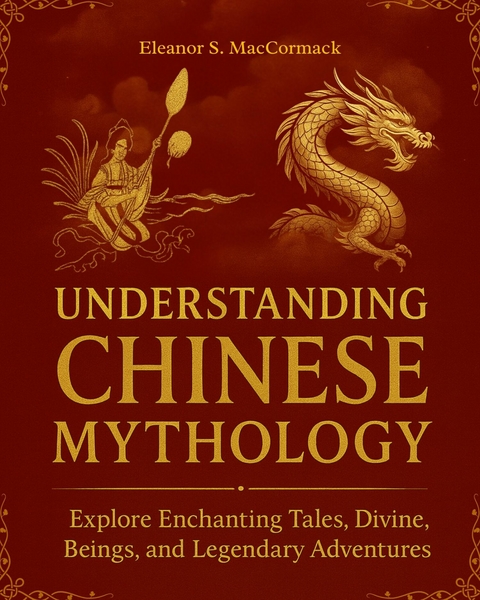
Understanding Chinese Mythology (eBook)
366 Seiten
Seahorse Pub (Verlag)
978-0-00-097781-6 (ISBN)
Embark on an extraordinary journey through the rich and mystical world of Chinese mythology with 'Understanding Chinese Mythology: Explore Enchanting Tales, Divine Beings, and Legendary Adventures.' This captivating guide invites you to uncover the ancient stories that have shaped Chinese culture, philosophy, and spirituality for thousands of years. From celestial gods and goddesses to heroic mortals and mythical creatures, this book brings to life the vibrant conections of legends that continue to inspire wonder.
Stroll into timeless tales of creation, love, betrayal, and triumph-stories that reveal the profound connection between humanity and the cosmos. Meet legendary figures like the Jade Emperor, Nuwa, and Sun Wukong, whose adventures reflect universal themes of courage, wisdom, and resilience. Discover how these myths influenced art, literature, festivals, and even modern-day beliefs. Whether you're fascinated by dragons soaring across the skies, intrigued by the balance of yin and yang, or eager to explore the symbolism behind the zodiac, this book offers a treasure trove of knowledge.
Written in an engaging, accessible style, it's perfect for beginners yet deep enough to captivate seasoned enthusiasts.
Unveil the secrets of China's storied past, connect with its timeless wisdom, and let these enchanting tales ignite your imagination. Add this essential guide to your collection today-it's more than just a book; it's a portal to a magical realm waiting to be explored!
Preface
The ancient bronze vessel sat in the corner of my grandfather's study, its patina darkened by centuries, its surface adorned with dragons that seemed to writhe in the afternoon light. I was ten years old when I first traced those serpentine forms with my fingertips, listening as my grandfather explained how these weren't mere decorative creatures but powerful symbols connecting heaven and earth in Chinese cosmology. That moment—the cool metal beneath my fingers, the smell of old books lining the walls, and the reverence in my grandfather's voice—planted a seed that would grow into a lifelong fascination with Chinese mythology.
Chinese mythological traditions represent one of humanity's most complex and enduring attempts to understand our place in the universe. Unlike the more familiar narrative structures of Western mythologies, Chinese myths exist in a state of beautiful contradiction—simultaneously ancient and evolving, fragmented yet interconnected, historically documented while remaining spiritually alive. These are not simply stories preserved in amber but living traditions that continue to shape cultural identity, artistic expression, and spiritual practice across East Asia.
What makes Chinese mythology particularly fascinating is how it blends historical figures with divine beings, merges philosophical concepts with fantastical narratives, and weaves together Taoist, Confucian, and Buddhist influences into a tapestry that defies simple categorization. The Yellow Emperor, for instance, stands as both a foundational historical ruler and a deity who ascended to heaven on the back of a dragon after discovering the secrets of immortality. Such beautiful ambiguities challenge Western conceptual boundaries between history and myth, human and divine.
As you turn these pages, you'll encounter gods who began as stars in the night sky, immortals who were once mortal seekers, and cosmic patterns that have shaped everything from traditional medicine to modern architecture. You'll discover how these myths have survived dynasties, revolutions, and cultural transformations—evolving yet retaining their essential wisdom.
The middle kingdom—Zhōngguó (中国)—has produced a mythological landscape as vast and varied as China itself. From the mist-shrouded mountains where immortals dwell to the celestial bureaucracy that mirrors imperial administration, from household gods protecting family hearths to cosmic deities determining the fate of the universe—these myths reflect both the extraordinary diversity and the remarkable continuity of Chinese civilization across millennia.
My own path through this landscape began with childhood stories and scholarly pursuit, eventually leading to years spent traveling across China, visiting temples where these deities are still venerated, speaking with practitioners who carry living traditions, and studying ancient texts alongside contemporary interpretations. What struck me throughout this journey was not just the richness of the mythology but how deeply it remains embedded in cultural consciousness, even in our modern era.
In creating this guide, I've wrestled with numerous challenges familiar to anyone attempting cross-cultural translation of complex concepts. How does one faithfully represent beliefs that sometimes exist outside Western conceptual frameworks? How can we honor the regional variations that give Chinese mythology its depth without overwhelming readers new to the subject? And perhaps most importantly, how do we present these traditions with both scholarly accuracy and narrative engagement?
My approach prioritizes cultural context alongside storytelling. You'll find that each mythological figure or concept is presented not in isolation but within the cultural, historical, and philosophical systems that give it meaning. The Eight Immortals, for example, cannot be fully appreciated without understanding the Taoist pursuit of longevity and transcendence that they embody. The story of Nüwa repairing the heavens makes deeper sense when connected to ancient Chinese cosmology and the concept of cosmic balance.
Regarding terminology, I've made deliberate choices to enhance accessibility while respecting authenticity. Chinese terms appear with both pinyin romanization and simplified Chinese characters upon first mention, allowing readers to recognize these terms in other contexts. Pronunciation guides accompany key names, acknowledging that unfamiliar sounds can create unnecessary distance between reader and subject. I've generally followed standard academic romanization systems while occasionally prioritizing readability over technical precision for names that might otherwise intimidate the general reader.
I must acknowledge my tremendous debt to generations of scholars, storytellers, and cultural practitioners who have preserved and interpreted these traditions. This work synthesizes research from Chinese and Western academic sources, traditional accounts from various regions, and insights from contemporary practitioners. While the bibliography provides formal recognition of published sources, I'm equally indebted to the many individuals who shared their knowledge and perspectives during my research—from temple caretakers in remote villages to folklore professors at major universities, from practicing Taoists to ordinary families maintaining household traditions.
Throughout this project, I've attempted to balance my outsider's perspective with deep respect for insiders' understanding. My position as someone straddling cultural contexts brings both limitations and opportunities. I cannot claim the intuitive cultural knowledge of someone raised entirely within Chinese traditions, yet this intermediary position perhaps allows me to anticipate and address the questions and misconceptions that might arise for Western readers encountering these concepts for the first time.
This guide makes no claim to be comprehensive—such an achievement would be impossible given the vastness of Chinese mythological traditions. What it offers instead is a thoughtfully curated journey through major systems, significant figures, and essential concepts. I've prioritized depth over breadth in many cases, believing that thorough understanding of key elements provides better foundation than superficial coverage of everything. Regional variations receive particular attention, highlighting how mythological traditions differ between northern and southern China, coastal and inland regions, Han majority and ethnic minority traditions.
Some readers may notice that certain academic debates receive less attention than they might in a scholarly work. This represents a deliberate choice to maintain narrative flow while still acknowledging interpretive diversity. Where significant scholarly disagreements exist about interpretation, I've noted them without allowing technical discussions to overwhelm the storytelling. Similarly, while historical context is essential, I've integrated it organically rather than segregating it into separate sections that might interrupt engagement with the mythological content itself.
One particular challenge in presenting Chinese mythology to Western audiences involves navigating different conceptual frameworks. Chinese traditions often blur distinctions that seem fundamental in Western thinking—between religious and secular, historical and mythical, philosophical and spiritual. Rather than imposing artificial boundaries, I've attempted to present these elements as they function within Chinese cultural contexts, even when that means embracing ambiguity or apparent contradiction. The Dragon Kings, for instance, operate simultaneously as nature deities controlling rainfall, as bureaucratic officials in the celestial administration, and as symbols within complex philosophical systems.
Throughout this work, I've tried to convey something often missing from treatments of world mythology—these are not simply artifacts of a distant past but living traditions that continue to evolve and influence contemporary life. Myths are not static narratives but dynamic systems of meaning that communities continually reinterpret to address changing circumstances. Even today, these mythological elements appear in everything from government symbolism to popular entertainment, from traditional rituals to cutting-edge digital art.
How to Use This Book
This guide can be approached in several ways depending on your interests and purposes. For those new to Chinese mythology, I recommend beginning with the "Foundations" section, which introduces key concepts, historical context, and structural frameworks that will enhance your understanding of specific figures and narratives in later chapters.
If you're drawn to particular aspects of mythology, the thematic organization allows you to focus on areas of interest—whether celestial deities, nature spirits, folk heroes, or mythical creatures. Each section functions as both a standalone exploration and part of the larger mythological landscape, with cross-references guiding you to related concepts throughout the book.
Those with Chinese heritage might approach this book as an exploration of cultural roots, perhaps recognizing figures from family stories or cultural celebrations. I particularly hope this work serves as a bridge between generations, perhaps inspiring conversations between those raised with these traditions and younger family members seeking connection to cultural heritage.
Whatever path you choose through these pages, I encourage an approach that balances analytical understanding with imaginative engagement. These myths have endured for millennia because they speak to something essential in human experience—our search for meaning, our relationship with...
| Erscheint lt. Verlag | 25.7.2025 |
|---|---|
| Sprache | englisch |
| Themenwelt | Geschichte ► Allgemeine Geschichte ► Vor- und Frühgeschichte |
| ISBN-10 | 0-00-097781-0 / 0000977810 |
| ISBN-13 | 978-0-00-097781-6 / 9780000977816 |
| Informationen gemäß Produktsicherheitsverordnung (GPSR) | |
| Haben Sie eine Frage zum Produkt? |
 EPUB (Adobe DRM)
Größe: 3,0 MB
Kopierschutz: Adobe-DRM
Adobe-DRM ist ein Kopierschutz, der das eBook vor Mißbrauch schützen soll. Dabei wird das eBook bereits beim Download auf Ihre persönliche Adobe-ID autorisiert. Lesen können Sie das eBook dann nur auf den Geräten, welche ebenfalls auf Ihre Adobe-ID registriert sind.
Details zum Adobe-DRM
Dateiformat: EPUB (Electronic Publication)
EPUB ist ein offener Standard für eBooks und eignet sich besonders zur Darstellung von Belletristik und Sachbüchern. Der Fließtext wird dynamisch an die Display- und Schriftgröße angepasst. Auch für mobile Lesegeräte ist EPUB daher gut geeignet.
Systemvoraussetzungen:
PC/Mac: Mit einem PC oder Mac können Sie dieses eBook lesen. Sie benötigen eine
eReader: Dieses eBook kann mit (fast) allen eBook-Readern gelesen werden. Mit dem amazon-Kindle ist es aber nicht kompatibel.
Smartphone/Tablet: Egal ob Apple oder Android, dieses eBook können Sie lesen. Sie benötigen eine
Geräteliste und zusätzliche Hinweise
Buying eBooks from abroad
For tax law reasons we can sell eBooks just within Germany and Switzerland. Regrettably we cannot fulfill eBook-orders from other countries.
aus dem Bereich