


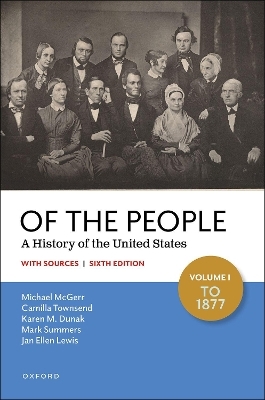
Of The People 6Th Edition Volume 1
Oxford University Press Inc (Verlag)
978-0-19-779874-4 (ISBN)
- Noch nicht erschienen (ca. Juli 2026)
- Versandkostenfrei
- Auch auf Rechnung
- Artikel merken
Of the People: A History of the United States does more than tell the history of America-of its people and places, of its dealings and ideals. It unfolds the story of American democracy, carefully marking how this country's evolution has been anything but certain, from its complex beginnings to its modern challenges.The authors see American history as a story "of the people," of their struggles to shape their lives and their land.
Their narrative focuses on the social and political lives of people-some famous, some ordinary-revealing the compelling story of America's democracy from an individual perspective, from across the landscapes of
diverse communities, and ultimately from within the larger context of the world.The theme of democracy concentrates attention on the most fundamental concerns of history: people and power. These concerns have been especially relevant as the authors completed revising the book for this new edition in the midst of the 2024 presidential election campaign, one of the most divisive in modern American history. Recent history is always a challenge and always subject to revision,
but the authors show how contemporary struggles over democracy are rooted in the past. Their balanced, inclusive approach makes it more possible for teachers and students to deal with the most
controversial events.
Michael McGerr is Paul V. McNutt Professor of History at Indiana University-Bloomington. Camilla Townsend is Distinguished Professor of History at Rutgers University. Karen M. Dunak is Associate Professor of History at Muskingum University. Mark Summers is Thomas D. Clark Professor of History at the University of Kentucky. Jan Ellen Lewis was Professor of History and Dean of the Faculty of Arts and Sciences at Rutgers University-Newark.
Contents
Maps
Features
Preface
About the Authors
Chapter 1: Worlds in Motion, 1450-1550
American Portrait: Malinche, Cultural Translator
1.1 The Worlds of Indigenous Peoples
Great Migrations
The Emergence of Farming
The Cradle of the Americas
The Northern World Takes Shape
American Landscape: Tenochtitlan: a City on a Lake
1.2 The Worlds of Christopher Columbus
The Reconquista
The Age of Exploration
New Ideas Take Root
1.3 Collision in the Caribbean
Columbus's First Voyage
The Origins of a New World Political and Economic Order
The Division of the World
1.4 Onto The Mainland
The First Florida Ventures
The Conquest of Mexico
Struggles For Democracy: Native Americans Debate the Question of the Europeans
The Establishment of a Spanish Empire
The Return to North America
1.5 The Consequences of Conquest
Demographic Disaster
The Columbian Exchange
Men's and Women's Lives
Conclusion
Chapter 1 Primary Sources
1.1 Aztec Stories
1.2 Visual Documents: Chaco Culture National Historical Park, Pueblo Bonito
1.3 King Fernando and Queen Isabella of Spain, "Granada Capitulations" (1492)
1.4 Aztec Priests, Statement to the Franciscan Friars (1520s)
1.5 Alvar Núñez Cabeza de Vaca, Describing North America (1535)
Chapter 2: Colonial Outposts, 1550-1650
American Portrait: Paquiquineo Finds His Way Home
2.1 Pursuing Wealth and Glory Along the North American Shore
European Objectives
The Huge Geographical Barrier
Spanish Outposts
2.2 New France: An Outpost in Global Politics and Economics
The Five Nations of Iroquois and the Political Landscape
Champlain Encounters the Hurons
Creating a Middle Ground in New France
Struggles For Democracy: The Settlers and the Indigenous Learn to Compromise
An Outpost in a Global Political Economy
2.3 New Netherland: The Empire of a Trading Nation
Colonization by a Private Company
Slavery and Freedom in New Netherland
The Dutch-Indigenous Trading Partnership
The Beaver Wars
2.4 England Attempts an Empire
Competition with Spain
Rehearsal in Ireland
American Landscape: Terra Nova
The Roanoke Venture
The Abandoned Colony
Conclusion
Chapter 2 Primary Sources
2.1 Letter from Fray Pedro de Feria to Phillip II, King of Spain, about Paquiquineo (1563)
2.2 Richard Hakluyt, Excerpt from The Principal Navigations, Voyages, Traffiques, and Discoveries of the English Nation (1589-1600)
2.3 The Beaver Trade Takes Hold (1634)
2.4 John Heckewelder, Account of the Arrival of the Dutch at Manhattan
Chapter 3: The English Come to Stay, 1600-1660
American Portrait: The Predicament of Pocahontas, Alias Rebecca
3.1 The First Chesapeake Colonies
Founding Virginia
Starving Times
Troubled Relations with the Powhatans
Toward a New Economic Order and the Rise of Democracy
Toward the Destruction of the Powhatans
A New Colony in Maryland
3.2 The Economy Based on Slavery Emerges
The Insatiable Demand for Cheap Labor
The Origins of African Slavery in the Chesapeake
Gender and the Social Order in the Chesapeake
American Landscape: The Forest
3.3 A Bible Commonwealth in the New England Wilderness
The English Origins of the Puritan Movement
Struggles For Democracy: The First African Arrivals Exercise Some Rights
What Did the Puritans Believe?
The Pilgrim Colony at Plymouth
The Puritan Colony at Massachusetts Bay
The New England Way
Changing the Landscape to Fit the Economic Needs of the Commonwealth
The Puritan Family
3.4 Dissension in The Puritan Ranks
Roger Williams and Toleration
Anne Hutchinson and the Equality of Believers
Puritan Indian Policy and the Pequot War
Conclusion
Chapter 3 Primary Sources
3.1 Edward Waterhouse's Report on the Uprising of 1622
3.2 Letter from Richard Frethorne to His Parents About Life in Virginia (1623)
3.3 Excerpts from Anne Hutchinson's Trial Transcript (1637)
3.4 Letter from Anne Bradstreet to Her Children (Undated)
Chapter 4: Continental Empires, 1660-1720
American Portrait: Mercy Lewis Learns to Fear the Devil
4.1 The Plan of Empire
Turmoil in England
The Meaning of Mercantilism
4.2 New Colonies, New Patterns
New Netherland Becomes New York
American Landscape: New Amsterdam/New York
Diversity and Prosperity in Pennsylvania
Indigenous and Africans in the Political Economy of Carolina
The Barbados Connection
4.3 The Transformation of Virginia
Social Change in Virginia
Bacon's Rebellion and the Abandonment of the Middle Ground
Virginia Becomes a Slave Society
4.4 New England Under Assault
Social Prosperity and the Fear of Religious Decline
King Philip's War
Indians and the Empire
4.5 The Empire Strikes
The Dominion of New England
The Glorious Revolution in Britain and America
Struggles For Democracy: Maryland's Colonists Demand a New Government
The Rights of Englishmen
Conflict in the Empire
4.6 Massachusetts in Crisis
The Social and Cultural Contexts of Witchcraft
Witchcraft at Salem
The End of Witchcraft
4.7 Empires in Collision
France Attempts an Empire
The Spanish Outpost in Florida
Conquest, Revolt, and Reconquest in New Mexico
Native Americans and the Country Between
Conclusion
Chapter 4 Primary Sources
4.1 The Dutch Lose Power in America: A Meeting with Indians on the Delaware (1670)
4.2 Letter from William Penn to His Backers (1683)
4.3 Hannah Dustan, excerpted from Cotton Mather, Magnalia Christi Americana (1702)
4.4 Declaration of a Pueblo Indian Captured by the Spaniards (1680)
4.5 Robert Calef, Excerpts from More Wonders of the Invisible World (1700)
Chapter 5: The Eighteenth-Century World, 1700-1775
American Portrait: Young Alexander Hamilton: One Immigrant's Story
5.1 The Population Explosion of the Eighteenth Century
The Dimensions of Population Growth
Bound for America: European Immigrants
Bound for America: Enslaved Africans
5.2 The Transatlantic Economy: Producing and Consuming
The Nature of Colonial Economic Growth
The Transformation of the Family Economy
Sources of Regional Prosperity
Merchants and Dependent Laborers in the Transatlantic Economy
Consumer Choices and the Creation of Gentility
5.3 The Varieties of Colonial Experience
Creating an Urban Public Sphere
The Diversity of Urban Life
The Maturing of Rural Society
The World That Slavery Made
Georgia: From Frontier Outpost to Plantation Society
5.4 The Head and The Heart in America: The Enlightenment and Religious Awakening
The Ideas of the Enlightenment
The Economic and Social Foundations of Democracy
Struggles For Democracy: Books Become More Accessible
Enlightened Institutions
Origins of the Great Awakening
The Grand Itinerant
Cultural Conflict and Challenges to Authority
What the Awakening Wrought
Conclusion
Chapter 5 Primary Sources
5.1 Benjamin Franklin, The Autobiography of Benjamin Franklin (1771-1790)
5.2 Joseph Johnson, Letter to "All Our Indian Brethren" (1773)
5.3 Olaudah Equiano, Excerpts from The Interesting Narrative and Other Writings (1789)
5.4 George Whitefield, Account of a Visit to Carolina (1740)
5.5 Phillis Wheatley, "To the University of Cambridge, In New England" (1773)
Chapter 6: Conflict in the Empire, 1713-1774
American Portrait: Susannah Willard Johnson Experiences the Empire
6.1 The Victory of the British Empire
New War, Old Pattern
The Local Impact of Global War
The French Empire Crumbles from Within
The Virginians Ignite a War
From Local to Imperial War
Problems with British-Colonial Cooperation
The British Gain the Advantage
6.2 Enforcing the Empire
Pontiac's Rebellion and Its Aftermath
American Landscape: Conestoga Indian Town
Paying for the Empire: Sugar and Stamps
6.3 The British Empire in Crisis
An Argument About Constitutional Government
The Theory and Practice of Resistance
Contesting the Townshend Duties
6.4 A Revolution in the Empire
"Massacre" in Boston
Struggles For Democracy: The Boston Massacre
The Boston Tea Party and Its Effects
The First Continental Congress
Conclusion
Chapter 6 Primary Sources
6.1 Letters between Sir Jeffrey Amherst and Henry Bouquet (1763)
6.2 Benjamin Franklin, Excerpts from "A Narrative of the Late Massacres" (1764)
6.3 A Visiting Frenchman's Account of Patrick Henry's Caesar-Brutus Speech (1765)
6.4 The Stamp Act Riots: The Destruction of Thomas Hutchinson's House (1765)
6.5 The Intolerable Acts (1774)
Chapter 7: Creating a New Nation, 1775-1788
American Portrait: Abigail Adams and the Wartime Economy
7.1 The War Begins
The First Battles
Congress Takes the Lead
Military Ardor
Declaring Independence
Creating a National Government
Creating State Governments
7.2 Winning the Revolution
Competing Strategies
The British on the Offensive: 1776
A Slow War: 1777-1781
American Landscape: The South Carolina Backcountry
Securing a Place in the World
7.3 The Challenge of the Revolution
The Departure of the Loyalists
The Challenge of the Economy
Contesting the New Economy
Can Women Be Citizens?
The Challenge of Slavery
7.4 A New Policy in the West
The Indians' Revolution
The End of the Middle Ground
Settling the West
7.5 A Government of the People
A Crippled Congress
Writing a New Constitution
Ratifying the Constitution: Politics
Struggles For Democracy: The Ratification of the Constitution
Ratifying the Constitution: Ideas
Conclusion
Chapter 7 Primary Sources
7.1 Thomas Paine, Common Sense (1776)
7.2 Alexander Hamilton Recommends Arming Slaves and George Washington Rejects the Idea (1779)
7.3 Letter from Abigail Adams to John Adams (1776)
7.4 Slave Petition for Freedom to the Massachusetts Legislature (1777)
7.5 The Federalists and the Anti-Federalists (1787-1788)
Chapter 8: Contested Republic, 1789-1800
American Portrait: Ona Judge Finds Her Freedom
8.1 The Struggle to Form a Government
Creating a National Government
The States and the Bill of Rights
Debating the Economy
8.2 A Society in Transition
A People on the Move
The First Emancipation Movements
American Landscape: Philadelphia
Conflicting Visions of Republican Society
The Culture of the Republic
8.3 Securing The Nation
Borders and Boundaries
Controlling the Borderlands
The Whiskey Rebellion
Democratic Revolutions Abroad
Between France and Great Britain
To the Brink of War
The Administration of John Adams
Tensions at Home
Struggles For Democracy: The Alien and Sedition Acts
Conclusion
Chapter 8 Primary Sources
8.1 Henry Knox, Report on the Indians (1789)
8.2 Alexander Hamilton, Report on Manufactures (1791)
8.3 Thomas Jefferson's Letter to Philip Mazzei (1796)
8.4 Charles Brockden Brown's Defense of Education for Women (1798)
8.5 United States Congress, "An Act to Establish an Uniform Rule of Naturalization" (1790) and an Act Respecting Alien Enemies (1798)
8.6 The Virginia and Kentucky Resolutions (1798-1799)
8.7 Excerpts from "An Act for the Gradual Abolition of Slavery," in Laws of the State of New York, 22nd Session (1799)
Chapter 9: A Republic in Transition, 1800-1819
American Portrait: A Young Andrew Jackson Finds a Cause
9.1 A Politics of Transition
A Contested Election, an Anxious Nation
Struggles For Democracy: The Gabriel Revolt
Democratic Republicans in Office
The Louisiana Purchase
Embargo
9.2 The War of 1812
Madison and the War
Federalist Response
9.3 An Economy in Transition
International Markets
Crossing the Appalachian Mountains
Invention and Exploration
Early Industrial Society in New England
The Rule of Law and Lawyers
9.4 Ways of Life in Flux
Indian Resistance to American Expansion
Winners and Losers in the New Economy
Religion
The Problem of Trust in a Changing Society
American Landscape: American Indians Watch Home Slip Away
The Panic of 1819
Conclusion
Chapter 9 Primary Sources
9.1 Thomas Jefferson, First Inaugural Address (1801)
9.2 Tecumseh's Speech to Governor Harrison, August 20, 1810
9.3 Felix Grundy, Predictions About the War of 1812
9.4 Constitution of the Lowell Factory Girls Association (1834)
9.5 Elder David Purviance's Description of the Cane Ridge Revival (1801)
Chapter 10: Jacksonian Democracy, 1820-1840
American Portrait: John Ross and the Limits of Democracy
10.1 A New National Politics
Changes in the Democratic Republican Party
James Monroe and National Republicanism
The Missouri Compromise
The Election of 1824 and the "Corrupt Bargain"
The Adams Presidency and the Gathering Forces of Jacksonianism
10.2 The Social and Political Bases of Jacksonian Democracy
Settlers
Free Labor
Suffrage Reform
Opposition to Special Privilege and Secret Societies
10.3 Southern Slavery
"Property in Man"
The Domestic Slave Trade
Plantation Slavery
Other Varieties of Slavery
American Landscape: Gowrie: The Story of Profit and Loss on an American Plantation
Resistance and Creativity Among Southern Enslaved People
10.4 Slavery and National Development
Slavery and Industrialization in the Northeast
Slavery and the Laws of the Nation
Free Black People in a Republic of Slavery
10.5 Jacksonian Democracy in Action
The Election of 1828
The Bank War
Dismembering the Bank
The Specie Circular
10.6 A Policy of Removing Indigenous People
Jackson and Native Peoples
The Removal Act
History, Destiny, and the Remaking of Indian Societies
10.7 The Growth of Sectional Tension
The Sources of Southern Discontent
South Carolina's Protest
Struggles For Democracy: The Federal Government Responds to Abolitionism
The Nullification Crisis
Conclusion
Chapter 10 Primary Sources
10.1 Rufus King, Excerpts from The Substance of Two Speeches Delivered in the Senate of the United States, on the Subject of the Missouri Bill (1820) and William Pinkney, Excerpts from His Response on the Missouri Question (1820)
10.2 Andrew Jackson, Excerpt from Bank Veto Message (1832) and Visual Document: H. R. Robinson, "General Jackson Slaying the Many Headed Monster" (1836)
10.3 Theodore Frelinghuysen's Argument Against the Removal Act (1830)
10.4 Frances Kemble's Journal (1838-1839)
10.5 Black Hawk's Autobiography
Chapter 11: Reform and Conflict, 1820-1848
American Portrait: William and Ellen Craft
11.1 Perfectionism and the Theology of Human Striving
Millennialism and Communitarians
The Benevolent Empire
11.2 Organizing Against Slavery
The Antislavery Movement
Black Abolitionists
Immediatism
American Landscape: Harmony Hall
Anti-abolition Violence
The Emergence of Political Abolitionism
Freedom National, Slavery Local
11.3 Reform and the Urban Classes
Wage Dependency and Labor Protest
A New Urban Middle Class
Immigration and Nativism
Internal Migration
11.4 Self-Reform and Social Regulation
A Culture of Self-Improvement
Temperance
The Common School Movement and Democracy
Penal Reform
Electoral Politics and Moral Reform
11.5 Women's Rights
Women and Reform Movements
Struggles For Democracy: The Seneca Falls Convention
The Seneca Falls Convention
Conclusion
Chapter 11 Primary Sources
11.1 David Walker, Excerpts from "Walker's Appeal" (1829)
11.2 William Lloyd Garrison, Excerpt from the First Issue of The Liberator (1831)
11.3 William Apess, "An Indian's Looking Glass for the White man" (1833)
11.4 Angelina Grimké, Excerpt from An Appeal to the Women of the Nominally Free States (1838)
11.5 Louisa May Alcott, Excerpts from "Transcendental wild Oats" (1873)
11.6 Alexis de Tocqueville, Excerpts from Democracy in America: Volume II (1840)
Chapter 12: Manifest Destiny, 1836-1848
American Portrait: Joe, an Enslaved Man at the Alamo
12.1 The Decline of Jacksonianism
Political Parties in Crisis
Van Buren and the Legacy of Jackson
12.2 Acquiring the trans-Mississippi West
Manifest Destiny in Antebellum Culture
Texas
On to Oregon
Indian Nations of the Trans-Mississippi West
12.3 Slavery's Connection to Geographic Expansion
Log Cabins and Hard Cider: The Election of 1840
And Tyler, Too
Occupy Oregon, Annex Texas
War with Mexico
American Landscape: The Battlefield of Churubusco
Struggles For Democracy: Mexicans in California Lose Their Rights
Conclusion
Chapter 12 Primary Sources
12.1 Chief John Ross, The Petition and Memorial of the Delegates and Representatives of the Cherokee Nation (1840)
12.2 Visual Documents: Thomas Cole, Landscape (1825); Frederic Edwin Church, Niagara Falls (1857); Louis Rémy Mignot, Landscape in Ecuador (1859)
12.3 Lydia Allen Rudd, Account of Westward Journey (1852)
12.4 John O'Sullivan, "Annexation" (1845)
12.5 María Amparo Ruiz de Burton, The Squatter and the Don (1885)
Chapter 13: The Politics of Slavery, 1848-1860
American Portrait: Frederick Douglass
13.1 The Political Economy of Freedom and Slavery
A Changing Economy in the North
The Slave Economy
American Landscape: City of Broad Shoulders and Broader Implications: Chicago
The Importance of the West
13.2 Slavery Becomes a Political Issue
Wilmot Introduces His Proviso
A Compromise Without Compromises
The Fugitive Slave Act Provokes a Crisis
The Election of 1852 and the Decline of the Whig Party
13.3 The Origins of the Republican Party
The Challenge of Immigration
Nativism's Political Moment
Slavery as a Foreign Policy
The Kansas-Nebraska Act Revives the Slavery Issue
The Labor Problem and the Politics of Slavery
"Bleeding Kansas"
13.4 A New Political Party Takes Shape
The First Sectional Election
Struggles For Democracy: The Settling and Unsettling of Kansas
The Dred Scott Decision
The Lecompton Constitution Splits the Democratic Party
The "Irrepressible" Conflict
13.5 The Retreat From Union
John Brown's War Against Slavery
Northerners Elect a President
Conclusion
Chapter 13 Primary Sources
13.1 John Greenleaf Whittier, "The Haschish" (1854)
13.2 The Fugitive Slave Law Claims a Victim (1852)
13.3 Letter from Edward Bridgman about Kansas Warfare (1856)
13.4 James H. Hammond, "Speech on the Admission of Kansas" (1858)
13.5 Abraham Lincoln, Speech at Springfield, Illinois (1857)
Chapter 14: A War for Union and Emancipation, 1861-1865
American Portrait: Clara Barton and the Angels of the Battlefield
14.1 Liberty and Union
The Deep South Secedes
The Upper South Makes Its Choice
Civilians Demand a Total War
What Were Soldiers Fighting For?
Struggles For Democracy: The Citizen Soldier Learns a Profession
14.2 Mobilizing For War
The Military Scorecard
Union Naval Supremacy
King Cotton's Failed Diplomacy
The Political Economy of Total War
Filling the Ranks-and the Jails
Sinews of War
14.3 The Civil War as Social Revolution
Union Victories in the West
Richmond Is a Hard Road to Travel
A New Birth of Freedom
The Turn of the Tide-Gettysburg and Vicksburg
Emancipation in Practice
14.4 The War at Home
The "Butcher's Bill"
Discontent on Both Sides
14.5 Union Victory at Terrible Cost
Grant Takes Command
No Turning Back: Hard War in an Election Year
Atlanta to Appomattox
American Landscape: "Burnwell": Sherman's March from the Sea and the Long-Term Cost of Devastation
From Emancipation to Abolition
The Meaning of the Civil War
Conclusion
Chapter 14 Primary Sources
14.1 John Sherman, A Letter on the Crisis to Philadelphians (1860)
14.2 Julia Ward Howe, "The Battle Hymn of the Republic" (1862)
14.3 Louisa May Alcott Nurses the Wounded (1863)
14.4 John Beauchamp Jones Observes the Deterioration on the Confederate Home Front (1863-1864)
14.5 Henry Clay Work, "Kingdom Coming" (1862)
14.6 Abraham Lincoln, Second Inaugural Address (1865)
Chapter 15: Reconstructing a Nation, 1865-1877
American Portrait: John Dennett Visits a Freedmen's Bureau Court
15.1 Wartime Reconstruction
Lincoln's Ten Percent Plan Versus the Wade-Davis Bill
The Meaning of Freedom
Experiments with Free Labor
15.2 Presidential Reconstruction, 1865-1867
The Political Economy of Contract Labor
Resistance to Presidential Reconstruction
Congress Clashes with the President
Origins of the Fourteenth Amendment
15.3 Congressional Reconstruction
The South Remade
The Impeachment and Trial of Andrew Johnson
Radical Reconstruction in the South
Achievements and Failures of Radical Government
The Political Economy of Sharecropping
The Gospel of Prosperity
A Counterrevolution of Terrorism and Economic Pressure
15.4 A Reconstructed West
The Overland Trail
The Origins of Indian Reservations
Reforming Native American Tribes out of Existence
15.5 The Retreat From Republican Radicalism
Republicans Become the Party of Moderation
15.6 Reconstructing the North
The Fifteenth Amendment and Nationwide African American Suffrage
Women and Suffrage
Reconstructing America's Foreign Policy
15.7 The End of Reconstruction
Corruption Is the Fashion
Liberal Republicans Revolt
"Redeeming" the South
Struggles For Democracy: An Incident at Coushatta, August 1874
The Twice-Stolen Election of 1876
Sharecropping Becomes Wage Labor
American Landscape: The Exodusters Make it to the Promised Land
Conclusion
Chapter 15 Primary Sources
15.1 Petroleum V. Nasby [David Ross Locke], A Platform for Northern Democrats (1865)
15.2 A Black Tenant Farmer Describes Working Conditions
15.3 Sharecropping Contract Between Alonzo T. Mial and Fenner Powell (1886)
15.4 Joseph Farley, An Account of Reconstruction
15.5 A Southern Unionist Judge's Daughter Writes the President for Help (1874)
15.6 Red Cloud Pleads the Plains Indians' Point of View at Cooper Union (1870)
| Erscheinungsdatum | 26.07.2025 |
|---|---|
| Verlagsort | New York |
| Sprache | englisch |
| Gewicht | 1 g |
| Themenwelt | Geisteswissenschaften ► Geschichte ► Regional- / Ländergeschichte |
| ISBN-10 | 0-19-779874-8 / 0197798748 |
| ISBN-13 | 978-0-19-779874-4 / 9780197798744 |
| Zustand | Neuware |
| Informationen gemäß Produktsicherheitsverordnung (GPSR) | |
| Haben Sie eine Frage zum Produkt? |
aus dem Bereich


