


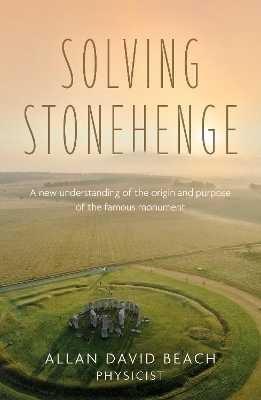
Solving Stonehenge
A new understanding of the origin and purpose of the famous monument
Seiten
2026
Troubador Publishing (Verlag)
978-1-83628-579-3 (ISBN)
Troubador Publishing (Verlag)
978-1-83628-579-3 (ISBN)
A completely new understanding of the origin and purpose of Stonehenge. This is a full history and explanation of this world-famous structure and the people who built it.
5,000 years ago, the people who lived on the north Pembrokeshire coast moved their entire culture, along with as many as 8o 1-to-2 tonne “Bluestones”, 300km across country to the place now known as Stonehenge. Why? In this book you will find an answer – 50 years of archaeological discoveries and forensic science have been assembled into a fascinating story of Stone Age motivation and achievement.
They first built a lunar observatory to try and unravel the Moon’s influence on the tides in their fishery, the estuary of the Nevern river, but the observations failed – they had no clear horizon to monitor moonrise bearings. But they knew of a better place in southern England where the chalk Downs inhibited tree growth and had clear horizons.
And so, Stonehenge came to be. It is the sum of 5 or 6 different circular constructions, all with the same centre. The builders of Stonehenge 1 defined that centre and made the 110m diameter boundary ditch and, most puzzling to modern investigators, the number 56 of the Aubrey ring of Bluestones.
This book gives the answer. The only answer so far that tells us why, at Stonehenge, 56 is 14 times 4.
5,000 years ago, the people who lived on the north Pembrokeshire coast moved their entire culture, along with as many as 8o 1-to-2 tonne “Bluestones”, 300km across country to the place now known as Stonehenge. Why? In this book you will find an answer – 50 years of archaeological discoveries and forensic science have been assembled into a fascinating story of Stone Age motivation and achievement.
They first built a lunar observatory to try and unravel the Moon’s influence on the tides in their fishery, the estuary of the Nevern river, but the observations failed – they had no clear horizon to monitor moonrise bearings. But they knew of a better place in southern England where the chalk Downs inhibited tree growth and had clear horizons.
And so, Stonehenge came to be. It is the sum of 5 or 6 different circular constructions, all with the same centre. The builders of Stonehenge 1 defined that centre and made the 110m diameter boundary ditch and, most puzzling to modern investigators, the number 56 of the Aubrey ring of Bluestones.
This book gives the answer. The only answer so far that tells us why, at Stonehenge, 56 is 14 times 4.
Allan David Beach is a retired physicist who has worked in both the United Kingdom and New Zealand, where he now lives. He spent much of his career working for the UK Atomic Energy Authority before moving to New Zealand in 1973. Here he continued to work first for NZ DSIR and then Industrial Research Ltd.
| Erscheint lt. Verlag | 28.1.2026 |
|---|---|
| Verlagsort | Market Harborough |
| Sprache | englisch |
| Maße | 129 x 198 mm |
| Gewicht | 150 g |
| Themenwelt | Geisteswissenschaften ► Archäologie |
| ISBN-10 | 1-83628-579-5 / 1836285795 |
| ISBN-13 | 978-1-83628-579-3 / 9781836285793 |
| Zustand | Neuware |
| Informationen gemäß Produktsicherheitsverordnung (GPSR) | |
| Haben Sie eine Frage zum Produkt? |
Mehr entdecken
aus dem Bereich


aus dem Bereich
maternal health science and the reproduction of harm
Buch | Softcover (2024)
University of California Press (Verlag)
CHF 52,35
long-lasting legacies of colonialism and nationalism in Israel, …
Buch | Softcover (2025)
Vernon Press (Verlag)
CHF 109,95


