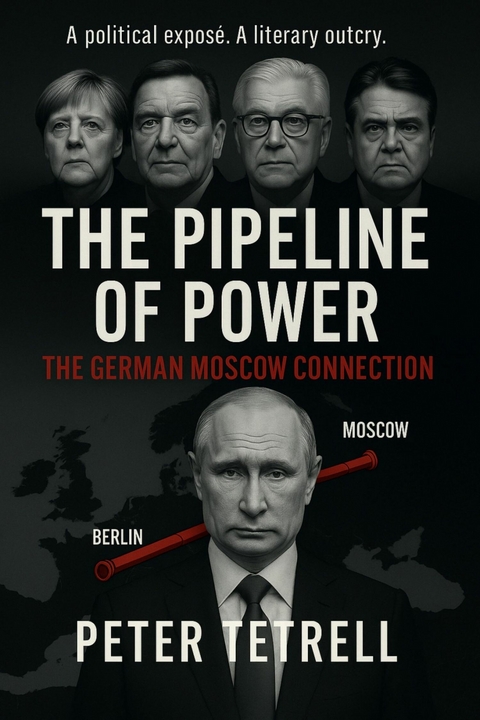
The Pipeline of Power (eBook)
296 Seiten
epubli (Verlag)
978-3-8197-7222-1 (ISBN)
Pseudonym
Pseudonym
The war in Georgia is the first major foreign policy test for the West under Medvedev. But there is great uncertainty:
- In Berlin and Paris, people believe in Medvedev's influence
- The US – under President Bush – is beginning to realize that Putin never went away
- Sarkozy flies to Moscow to negotiate a ceasefire—with Medvedev, but on Putin's terms
"We are talking to the president. But the prime minister is waging war."
– EU Commission analysis paper, October 2008
VII. The result – Russia wins, the West hesitates
The Russian army destroys Georgian military installations and controls South Ossetia and Abkhazia.
NATO responds with rhetoric – no sanctions, no troops, no protection.
Georgia is effectively crushed – and left alone de jure.
- Abkhazia and South Ossetia are recognized as "independent" by Moscow.
- Western countries protest – but take no countermeasures
- Georgia loses 20% of its territory – permanently.
"Russia tested our weakness. And found it confirmed."
– Stefan Meister, German Council on Foreign Relations, 2009
VIII. The lesson – and the mistake
The West wanted to see Medvedev as a beacon of hope.
The war in Georgia shows that Putin rules and Medvedev moderates.
The international order is quietly changing – not through treaties, but through tanks.
Chapter 3.3: The silence of energy policy – Why Nord Stream was not stopped
"Russia delivers – Germany remains silent."
– Commentary in the Süddeutsche Zeitung, October 2008
I. The contradiction: War in Georgia – gas through the Baltic Sea
While Russian tanks occupy territories in the Caucasus, another project continues quietly, according to plan and without political opposition:
the construction of the Nord Stream 1 Baltic Sea gas pipeline.
- The first pipe is laid in 2007
- In the summer of 2008, construction is progressing rapidly
- Supply via the Baltic Sea is supposed to make Germany less dependent on Ukraine as a transit country – at least according to the political narrative
But the contradiction is glaring:
- On the one hand, Russia is attacking a sovereign country
- On the other hand, Germany is deepening its dependence on Russian gas
"We are laying pipes with a country that is currently at war – just imagine that."
– Joschka Fischer, looking back in 2015
II. The role of Gerhard Schröder
The former chancellor, who became chairman of the shareholders' committee of Nord Stream AG after leaving office in 2005, defends the project as:
- "private enterprise"
- "strategically sensible"
- "a peace project between Russia and Europe"
However, there are doubts internally:
- The German Foreign Office warns against "excessive unilateral energy dependence."
- The EU Commission is calling for transparency regarding ownership structures
- In Eastern Europe—especially Poland and the Baltic states—there is talk of "German betrayal."
"Germany is creating exclusive access for itself – at the expense of our security."
– Lech Kaczyński, President of Poland, August 2008
III. Angela Merkel – silent approval
Although Angela Merkel publicly criticized Russia in 2008, she did not change the course of Nord Stream.
On the contrary
- her government continued to support the project
- There is no parliamentary debate about suspending it
- The pipeline is not even mentioned while the world is discussing Georgia
Why?
- The German economy demands stable gas prices
- The contract with Gazprom had already been signed – pulling out would have cost billions
- Merkel sees herself as a "mediator" – not as someone who blocks progress
"We are talking to Russia, even if it is difficult."
– Merkel at the EU summit, Brussels, December 2008
IV. The SPD – between loyalty and lobbying
There is no open criticism of Schröder's role within the SPD.
Instead
- Frank-Walter Steinmeier, then foreign minister, remains committed to dialogue with Russia
- In party circles, Schröder's role is described as "unhelpful, but legal."
- The debate remains subdued – despite growing criticism in the media
"When someone from the SPD goes to Moscow, it's called historical. When someone from the CDU does it, it's called economic. In reality, both are deeply political."
– Helmut Schmidt, quoted in 2009
V. Europe – irritated but powerless
Voices are growing louder in Brussels:
- In 2008, the EU Commissioner for Energy warns: "No bilateral project must jeopardize the Union's energy security."
- The Baltic states speak openly of a "second Hitler-Stalin pact."
- Sweden and Finland express concerns about the environment and the military proximity of the pipeline
However
Nord Stream AG is formally a private company, the project is outside the
reach of European sanctions policy, and Germany refuses to discuss the matter.
VI. The strategic miscalculation
The belief in change through trade continues to dominate.
In 2008, in the midst of Russia's first open war of aggression since the collapse of the Soviet Union, Berlin continues to believe in integration rather than confrontation.
- There is no review of dependencies
- No energy security plan
- No diplomatic U-turn
"We thought we were buying peace – but we traded gas for sovereignty."
– Norbert Röttgen, Looking Back in 2022
Chapter 3.4: The return of the KGB – How Putin is reorganizing his security apparatus
"The dissolution of the Soviet Union was the greatest geopolitical catastrophe of the 20th century."
– Vladimir Putin, April 2005
I. A president from the Lubyanka
Vladimir Putin was a KGB officer – that is well known.
But what is less well known is how deeply the security apparatus has penetrated all levels of the state under his presidency.
- As early as 2000, when he took office, Putin appointed numerous confidants from the FSB (the successor to the KGB) to key positions
- The old logic of the Soviet apparatus is not being abolished, but modernized
"We are bringing Russia back under control – not with ideology, but with structure."
– Nikolai Patrushev, then head of the FSB
II. The siloviki – Putin's power base
The term "siloviki" comes from the Russian word for "power" (сила).
It refers to those men who:
- come from the secret services, the army, the Ministry of the Interior
- economically, politically secure, institutionally networked
- Not only loyal to Putin, but also form the basis of his rule
Key figures:
| Name | Background | Position since 2000 |
| Igor Sechin | KGB, interpreter, energy sector | Deputy Head of the Presidential Administration, later CEO of Rosneft |
| Sergei Ivanov | GRU/KGB, military | Minister of Defense, later Kremlin administrator |
| Nikolai Patrushev | FSB | FSB Director, later Security Council Secretary |
| Alexander Bortnikov | FSB | From 2008 FSB Director, architect of surveillance policy |
| Viktor Shoigu | Military, Ministry of Internal Affairs | Since 2012 Minister of Defense, later war administrator |
III. 2008 – The structure is cemented
The war in Georgia in 2008 did not coincide by chance...
| Erscheint lt. Verlag | 20.7.2025 |
|---|---|
| Verlagsort | Berlin |
| Sprache | englisch |
| Themenwelt | Sachbuch/Ratgeber ► Geschichte / Politik |
| Geisteswissenschaften ► Geschichte | |
| Schlagworte | #history • #Merkel • #NordStream • #Politics • #Putin • #Russia • #Steinmeier |
| ISBN-10 | 3-8197-7222-7 / 3819772227 |
| ISBN-13 | 978-3-8197-7222-1 / 9783819772221 |
| Informationen gemäß Produktsicherheitsverordnung (GPSR) | |
| Haben Sie eine Frage zum Produkt? |
 EPUB (Ohne DRM)
Digital Rights Management: ohne DRM
Dieses eBook enthält kein DRM oder Kopierschutz. Eine Weitergabe an Dritte ist jedoch rechtlich nicht zulässig, weil Sie beim Kauf nur die Rechte an der persönlichen Nutzung erwerben.
Dateiformat: EPUB (Electronic Publication)
EPUB ist ein offener Standard für eBooks und eignet sich besonders zur Darstellung von Belletristik und Sachbüchern. Der Fließtext wird dynamisch an die Display- und Schriftgröße angepasst. Auch für mobile Lesegeräte ist EPUB daher gut geeignet.
Systemvoraussetzungen:
PC/Mac: Mit einem PC oder Mac können Sie dieses eBook lesen. Sie benötigen dafür die kostenlose Software Adobe Digital Editions.
eReader: Dieses eBook kann mit (fast) allen eBook-Readern gelesen werden. Mit dem amazon-Kindle ist es aber nicht kompatibel.
Smartphone/Tablet: Egal ob Apple oder Android, dieses eBook können Sie lesen. Sie benötigen dafür eine kostenlose App.
Geräteliste und zusätzliche Hinweise
Buying eBooks from abroad
For tax law reasons we can sell eBooks just within Germany and Switzerland. Regrettably we cannot fulfill eBook-orders from other countries.
aus dem Bereich