


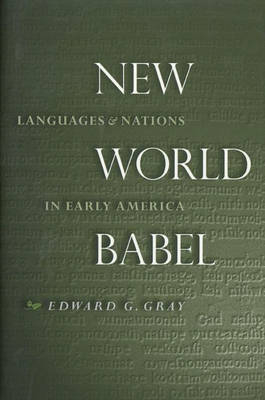
New World Babel
Languages and Nations in Early America
Seiten
1999
Princeton University Press (Verlag)
978-0-691-01705-1 (ISBN)
Princeton University Press (Verlag)
978-0-691-01705-1 (ISBN)
- Titel ist leider vergriffen;
keine Neuauflage - Artikel merken
This text presents a cultural and intellectual history of the languages spoken by the native peoples of North America from the earliest era of European conquest through to the beginning of the 19th century. It focuses on different aspects of the Euro-American response to indigenous languages.
This text presents a cultural and intellectual history of the languages spoken by the native peoples of North America from the earliest era of European conquest through the beginning of the 19th century. It focuses on different aspects of the Euro-American response to indigenous languages. By focusing on different aspects of the Euro-American response to indigenous speech, the author illuminates the ways in which Europeans' changing understanding of "language" shaped their relations with Native Americans. The work brings to light early America as a place of enormous linguistic diversity, with acute social and cultural problems associated with multilingualism. Beginning with the 16th and 17th centuries, the author shows that European explorers and colonists generally regarded American-Indian languages as a divine endowment that bore only a superficial relationship to the distinct cultures of speakers. He demonstrates how, during the 18th century, this perception gave way to the notion that language was a human innovation, and reflected the apparent social and intellectual differences of the worlds people.
This text presents a cultural and intellectual history of the languages spoken by the native peoples of North America from the earliest era of European conquest through the beginning of the 19th century. It focuses on different aspects of the Euro-American response to indigenous languages. By focusing on different aspects of the Euro-American response to indigenous speech, the author illuminates the ways in which Europeans' changing understanding of "language" shaped their relations with Native Americans. The work brings to light early America as a place of enormous linguistic diversity, with acute social and cultural problems associated with multilingualism. Beginning with the 16th and 17th centuries, the author shows that European explorers and colonists generally regarded American-Indian languages as a divine endowment that bore only a superficial relationship to the distinct cultures of speakers. He demonstrates how, during the 18th century, this perception gave way to the notion that language was a human innovation, and reflected the apparent social and intellectual differences of the worlds people.
| Erscheint lt. Verlag | 4.4.1999 |
|---|---|
| Reihe/Serie | Princeton Legacy Library |
| Zusatzinfo | 1 Maps |
| Verlagsort | New Jersey |
| Sprache | englisch |
| Maße | 197 x 254 mm |
| Gewicht | 454 g |
| Themenwelt | Geschichte ► Allgemeine Geschichte ► Neuzeit (bis 1918) |
| Geisteswissenschaften ► Geschichte ► Regional- / Ländergeschichte | |
| Geisteswissenschaften ► Sprach- / Literaturwissenschaft ► Sprachwissenschaft | |
| ISBN-10 | 0-691-01705-0 / 0691017050 |
| ISBN-13 | 978-0-691-01705-1 / 9780691017051 |
| Zustand | Neuware |
| Informationen gemäß Produktsicherheitsverordnung (GPSR) | |
| Haben Sie eine Frage zum Produkt? |
Mehr entdecken
aus dem Bereich



aus dem Bereich
Geschichte einer wilden Handlung
Buch | Hardcover (2024)
C.H.Beck (Verlag)
CHF 47,60


