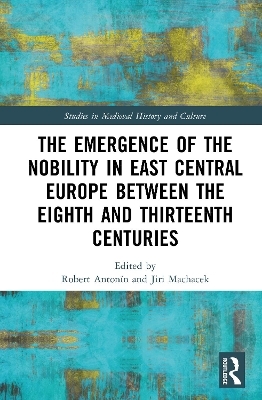
The Emergence of the Nobility in East Central Europe between the Eighth and Thirteenth Centuries
Routledge (Verlag)
978-1-032-94877-5 (ISBN)
The Emergence of the Nobility in East Central Europe between the Eighth and Thirteenth Centuries explores the formation and evolution of medieval elites in the frontier and peripheral regions of the Frankish/East Frankish Empire and East Central Europe between the eighth and thirteenth centuries. It addresses the dynamics of elite emergence during a transformative era marked by the interaction of established centres and developing borderlands. By focusing on regions such as Saxony, Poland, the Baltic, Bavaria, Carinthia, the Czech lands, Great Moravia, Hungary, and Croatia, the book offers a geographically broad perspective on the mechanisms of power and social hierarchy in early and high medieval Europe.
This book presents the results of comparative research into how elite status was constructed and legitimised, investigating whether this occurred through centralised imposition or organic processes of alliance-building, gift exchange and negotiation. It draws on Pierre Bourdieu’s Theory of Practice to analyse the economic, cultural, social and symbolic capital that defined elite status. The volume also considers the influences of indigenous development versus cultural transfer in shaping elite identities and practices. Each contribution offers a case study or regional focus, collectively illustrating both shared patterns and local specificities in elite transformation across centuries.
Targeted at scholars and students of medieval archaeology and history, this interdisciplinary work is equally relevant to researchers interested in social structures, cultural exchange and political power in premodern Europe. Its synthesis of theory, comparative methodology and empirical data makes it a valuable resource for both academic study and future research on elite formation in medieval frontier societies.
Robert Antonín is a professor of medieval history at the Department of History of the Faculty of Arts, the University of Ostrava (Czech Republic), where he has also been the dean since 2018. His long-term research interests focus on the issues of political, social, economic and cultural development of Central Europe during High Middle Ages and on the topics related to the limits of interpretation of (not only) medieval historiography. He is the author of several monographs, including The Ideal Ruler in Medieval Bohemia (2017); numerous research articles on medieval history and the main editor of the collective monograph The Fourth Lateran Council and the Czech Lands in 13th and 14th Centuries (2020). Jiří Macháček is a professor at Masaryk University in Brno, Czech Republic. He specialises in medieval archaeology, archaeological methods and computer applications in archaeology. His work has been published in international journals such as the Journal of Archaeological Science, the Journal of World Prehistory, Medieval Archaeology, and the Praehistorische Zeitschrift, as well as by publishing houses including Brill, Leiden-Boston; Habelt, Bonn; and BAR Publishing, Oxford. He studied archaeology at universities in Brno, Bamberg and Vienna. He has been a visiting professor at the University of Bamberg and a fellow of the Alexander von Humboldt Foundation in Frankfurt am Main and Göttingen.
Introduction
Chapter 1
From Kinship to Nobility: The Emergence of the Elite in Early Medieval Croatia
Ante Alajberg
Chapter 2
Governance and Social Structures in the Early Medieval Eastern Alpine Region
Stefan Eichert and Nina Richards
Chapter 3
Transforming the Might of the Mighty in Northeast Bavaria in the Early and High Middle Ages
Jan Hasil
Chapter 4
The Formation of a New Type of Medieval Elite on the Eastern Frontier of the Frankish Empire: The Great Moravian Case from an Archaeological Perspective.
Jiří Macháček
Chapter 5
Great Moravian Nobility? From confusion of concepts to the search for continuity of early medieval elites
Robert Antonín
Chapter 6
From clan bosses to medieval nobility. Bohemia of the eighth–twelfth centuries and archaeological challenges
Ivo Štefan
Chapter 7
The Elites of tenth to twelfth-century Bohemia (The perspective of a historian)
David Kalhous
Chapter 8
The development of elites in Polish lands between the eighth and eleventh centuries
Aleksandra Pankiewicz
Chapter 9
Dynamics of diversification. Medieval elites on the territory of the first Polish state (Second half of the tenth–fifteenth century)
Przemysław Wiszewski
Chapter 10
The Elites of the Northwestern Slavs in the Early Middle Ages
Felix Biermann
Chapter 11
The development of medieval elites in the territory of Romania
Cosmin Popa-Gorjanu
Chapter 12
Emerging elite in the early Lithuanian state: from debates about origin to the search for sources of power
Nerijus Babinskas
Chapter 13
Continuity or Significant Shift? The Evolution of Ruling Elites in the Early Grand Duchy of Lithuania
Yanina Ryier
Conclusions: The emergence of the medieval nobility in East Central Europe and the sources of their power: cultural, symbolic, economic and social capital
| Erscheinungsdatum | 31.10.2025 |
|---|---|
| Reihe/Serie | Studies in Medieval History and Culture |
| Zusatzinfo | 19 Halftones, black and white; 19 Illustrations, black and white |
| Verlagsort | London |
| Sprache | englisch |
| Maße | 156 x 234 mm |
| Gewicht | 800 g |
| Themenwelt | Geschichte ► Allgemeine Geschichte ► Mittelalter |
| Geisteswissenschaften ► Geschichte ► Regional- / Ländergeschichte | |
| ISBN-10 | 1-032-94877-9 / 1032948779 |
| ISBN-13 | 978-1-032-94877-5 / 9781032948775 |
| Zustand | Neuware |
| Informationen gemäß Produktsicherheitsverordnung (GPSR) | |
| Haben Sie eine Frage zum Produkt? |
aus dem Bereich