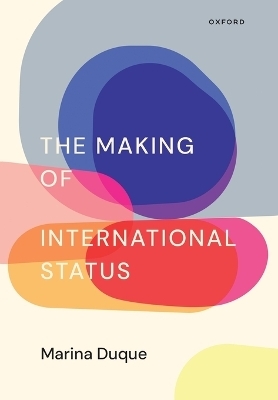
The Making of International Status
Oxford University Press Inc (Verlag)
978-0-19-780196-3 (ISBN)
Scholars have traditionally assumed that status is a function of state attributes, particularly material capabilities like military and economic resources. Drawing on an interdisciplinary body of research, Marina Duque argues instead that status depends on patterns of state relations, rather than directly on state properties. To understand how international hierarchies of status are established, Duque traces their roots back to key transformations that magnified global inequality in the nineteenth century, a foundational period for the contemporary international order. As Europeans turned to imperialism, status distinctions legitimized inequality by drawing a boundary between "civilized" Europeans entitled to sovereignty and "uncivilized" non-Europeans unable to govern themselves. Once established, status distinctions reinforced inequality via cumulative advantage mechanisms: the higher standing a state enjoys, the more it attracts additional recognition. It is no coincidence that, to this day, status evaluations rely on governance ideals associated with the West. By analyzing the global network of diplomatic relations since the early nineteenth century, The Making of International Status develops a theory of status that situates the concept at the heart of contemporary international politics.
Marina Duque is a Lecturer in International Politics at Newcastle University. Previously, she taught at University College London and Florida State University, held postdoctoral fellowships at Princeton University and the Harvard Kennedy School, was the Managing Editor of Security Studies, and earned a Ph.D. in Political Science from The Ohio State University. Before entering academia, Duque worked as a career diplomat in Brazil when the country, like other emerging powers, strove to be recognized as an equal by the great powers. Drawing from this experience, her award-winning research explores international status by integrating interdisciplinary knowledge and using a multi-method approach.
1: How Do Countries Achieve Status?
2: A Network Theory of Status
3: A Relational Empirical Strategy
4: A Network Model of Diplomatic Status
5: The Core-Periphery Structure of the Diplomatic Network
6: Do Nuclear Weapons Confer Status?
7: Conclusion
Appendix
| Erscheinungsdatum | 06.12.2025 |
|---|---|
| Verlagsort | New York |
| Sprache | englisch |
| Maße | 156 x 234 mm |
| Gewicht | 522 g |
| Themenwelt | Geisteswissenschaften ► Philosophie |
| Sozialwissenschaften ► Politik / Verwaltung ► Europäische / Internationale Politik | |
| Sozialwissenschaften ► Politik / Verwaltung ► Politische Theorie | |
| ISBN-10 | 0-19-780196-X / 019780196X |
| ISBN-13 | 978-0-19-780196-3 / 9780197801963 |
| Zustand | Neuware |
| Informationen gemäß Produktsicherheitsverordnung (GPSR) | |
| Haben Sie eine Frage zum Produkt? |
aus dem Bereich