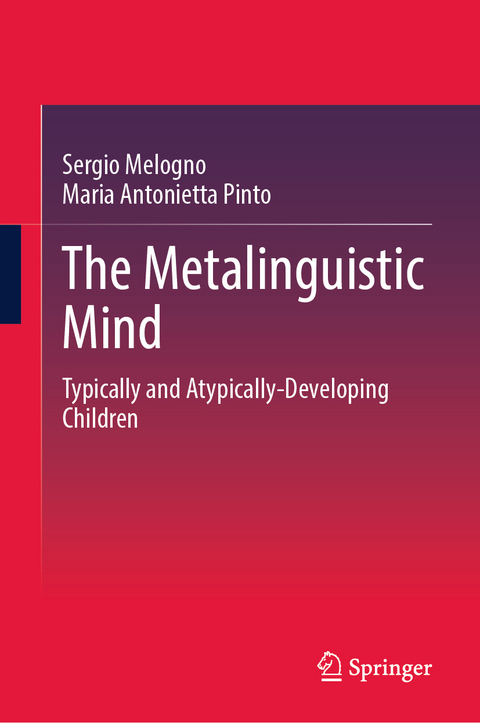
The Metalinguistic Mind
Springer International Publishing (Verlag)
978-3-032-03023-8 (ISBN)
- Noch nicht erschienen - erscheint am 24.01.2026
- Versandkostenfrei
- Auch auf Rechnung
- Artikel merken
This book is about metalinguistic awareness (MLA), a broad area whose relevance has been acknowledged by several disciplines. The authors treat the topic from three main perspectives: developmental, methodological, and clinical. They begin by outlining the main historical developmental models and the way metalinguistic development is intertwined with such factors as literacy, bilingualism, executive function, and Theory of Mind. They then proceed to consider a series of methodological issues related to the assessment of MLA based on the possible variation of research objectives, tools, and designs, and finally face the metalinguistic challenges experienced by children and adults with neurodevelopmental disorders. Throughout the three sections of the book that develop these perspectives, a common thread can be recognized, which justifies the title: The metalinguistic mind . By this expression, the authors mean a way of reasoning on form/content relationships that applies transversally to phonological, morphological, syntactical, semantic, and pragmatic aspects of language.
This process begins at preschool age with active forms of curiosity about forms and meanings of words, using explicit language to comment on language, often revealing an awareness of conflicts between linguistic forms, and showing the need to find consistent solutions to reconcile these linguistic conflicts. This argumentative attitude goes much beyond the application of linguistic rules or the use of metalanguage, and may manifest itself even when unrequested. The authors insist on the conflictual aspect inherent in all metalinguistic tasks. Accordingly, metalinguistic assessment should point to the consistency with which these conflicts are reconciled on explicit grounds. This is where metalinguistic development and methodology can converge, on the condition that both researchers and examiners bring to light those capabilities to argue about structural aspects of language. Lastly, even in the clinical conditions described by the authors, despite evident language difficulties, recent treatments have shown very interesting possibilities to enhance basic linguistic abilities and promote further improvem
Sergio MELOGNO
Prof. Sergio Melogno graduated in Psychology from the Faculty of Psychology - Sapienza, University of Rome, Italy, and in Neuropsychological rehabilitation from the Faculty of Medicine - Sapienza University of Rome, Italy. He holds a PhD in Neuroscience from the Faculty of Medicine - Sapienza University of Rome, Italy, and he currently teaches cognitive developmental neuroscience, developmental neuropsychology, psychology of neurodevelopmental disorders, psychology of cognitive development and social cognition. He is also responsible for the laboratory of developmental neuropsychology in the Unicusano Telematic University of Rome.
Maria Antonietta PINTO
Ass. Prof. Maria Antonietta Pinto graduated in Philosphy from the Faculty of Letters and Philosophy - Sapienza University of Rome, Italy, and in Psychology from the Faculty of Psychology and Education Sciences University of Geneva, Switzerland. She has taught psycholinguistics, developmental psychology, and educational psychology at the Faculty of Medicine and Psychology - Sapienza University of Rome, and has published extensively on cognitive and language development, with a special focus on metalinguistic development, from preschool to adult age, for which she has created three tests that have been translated into various languages and widely used in international research on bilingualism and language learning.
Part I. WHAT IS A METALINGUISTIC MIND?.- 1. Some terminological issues.- 2.One metalinguistic mind or several metalinguistic skills?.- 3.Explaining the emergence of the metalinguistic mind in typically-developing children.- 4. Conceptual issues related to the assessment of the metalinguistic mind.- Part II. TYPICAL AND ATYPICAL DEVELOPMENT: WHAT DIFFERS ?.- 5.What differs in the emergence of the metalinguistic mind in atypically-developing children.- 6.Short review of a typical cases.- 7.Assessment and treatment: cases from clinical experience.- 8.The metalinguistic mind: what differs in its social implications in typical and a typical development.- Part III. SOME TOOLS TO ASSESS THE DEVELOPMENT OF THE METALINGUISTIC MIND.- 9.The literature on the existing metalinguistic tools.- 10.Tools for the transition from preschool to primary school.- 11.Tools for the transition from the end of primary to Junior High school.- 12.Tools for the transition to the High school stage.- BM.
| Erscheinungsdatum | 29.11.2025 |
|---|---|
| Zusatzinfo | IX, 204 p. 3 illus. |
| Verlagsort | Cham |
| Sprache | englisch |
| Maße | 155 x 235 mm |
| Themenwelt | Geisteswissenschaften ► Psychologie ► Entwicklungspsychologie |
| Schlagworte | Basic language abilities versus metalinguistic reasoning • Construct of metalinguistic awareness • Development of the metalinguistic mind • Metalinguistic abilities • Metalinguistic profiles of typically-developing children |
| ISBN-10 | 3-032-03023-4 / 3032030234 |
| ISBN-13 | 978-3-032-03023-8 / 9783032030238 |
| Zustand | Neuware |
| Informationen gemäß Produktsicherheitsverordnung (GPSR) | |
| Haben Sie eine Frage zum Produkt? |
aus dem Bereich