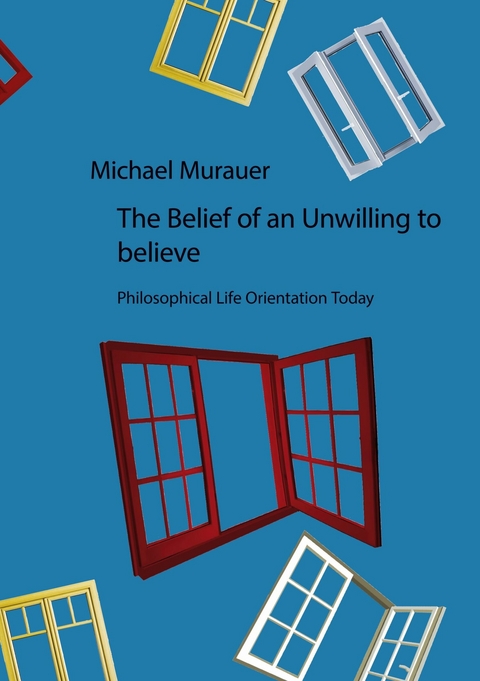
The Belief of an Unwilling to believe (eBook)
606 Seiten
Books on Demand (Verlag)
9783819291029 (ISBN)
Michael Murauer, geboren 1955 in München, studierte Philosophie und Medizin in Regensburg und München. Heute lebt und arbeitet er als Arzt in Deggendorf/Niederbayern. Neben den körperlichen Leiden seiner Patienten bedrückte ihn zusehends der zu geringe Stellenwert einer philosophischen Lebensorientierung in unserer Gesellschaft. Als gut verträgliches und unterhaltsames Heilmittel entdeckte er das literarische und bildhafte Philosophieren. Diese Tradition erwies sich als so faszinierend, daß dem Autor die Motive für sein Buch "Gott und die chinesische Teekanne" zufielen wie dem armen kleinen Mädchen die Sterntaler. Ein Kommentarband hierzu ist 2008 sowie in zweiter, erweiterter Auflage 2012 bei BoD herausgekommen - siehe unten. Das philosophische Hauptwerk "Der Glaube eines Glaubensunwilligen. Philosophische Lebensorientierung heute" ist in zweiter völlig neu bearbeiteter und erweiterter Auflage im Juni 2011 bei BoD erschienen.
Introduction
The future belongs to philosophy, not to religions or secular ideologies
"We have learned nothing from historic experience if we have not learned that man lives by more than his applied intelligence alone."1
Lewis Mumford
Today religion is socially acceptable again, even among intellectuals. Criticism of religion in the Enlightenment tradition is denounced as out-dated. After criticising religion, philosophy has criticised itself. From logical empiricism and the philosophy of Wittgenstein to analytic philosophy of language it tried to ban philosophy of life from its sphere. This movement reached its peak from the sixties to the eighties of the 20th century. After that the short-lived period of postmodernism chose all kinds of feuilletonistic frills as philosophical topics. No wonder that thereafter the interests in question of ethics, morals and philosophy of life has increased again.
But lo and behold: society has got philosophy’s self-criticism down the wrong throat. Philosophy is widely considered as a museum-like or ivory tower enterprise that leads to more or less arbitrary results, not convincingly committing anybody to anything. This kind of philosophy is allowed to participate to some extent in the market of life and business counsellors and coaches. But when it comes to serious problems of personal life and society it does not suggest itself to seek advice from philosophy and philosophers. Many people still prefer to turn to a priest, a bishop, possibly his boss in Rome, or the friendly, seemingly unmissionary Dalai Lama, or whoever the respective religious denomination recommends.
Meanwhile, philosophers write lots of intelligent articles and books in which they weigh up values on the basis of rational consideration and try to provide decision-making aids for important personal and social problems. And how many people are interested? Not too many. No wonder, as philosophers have dismantled themselves beforehand.
The term "existential deficit" of philosophy was originally coined to reproach philosophy for its lack of engagement with existential questions. (Rahner2) In the meantime, it rather describes the lack of social receptiveness and social effects of philosophical thought and philosophical results in contemporary society. Philosophy presents itself far to humbly to be perceived adequately in a noisy and multimedia excited society.
This book stands in the tradition of Enlightenment thought. This is the basis for the concepts and demands on the task of philosophy in our time that will be discussed in the following.
There is no acceptable alternative to a rational debate on the issues of philosophy of life and morals. Absolute truth will not be found by such a debate, but reasoned value-based choices. This procedure is far preferable to choices based on untenable religious and ideological pretensions of truth or even dogmas.
Philosophers should definitely claim far more social participation and attention. They are the right people to shape future discussions on adequate life orientation and guidance and not the theologians, clergymen, gurus and ideologues with their dogmatic doctrines of faith which have long ago shown to be untenable by the standards of critical reason.
Only a life orientation guided by philosophical thinking is adequate for modern human beings. The indifferentist humbleness which often characterises the appearance of today’s philosophy in social debate is therefore completely misplaced. It means to draw a wrong consequence from the justified relativisation of absolute claims to truth and certainty.
It must be made clear again that scientific and especially philosophical thinking is in sharp contrast to religious life orientation and religious world views, that it leads – if it is keeping up with modern times –inevitably to a naturalistic world view and a naturalistic concept of humans, and that it is definitely willing and able to provide support and orientation concerning the crucial questions of life based on rational weighing of values and moral choices resulting therefrom. It also is a commitment for philosophers to stand up against political procedures which still impose on all members of society values and moral choices that are convincing only from a religious position (concerning, for example, bioethical issues). (1)
Lessons in philosophy and critical evaluation of philosophies of life must become a compulsory subject at school. Religious instruction, however, should be a private matter of religious denominations. Each bigger university should be ambitious to have minimum one philosopher or philosophically interested and renowned scholar in its ranks whose public presence and impact is a match for religious leaders, at least those of regional importance.
A secular philosopher may well have personal respect and personal sympathy for people with a religious life orientation and may feel closer to some of them than to unthinking areligious people. But this should not lead to covering up the fundamental differences in the way of thinking and their consequences for the shaping and guidance of life. Religions and ideologies are relics from former stages of human history of ideas – albeit regrettably still very much alive. Up-to-date philosophy is applied critical reason. It is not willing to accept assumptions without good reasons and is therefore inevitably opposed to religions and ideologies. Where these have been and are confronted with a process of enlightenment, present themselves in a moderate way, and respect the attitude of ideological tolerance, peaceful coexistence is possible. But even then, the fundamental conflict should not be disguised or talked to death. Putting it from the psychological point of view contributes to clarification: Religious people think that the areligious lack an important dimension of life. Areligious people think that the world view of the religious is illusionary to a considerable extent. By tolerance and affection, it is possible to build all kind of personal bridges across this rift, but the rift will stay.
Criticism of religion remains to be a way to secure an adequate position for philosophy in social debate. This way has been taken again with strong commitment in our time as well. (2) Often enough this is not really intellectually thrilling anymore, but it is absolutely necessary in the interest of our future. On the one hand, we need a sober and self-critical atheism that accepts religion as a cultural and social phenomenon. Without emotional ties to religion, it is able to acknowledge the positive aspects of this phenomenon and to cooperate with religious people and with representatives of religious denominations on certain social tasks without reservation. On the other hand, we still need a somewhat aggressive atheism, at times ironical to the point of sarcasm, that is mocking religious thinking without crossing the border of malice and bad taste. It has to make perfectly clear how astonishing, and even downright consternating, it is that in the twenty-first century the old religious ideas are still believed in and regarded as an adequate life orientation to such an extent. The provocative question »How can one still believe such things today?« may not always make appear the questioner likeable. But it is no fusty, epistemologically outdated, loudmouthed nineteen century atheism. This question may have an emotional enlightening effect that goes beyond dry rational argument.
Particularly with regard to radical but also already conservative traditionally interpreted Islam, the necessary, wise politics of prudent de-escalation must not be confused with a misguided appeasement policy that accepts an erosion of human and civil rights by rotten compromises and may therefore be used by other religions as well to stabilise or re-expand their claim to social and political power. (3) A religion which – despite many reasonable individual voices – has so far proved incapable to regard the contempt for life expressing itself in suicide attacks committed in its name en masse on an international level as its very own continuous moral and educational problem deserves a high degree of distrust for this reason alone, not to mention other problems with current mainstream Islam, like its poor record concerning the rights of women, homosexuals, apostates, or critics of religion. Being shocked by Islamic terrorism we should not lose sight of the fact that this is only the most extreme phenomenon of a widespread intolerance in the Islamic world that is also embedded in many ways in its legal and political systems. Historical assignments of guilt must not be accepted as an excuse for this. The debate and the struggle with an Islam that is dominated by an intolerant interpretation will continue for decades to come and must be conducted at all levels, from the education system to, unfortunately, military force.
However, we must not view religions too pessimistically. As human-made systems of interpretation and attribution of meaning they are open to reinterpretation by humans. All major religions contain sufficient starting points for a relatively humane reinterpretation under the influence of Enlightenment thinking, as has already been achieved to a considerable extent for Christianity, at least in modern pluralistic societies.
The scope of rational criticism of religion is limited. Therefore, it is important to find ways to satisfy the psychosocial needs underlying religions in a better way than they do. Hence the maxim expressed by the physicist Frank Wilczek: »So to me the important...
| Erscheint lt. Verlag | 10.7.2025 |
|---|---|
| Sprache | englisch |
| Themenwelt | Geisteswissenschaften |
| ISBN-13 | 9783819291029 / 9783819291029 |
| Informationen gemäß Produktsicherheitsverordnung (GPSR) | |
| Haben Sie eine Frage zum Produkt? |
 EPUB (Wasserzeichen)
Größe: 1,9 MB
DRM: Digitales Wasserzeichen
Dieses eBook enthält ein digitales Wasserzeichen und ist damit für Sie personalisiert. Bei einer missbräuchlichen Weitergabe des eBooks an Dritte ist eine Rückverfolgung an die Quelle möglich.
Dateiformat: EPUB (Electronic Publication)
EPUB ist ein offener Standard für eBooks und eignet sich besonders zur Darstellung von Belletristik und Sachbüchern. Der Fließtext wird dynamisch an die Display- und Schriftgröße angepasst. Auch für mobile Lesegeräte ist EPUB daher gut geeignet.
Systemvoraussetzungen:
PC/Mac: Mit einem PC oder Mac können Sie dieses eBook lesen. Sie benötigen dafür die kostenlose Software Adobe Digital Editions.
eReader: Dieses eBook kann mit (fast) allen eBook-Readern gelesen werden. Mit dem amazon-Kindle ist es aber nicht kompatibel.
Smartphone/Tablet: Egal ob Apple oder Android, dieses eBook können Sie lesen. Sie benötigen dafür eine kostenlose App.
Geräteliste und zusätzliche Hinweise
Buying eBooks from abroad
For tax law reasons we can sell eBooks just within Germany and Switzerland. Regrettably we cannot fulfill eBook-orders from other countries.
aus dem Bereich