


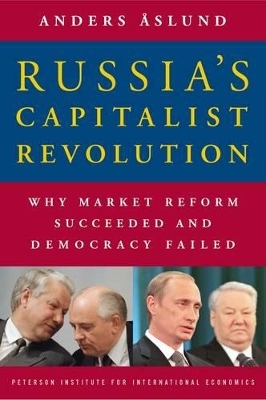
Russia`s Capitalist Revolution – Why Market Reform Succeeded and Democracy Failed
Seiten
2007
The Peterson Institute for International Economics (Verlag)
978-0-88132-409-9 (ISBN)
The Peterson Institute for International Economics (Verlag)
978-0-88132-409-9 (ISBN)
The Russian revolution, collapse of the Soviet Union, and Russia's ensuing transformation belong to the greatest dramas of our time. This book focuses on the transformation from Soviet Russia to Russia as a market economy, and explores why the country has failed to transform into a democracy. It also gives an overview of Russia's economic change.
The Russian revolution, collapse of the Soviet Union, and Russia's ensuing transformation belong to the greatest dramas of our time. Revolutions are usually messy and emotional affairs, challenging much of the conventional wisdom, and Russia's experience is no exception. This book focuses on the transformation from Soviet Russia to Russia as a market economy, and explores why the country has failed to transform into a democracy. It examines the period from 1985, when Mikhail Gorbachev became the Soviet Union's Secretary General of the Communist Party, to the present Russia of Vladimir Putin. Aslund provides a broad overview of Russia's economic change, highlighting the most important issues and their subsequent resolutions, including Russia's inability to sort out the ruble zone during its revolution, several failed coups, and the financial crash of August 1998.
The Russian revolution, collapse of the Soviet Union, and Russia's ensuing transformation belong to the greatest dramas of our time. Revolutions are usually messy and emotional affairs, challenging much of the conventional wisdom, and Russia's experience is no exception. This book focuses on the transformation from Soviet Russia to Russia as a market economy, and explores why the country has failed to transform into a democracy. It examines the period from 1985, when Mikhail Gorbachev became the Soviet Union's Secretary General of the Communist Party, to the present Russia of Vladimir Putin. Aslund provides a broad overview of Russia's economic change, highlighting the most important issues and their subsequent resolutions, including Russia's inability to sort out the ruble zone during its revolution, several failed coups, and the financial crash of August 1998.
Anders Aslund was a senior fellow at the Peterson Institute for International Economics from 2006 to May 2015. He examined the economic policies of Russia, Ukraine, and Eastern Europe, as well as the broader implications of economic transition. Aslund served as an economic adviser to the governments of Russia in 1991-94 and Ukraine in 1994-97.
Introduction: A Great Transformation; 1: Perestroika: The Great Awakening, 1985-87; 2: The Collapse, 1988-91; 3: Revolution, 1991-93; 4: Rise and Fall of the Red Directors, 1993-95; 5: The Oligarchy, 1996-98; 6: Post-Revolutionary Stabilization, 1999-2003; 7: Authoritarianism and Recentralization, 2004-07; 8: Conclusions and Policy Lessons.
| Verlagsort | Washington |
|---|---|
| Sprache | englisch |
| Maße | 151 x 228 mm |
| Gewicht | 582 g |
| Themenwelt | Geschichte ► Allgemeine Geschichte ► Neuzeit (bis 1918) |
| Geisteswissenschaften ► Geschichte ► Regional- / Ländergeschichte | |
| Sozialwissenschaften ► Politik / Verwaltung | |
| Wirtschaft ► Volkswirtschaftslehre ► Makroökonomie | |
| ISBN-10 | 0-88132-409-4 / 0881324094 |
| ISBN-13 | 978-0-88132-409-9 / 9780881324099 |
| Zustand | Neuware |
| Informationen gemäß Produktsicherheitsverordnung (GPSR) | |
| Haben Sie eine Frage zum Produkt? |
Mehr entdecken
aus dem Bereich

aus dem Bereich
Geschichte einer wilden Handlung
Buch | Hardcover (2024)
C.H.Beck (Verlag)
CHF 47,60


