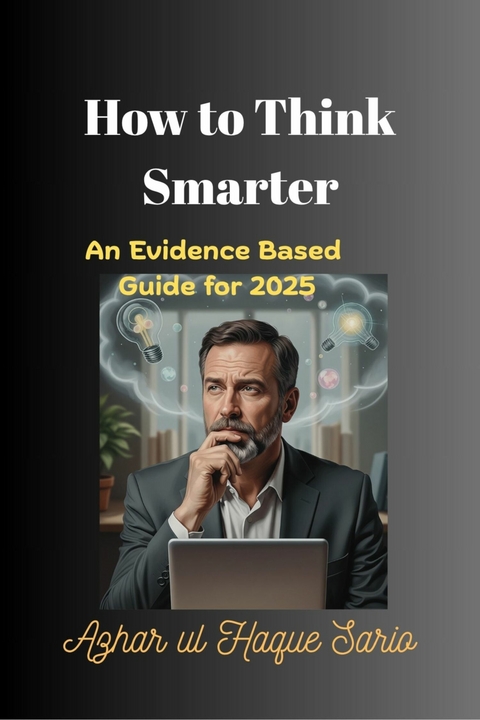
How to Think Smarter (eBook)
202 Seiten
Azhar Sario Hungary (Verlag)
978-3-384-64951-5 (ISBN)
Stop guessing about how to think smarter and start using what science knows. Ever feel like you're not reaching your full mental potential? This book is your guide to the incredible, adaptable machine that is your brain. We'll start by exploring the very blueprint of intelligence, looking at how different parts of your brain work together like a super-efficient team. You'll discover the real science behind how your mind can physically change and grow-a concept called neuroplasticity-and how a 'growth mindset' is the key to unlocking this power. We then dive into the foundational pillars of brain health that you can control right now: optimizing your sleep for memory and creativity, understanding the powerful connection between your gut and your mind, and eating for peak cognitive performance.
We live in a world of constant pings and notifications, so we'll tackle the art of mastering your attention, giving you concrete strategies to fight distraction and find deep focus. You'll learn to boost your creativity by understanding how your brain generates new ideas and how to enter the highly productive 'flow state.' The book then moves into the future, exploring cutting-edge tools like non-invasive brain stimulation and the incredible potential of a true partnership between human and artificial intelligence. But with great power comes great responsibility. We'll navigate the complex ethical questions of cognitive enhancement, from the risk of 'cognitive debt' to the biases hidden in AI. Finally, you'll be equipped with advanced mental frameworks, learning to think like a Bayesian statistician to make better decisions under uncertainty and mastering metacognition-the art of thinking about your own thinking. This isn't just about knowing more; it's about fundamentally upgrading your cognitive operating system for the world of 2025 and beyond.
This book provides a comprehensive, evidence-based roadmap to enhancing your cognitive abilities. It demystifies the neuroscience of intelligence, grounding abstract concepts in tangible brain functions. You'll learn about the Parieto-Frontal Integration Theory (P-FIT) and the roles of brain volume and white matter. The guide covers the profound impact of genetics, sleep, diet, and circadian rhythms on your mind. It offers practical techniques to improve focus, creativity, and mental flexibility. We explore cutting-edge topics like direct brain augmentation, human-AI symbiosis, and the ethics of enhancement. Finally, it equips you with advanced mental models like Bayesian reasoning and metacognition.
What sets this book apart is its rigorous, up-to-date scientific foundation, specifically tailored for 2025. While other books offer vague advice or focus on a single aspect of cognitive enhancement, this guide provides a holistic, integrated system. It bridges the gap between dense academic research and actionable, everyday strategies. It doesn't just tell you what to do; it explains the neurological and psychological why behind each technique. By weaving together the latest from neuroscience, psychology, and even artificial intelligence, it offers a uniquely comprehensive and forward-looking toolkit for anyone serious about upgrading their thinking.
Disclaimer: The author is not affiliated with, sponsored by, or endorsed by the NIH BRAIN Initiative or any other institution or organization mentioned. All trademarks and registered trademarks are the property of their respective owners. This work is an independent production, and the use of any trade names or trademarks is for identification and reference purposes only under the principle of nominative fair use.
PART II: Tools for Cognitive Augmentation
Direct Brain Augmentation: The Future of Neurostimulation
Unlocking the Brain's Potential: A Journey into the World of Non-Invasive Brain Stimulation
The human brain, a universe of thought and feeling, has long been a subject of fascination and mystery. But what if we could gently guide its intricate dance of neurons without surgery or medication? This is the promise of Non-Invasive Brain Stimulation (NIBS), a revolutionary field that is redefining our understanding of the mind. Forget the cold, sterile imagery of science fiction; NIBS is about a subtle, collaborative conversation with the brain, a way to help it heal, learn, and grow. Let's embark on a journey to explore these incredible tools and the new frontiers they are opening for human potential.
Transcranial Direct Current Stimulation (tDCS): The Brain's Gentle Whisper
Imagine your brain as a garden. Some areas may be a little sluggish, like flowers that need a bit more sun to thrive. Transcranial Direct Current Stimulation, or tDCS, is like a gentle, steady beam of sunlight, encouraging growth without forcing it. It uses a very mild electrical current, similar to that of a small battery, to subtly nudge brain cells, making them more or less receptive to firing.
A Deeper Connection:
Think of a neuron as a musician waiting for their cue. Anodal stimulation, with its positive charge, is like the conductor giving an encouraging nod, making the musician more alert and ready to play. This can be a game-changer for someone recovering from a stroke, helping to awaken dormant pathways and rediscover lost movement. On the other hand, cathodal stimulation is like a gentle hand on the shoulder, calming an over-excited section of the orchestra. This could offer solace to those battling chronic pain, quieting the relentless symphony of discomfort.
The true magic of tDCS lies in its ability to foster lasting change. Much like practicing a musical instrument strengthens the neural connections for that skill, repeated tDCS sessions can help remodel the brain's landscape. It’s a partnership with the brain's own ability to learn and adapt, a process called synaptic plasticity. This is why tDCS is often paired with therapy or training, creating a fertile ground for new growth and healing.
The Human Element:
For someone struggling with the fog of depression, tDCS can feel like the first glimmer of dawn after a long night. It's not a magic wand, but a gentle encouragement for the brain to find its own way back to a brighter state. The simplicity and portability of tDCS devices also offer a sense of empowerment, allowing individuals to take an active role in their own well-being. While its broad touch means it's not a tool for microscopic precision, its gentle influence holds immense promise for a wide range of conditions, offering a beacon of hope for a more balanced mind.
Transcranial Alternating Current Stimulation (tACS): Tuning into the Brain's Rhythm
Our brains are constantly humming with electrical rhythms, or brainwaves, each one a signature of our mental state – from the calm waves of relaxation to the energetic buzz of intense focus. Transcranial Alternating Current Stimulation (tACS) is like a master musician who can listen to the brain's symphony and gently guide it back into harmony.
A Rhythmic Dance:
Instead of a steady current, tACS uses an oscillating one, a rhythmic pulse that seeks to sync up with the brain's natural frequencies. Imagine a group of dancers who have fallen out of step. tACS is like a steady, guiding beat that helps them find their collective rhythm again. This "entrainment" can be incredibly powerful. For someone with Parkinson's, where movement-related brain rhythms can be disrupted, tACS could potentially help restore a more fluid and coordinated internal tempo.
The beauty of tACS lies in its nuanced approach. By adjusting the frequency of the current, researchers can target specific brainwave patterns associated with different cognitive functions. It's a dialogue with the brain on its own terms, a way to enhance its natural abilities. The brief flashes of light, or phosphenes, that some people experience during tACS are a gentle reminder of the intricate connection between electricity and our sensory world.
The Uncharted Territory:
While the exact mechanisms of tACS are still being explored, it represents a more sophisticated way of interacting with the brain. It's a testament to the idea that sometimes, the most effective change comes not from a forceful push, but from a gentle, rhythmic dance of entrainment. As we continue to decode the language of brainwaves, tACS holds the key to unlocking new treatments for conditions rooted in rhythmic disruptions, offering a future where we can fine-tune our own mental states.
Transcranial Magnetic Stimulation (TMS): The Precision of a Magnetic Touch
If tDCS is a gentle whisper, Transcranial Magnetic Stimulation (TMS) is a clear, focused instruction. It uses a powerful, rapidly changing magnetic field to create a brief electrical current in a specific area of the brain. Think of it as a magnetic key that can unlock a very particular door in the mind.
A Focused Intervention:
The precision of TMS is what makes it so revolutionary. It can target a small group of neurons with remarkable accuracy, making it a powerful tool for both research and therapy. For someone with treatment-resistant depression, where a specific brain circuit may be underactive, TMS can be like a personal trainer for the mind, repeatedly stimulating that area to bring it back online. The experience of sitting in a TMS chair, hearing the rhythmic clicks of the magnetic pulses, can be a profound one, a tangible sense of something shifting within.
The ability to temporarily and safely inhibit a brain region also makes TMS an invaluable tool for understanding ourselves. It allows us to ask fascinating questions: What happens to our ability to speak when the language center of our brain is briefly paused? How does our perception of the world change when we gently quiet the part of our brain that processes fear? TMS is a window into the intricate workings of the mind, a way to map its vast and complex landscape.
A New Lease on Life:
For many, TMS has been nothing short of life-changing. It offers hope where other treatments have failed, a non-invasive way to reclaim a life from the grips of mental illness. While the commitment to multiple sessions can be significant, the potential for lasting relief from conditions like OCD and migraines makes it a journey worth taking for many. TMS is a testament to the power of targeted, precise intervention, a magnetic touch that can reawaken the brain's own capacity for healing.
Transcranial Pulse Stimulation (TPS): The Promise of the Deep
Some of the brain's most crucial structures lie deep within, beyond the reach of many non-invasive techniques. This is where Transcranial Pulse Stimulation (TPS) comes in, a groundbreaking technology that uses focused ultrasound to reach these hidden depths. Think of it as a form of "acoustic sonar" for the brain, capable of sending gentle waves of energy to precise, deep locations.
Journey to the Brain's Core:
The ability of TPS to bypass the surface and target deep brain structures is a monumental leap forward. For conditions like Alzheimer's disease, where memory centers deep within the brain are affected, TPS offers a new and exciting avenue for treatment. The ultrasound pulses are thought to stimulate cell regeneration and improve blood flow, creating a more supportive environment for brain health.
Early studies showing improvements in memory and language in Alzheimer's patients are a powerful testament to the potential of this technology. It's a gentle yet profound intervention, a way to send a message of healing to the very core of the brain. The use of MRI guidance to personalize the treatment for each individual's unique brain anatomy adds an extra layer of precision and care.
The Future is Now:
As a newer technology, TPS is still on the frontier of neuroscience. But it represents a paradigm shift in how we think about brain stimulation. It's a reminder that there are still new and innovative ways to interact with the brain, to reach areas we once thought were inaccessible without invasive procedures. TPS is a beacon of hope for those with conditions affecting the deep structures of the brain, offering the promise of a future where we can heal the mind from the inside out.
The Symphony of the Mind
These remarkable NIBS technologies are more than just scientific tools; they are instruments in a grand symphony of brain health and discovery. Each one has its own unique voice, its own way of interacting with the intricate music of the mind. From the gentle whisper of tDCS to the rhythmic dance of tACS, the focused touch of TMS, and the deep resonance of TPS, we are learning to not only listen to the brain but also to gently guide it towards a more harmonious state. This is a journey of collaboration, of empowerment, and of profound hope, a future where we can all unlock the incredible potential that lies within our own minds.
The Neuro-Sculptor's Toolkit: Unlocking the Brain's Potential in...
| Erscheint lt. Verlag | 8.7.2025 |
|---|---|
| Sprache | englisch |
| Themenwelt | Geisteswissenschaften ► Psychologie |
| Schlagworte | brain health and nutrition • Cognitive Enhancement • Critical thinking skills • growth mindset • Human-AI Collaboration • Mastering focus • Neuroplasticity |
| ISBN-10 | 3-384-64951-6 / 3384649516 |
| ISBN-13 | 978-3-384-64951-5 / 9783384649515 |
| Informationen gemäß Produktsicherheitsverordnung (GPSR) | |
| Haben Sie eine Frage zum Produkt? |
 EPUB (Ohne DRM)
Digital Rights Management: ohne DRM
Dieses eBook enthält kein DRM oder Kopierschutz. Eine Weitergabe an Dritte ist jedoch rechtlich nicht zulässig, weil Sie beim Kauf nur die Rechte an der persönlichen Nutzung erwerben.
Dateiformat: EPUB (Electronic Publication)
EPUB ist ein offener Standard für eBooks und eignet sich besonders zur Darstellung von Belletristik und Sachbüchern. Der Fließtext wird dynamisch an die Display- und Schriftgröße angepasst. Auch für mobile Lesegeräte ist EPUB daher gut geeignet.
Systemvoraussetzungen:
PC/Mac: Mit einem PC oder Mac können Sie dieses eBook lesen. Sie benötigen dafür die kostenlose Software Adobe Digital Editions.
eReader: Dieses eBook kann mit (fast) allen eBook-Readern gelesen werden. Mit dem amazon-Kindle ist es aber nicht kompatibel.
Smartphone/Tablet: Egal ob Apple oder Android, dieses eBook können Sie lesen. Sie benötigen dafür eine kostenlose App.
Geräteliste und zusätzliche Hinweise
Buying eBooks from abroad
For tax law reasons we can sell eBooks just within Germany and Switzerland. Regrettably we cannot fulfill eBook-orders from other countries.
aus dem Bereich