


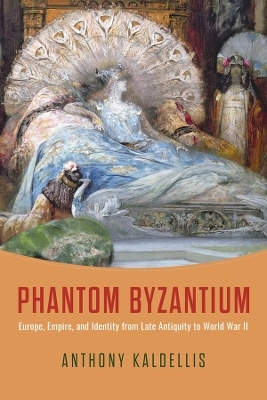
Phantom Byzantium
Europe, Empire, and Identity from Late Antiquity to World War II
Seiten
2026
University of Chicago Press (Verlag)
978-0-226-84713-9 (ISBN)
University of Chicago Press (Verlag)
978-0-226-84713-9 (ISBN)
- Noch nicht erschienen (ca. März 2026)
- Versandkostenfrei
- Auch auf Rechnung
- Artikel merken
How the West appropriated aspects of the eastern Roman empire while portraying it as inferior.
Unveiling the ideological foundations of Byzantine studies, Phantom Byzantium is a pioneering survey of western European perceptions of the eastern Roman empire (also known as Byzantium) spanning late antiquity to World War II. Through ten chronological chapters, Anthony Kaldellis makes the case that western Europe gradually formed its identity by adopting prestigious cultural elements from the eastern empire but simultaneously portraying the east as inferior. The West modeled its Roman imperial style on Constantinople while minimizing the latter as Greek rather than Roman; appropriated a host of Christian traditions from the east while casting the east as schismatic, heretical, or treacherous; and, during the Renaissance, used classical Hellenic philology from Greek scholars before marginalizing them as unworthy bearers of that tradition. This orientalizing impulse worked to buttress western exceptionalism and resulted in the fictitious construction of “Byzantium” as Europe’s evil doppelgänger, embodying the worst versions of traditions fundamental to European identity and casting the region as despotic, superstitious, and degenerate.
Explaining the creation, history, and functions of the ideological construct of Byzantium in the western imagination and European self-fashioning, this book has critical implications for contemporary views of European history.
Unveiling the ideological foundations of Byzantine studies, Phantom Byzantium is a pioneering survey of western European perceptions of the eastern Roman empire (also known as Byzantium) spanning late antiquity to World War II. Through ten chronological chapters, Anthony Kaldellis makes the case that western Europe gradually formed its identity by adopting prestigious cultural elements from the eastern empire but simultaneously portraying the east as inferior. The West modeled its Roman imperial style on Constantinople while minimizing the latter as Greek rather than Roman; appropriated a host of Christian traditions from the east while casting the east as schismatic, heretical, or treacherous; and, during the Renaissance, used classical Hellenic philology from Greek scholars before marginalizing them as unworthy bearers of that tradition. This orientalizing impulse worked to buttress western exceptionalism and resulted in the fictitious construction of “Byzantium” as Europe’s evil doppelgänger, embodying the worst versions of traditions fundamental to European identity and casting the region as despotic, superstitious, and degenerate.
Explaining the creation, history, and functions of the ideological construct of Byzantium in the western imagination and European self-fashioning, this book has critical implications for contemporary views of European history.
Anthony Kaldellis is professor of classics at the University of Chicago. He is the author of many books, including, most recently, The New Roman Empire: A History of Byzantium, and he is the host of the podcast Byzantium & Friends.
Introduction
1. The Dual Empire
2. The Barbarian Kingdoms
3. Pope and Kaiser
4. The Era of the Crusades
5. The Dead Ends of Colonization
6. Humanism and Hellenic Studies
7. Early Scholarship and Political Theory
8. Afoul of the Enlightenment
9. Great Power Politics
10. The Metaphysical Turn
Conclusion
Acknowledgments
Notes
Selected Bibliography
Index
| Erscheint lt. Verlag | 20.3.2026 |
|---|---|
| Sprache | englisch |
| Maße | 152 x 229 mm |
| Gewicht | 454 g |
| Themenwelt | Geschichte ► Allgemeine Geschichte ► Mittelalter |
| Geisteswissenschaften ► Geschichte ► Regional- / Ländergeschichte | |
| ISBN-10 | 0-226-84713-6 / 0226847136 |
| ISBN-13 | 978-0-226-84713-9 / 9780226847139 |
| Zustand | Neuware |
| Informationen gemäß Produktsicherheitsverordnung (GPSR) | |
| Haben Sie eine Frage zum Produkt? |
Mehr entdecken
aus dem Bereich


aus dem Bereich
Geschichte einer Augsburger Familie (1367-1650)
Buch | Softcover (2024)
Kohlhammer (Verlag)
CHF 47,60


