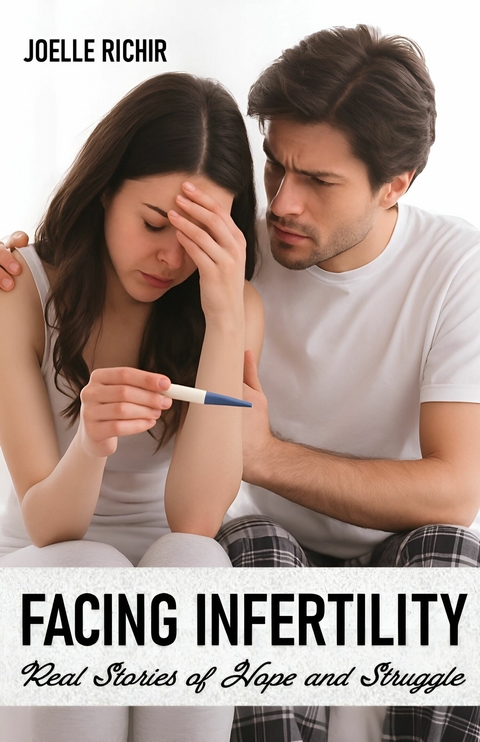
Facing Infertility (eBook)
194 Seiten
Publishdrive (Verlag)
978-0-00-096005-4 (ISBN)
What happens when the deepest longing of the heart remains unfulfilled?
In this moving collection of heartfelt reflections and testimonies, Joëlle Richir shares her own journey-and those of many others-through the silent grief of infertility. With honesty, compassion, and unwavering faith, she explores the emotional, spiritual, and relational impact of childlessness, especially within Christian communities where silence and misunderstanding often deepen the pain. More than a personal story, Facing Infertility is a lifeline. Whether you're walking this difficult path yourself, supporting someone who is, or simply seeking to understand, this book offers comfort, connection, and a renewed perspective on hope, healing, and trust in God-even when His answer is silence.
A week that was both wonderful and exhausting had just come to an end for this small rural church. About sixty children came every evening for three hours to attend the “Vacation Bible School.”
Each year, this event sparks a lot of buzz among the church members. Many lend a hand, whether it’s for decorating, music, crafts, teachings, or skits, not to mention the meals, since supper is served each day.
Here, there’s a reputation for doing things on a grand scale. In this church, which has a small congregation of about a hundred members, organizing this event always requires extensive effort and a lot of energy to ensure everything goes perfectly.
It was a great success, not only for the children, who had a wonderful time and participated enthusiastically in all activities, but also for the teenagers and adults, who took their work seriously and did their very best.
My husband often says he has four nationalities (the first being, of course, that of “citizen of the Kingdom of Heaven”); we were both born in Belgium, but since his mother is Swiss, he is very proud to show off his beautiful red passport with a white cross every time we travel. In 2001, we immigrated to Quebec, where we thought we would spend our days happily until old age.
We became Canadians. However, God had other plans: in November 2005, we both received the calling to embark on the great adventure of full-time missionary work.
In June 2006, obeying this divine call and with the approval and support of our church and friends, we packed our belongings into a small truck and drove across the United States to settle in Texas. There, we established a multimedia department for a mission that organizes sessions on couples and family life in various churches all over the country. We quickly adapted to Texan culture, despite the very distinctive English accent, which was often difficult to understand.
This Sunday morning, in that small church straight out of Little House on the Prairie, everyone is tired but happy. You can still feel the buzz and excitement of the collective effort. The service is a little different too. The children have just performed one of the songs they've learned, and despite the huge cacophony, the congregation applauds warmly because "it's so cute and charming."
As I might have expected, the sermon’s topic is children. As soon as the pastor begins to speak, my heart tightens. He talks about the blessing of having children and the divine gift that it represents.
My heart aches even more when he starts addressing "those who do not or cannot have children," saying that all the children in the church are also, in a way, their children. Irritation rises within me, and I can’t help but turn to my husband and say:
“It’s not fair to say that!”
From that point on, the sermon loses much of its appeal for me. I start reflecting on the inner frustration I feel and all that motivates it. Of course, over time and with years, I’ve learned to swallow and endure.
What I’m experiencing this morning is more of a sadness for others—those women who suffer as I have suffered, who hope as I have hoped, and who wait as I have waited.
I know that in the congregation this morning, there is at least one young woman suffering in silence. Is there really no one who takes a deep interest in this infertility issue? No one who truly understands what we feel as women, deep inside, with this unfulfilled maternal instinct that keeps tormenting us? How long will we continue to endure ungrounded and even less thoughtful accusations from Christians, and stock phrases like:
“Don’t worry, trust, it will happen one day!”
Will those who have children one day learn to understand and respect the suffering of those without children?
Catherine
I thought back to the woman I had met in Canada. At the time, I was working in a beauty salon as an esthetician, which gave me plenty of time to chat with clients. Catherine had come for a manicure, and since she was my last client of the day, our conversation extended well beyond the usual forty-five minutes. We had so much in common.
Catherine was in her thirties and was suffering from an infertility issue of unknown cause. Thankfully, she and her husband had a close and strong relationship. She could rely on his help and support. Yet, she was depressed and felt truly alone and abandoned. She had to leave her job because of her depression, and visits to therapists became increasingly frequent. She felt trapped, facing a problem with no solution.
Within her family, everyone knew, but no one spoke about it. When one of her sisters was pregnant, Catherine was the last to find out, because nobody had dared tell her. They didn’t want to hurt her or didn’t know how to approach the subject…
Catherine was crying. I cried with her. So many memories overwhelmed me.
“This is the first time,” she said to me, “that I meet someone who truly understands me.”
For me too, it was a revelation. Another infertile woman was opening her heart, sharing all her despair, honestly and sincerely. It was our first meeting; yet it felt as if we had known each other for years. What she was experiencing, I had lived through. I knew how to talk about it, how to listen, and above all, I could understand! There is nothing more comforting in distress than someone who can relate to our suffering and truly understand it.
Silence, Embarrassment or Indifference?
I was reflecting on all the years spent with my family, friends, members of my church, pastors, and doctors. At the time, I hadn’t met anyone who truly understood me or made an effort to show interest in what I was feeling.
This largely contributed to the failure of my first marriage. My suffering from not having children was a heavy burden for everyone around me. I could sense their discomfort whenever the subject was touched upon.
The hardest part was not being able to talk about it with those closest to me. Whenever I brought up anything related to children, they would shut down like oysters, and after what felt like an eternity of seconds, they would redirect the conversation to more comfortable topics for everyone. It sounded so false that my suffering only increased.
Why pretend there’s no problem? Why ignore it? Why is it such a taboo? Is it such a shame not to have children?
Even today, I often wonder if it was only out of fear or embarrassment that my loved ones and friends avoided discussing this topic so dear to my heart and so painful at the same time.
Unfortunately, my family is not an isolated case, and I see this same process repeating in the stories I read or hear. Certainly, I can understand that it’s really difficult to know what to say or do to help, but to outright ignore the subject—that’s a huge gap!
For my part, I feel it’s a bit too easy to take the escape route of silence, or even indifference, out of fear of being clumsy and causing additional suffering. Shouldn’t our compassion instead push us to find ways to help, to soothe, to understand?
Here is what Judith experienced:
2Directed to a specialized hospital in Paris, my husband and I underwent more complex examinations. That’s when I started to feel alone and misunderstood. Even the gynecologists, who are supposed to listen to their patients, appeared cold and distant. They don’t seem to grasp the strength of the desire to have a child: in my case, they didn’t see it necessary to start treatment immediately, given my young age. “You need to be patient… Stop thinking about it…” Easy to say! Even your family members can’t seem to understand.
We waited and waited, but still nothing. The wait is very long and unbearable.
Over the decades, there have been significant technological advances in reproduction. Experts have learned how to inject a single sperm into an egg; they can retrieve a woman’s egg, fertilize it, and reimplant it into another woman’s uterus. They have succeeded in freezing eggs so that a young woman can access them later, when she is ready to have a child.
However, only a few years ago, these same experts became aware that they needed to pay greater attention to their patients’ emotional health. Fertility clinics have expanded their services by hiring psychologists, starting support groups, and organizing workshops to reduce stress caused by treatments.
Treating the medical aspect of infertility can be complex, even physically painful; but the emotional aspect—such as frustration caused by repeated disappointments and failures—is even more intense.
In the past, society did not recognize infertility as a source of emotional burden. It was often hidden away and only recently has this changed: with increased awareness of the need for support, suffering in isolation is no longer accepted.
Distress, anxiety, loneliness, sleep problems, the mourning of motherhood, and marital stress are typically experienced by women facing infertility, whether with medical assistance or not. Men can also experience these symptoms, but in different ways.
I have followed my friend Irène’s journey over the past few years. She and her partner have an exemplary relationship. Their love is strong and mature. I know that in their fight against infertility, they support each other and are present for one another. However, Irène’s testimony reveals how differently this ordeal can be experienced:
While I thought this event was shared by both of us, I realize that each of us is living their own story. We share the moments of In Vitro Fertilization, hope, pain, suffering… but...
| Erscheint lt. Verlag | 6.6.2025 |
|---|---|
| Sprache | englisch |
| Themenwelt | Geisteswissenschaften ► Religion / Theologie ► Christentum |
| ISBN-10 | 0-00-096005-5 / 0000960055 |
| ISBN-13 | 978-0-00-096005-4 / 9780000960054 |
| Informationen gemäß Produktsicherheitsverordnung (GPSR) | |
| Haben Sie eine Frage zum Produkt? |
 EPUB (Adobe DRM)
Größe: 2,3 MB
Kopierschutz: Adobe-DRM
Adobe-DRM ist ein Kopierschutz, der das eBook vor Mißbrauch schützen soll. Dabei wird das eBook bereits beim Download auf Ihre persönliche Adobe-ID autorisiert. Lesen können Sie das eBook dann nur auf den Geräten, welche ebenfalls auf Ihre Adobe-ID registriert sind.
Details zum Adobe-DRM
Dateiformat: EPUB (Electronic Publication)
EPUB ist ein offener Standard für eBooks und eignet sich besonders zur Darstellung von Belletristik und Sachbüchern. Der Fließtext wird dynamisch an die Display- und Schriftgröße angepasst. Auch für mobile Lesegeräte ist EPUB daher gut geeignet.
Systemvoraussetzungen:
PC/Mac: Mit einem PC oder Mac können Sie dieses eBook lesen. Sie benötigen eine
eReader: Dieses eBook kann mit (fast) allen eBook-Readern gelesen werden. Mit dem amazon-Kindle ist es aber nicht kompatibel.
Smartphone/Tablet: Egal ob Apple oder Android, dieses eBook können Sie lesen. Sie benötigen eine
Geräteliste und zusätzliche Hinweise
Buying eBooks from abroad
For tax law reasons we can sell eBooks just within Germany and Switzerland. Regrettably we cannot fulfill eBook-orders from other countries.
aus dem Bereich