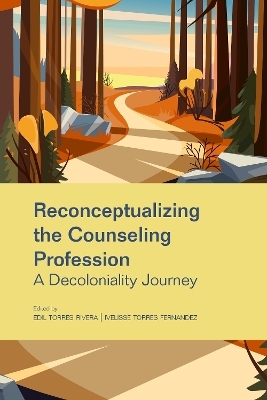
Reconceptualizing the Counseling Profession
American Counseling Association (Verlag)
978-1-55620-008-3 (ISBN)
- Lieferbar (Termin unbekannt)
- Versandkostenfrei
- Auch auf Rechnung
- Artikel merken
Featuring insights from 20 members of historically colonized nations, this bold new textbook reclaims the work that's been both foundational to and obfuscated in the field of counseling by giving voice to neglected populations. This book goes beyond social justice and advocacy, providing practical applications and interventions for anti-oppressive counseling practices. It invites counselors to the work of decolonial liberation and decoloniality so that their practice and care can deeply and richly meet the needs of post-colonized populations.
Dr. Edil Torres Rivera has a Ph.D. in Counseling Psychology with a concentration in multicultural counseling from the University of Connecticut, Storrs. He is a professor of counseling and the director of the Latinx Cluster initiative at Wichita State University, Wichita, Kansas. Edil Torres Rivera is native Puerto Rican with a career of over 25 years in counseling. This includes 12 years in the United States Army. He is the president elect of the American Counseling Association (2022-2023). Dr. Torres Rivera research interests are in multicultural counseling, group work, chaos theory, liberation psychology (decolonial approaches), indigenous counseling, Puerto Rican studies, identity development, and gang/prison-related behavior. Specifically, his primary research focuses on complexity and how indigenous healing techniques are a necessary ingredient when working with ethnic minority populations in the United States. Dr. Torres Rivera has additional interests in studying the implications of social injustice and oppression in counseling and psychotherapy with ethnic minorities in the United States. His community work includes consultation services to the Pyramid Lake Paiute Tribe Council in Nevada, visiting professor to the Universidad del Valle, Guatemala, and he was the director of the Graduate School of Education’s School Counseling Program in Singapore.
Part 1: Theories and Bases Chapter 1: History of Counseling: An anti-oppressive beginning
Chapter 2: A short recount of the intersectionality of counseling and decoloniality: Revisiting the Horse before the Carriage metaphor
Chapter 3: Identity as a form of liberation: An anti-oppressive and Decolonial Liberation process
Chapter 4: Development of the Theories on Decolonization: The North Meet the South
Chapter 5: Concepts of Decolonization: Definitions and Intersectionality
Chapter 6: Relationship between Colonization and Racism
Chapter 7: Counseling for Social Justice without Decolonization: A Fallacy
Chapter 8: Reconceptualization of the Counseling Profession from a Decoloniality Approach
Part II: Applications
Chapter 9: Clinical Approaches: Theory without Application is Useless
Chapter 10: Indigenous Way of Knowing Approaches
Chapter 11: Clinical Supervision: Deconstructing the Westernization of Counseling Supervision
Chapter 12: From Decolonization to Decoloniality as an Evolving Counseling Approach
Chapter 13: Different methods of decoloniality in counseling
Chapter 14: Implications and future direction
| Erscheinungsdatum | 14.01.2026 |
|---|---|
| Zusatzinfo | Illustrations |
| Verlagsort | Alexandria, VA |
| Sprache | englisch |
| Maße | 152 x 228 mm |
| Themenwelt | Geisteswissenschaften ► Psychologie |
| Medizin / Pharmazie ► Medizinische Fachgebiete ► Psychiatrie / Psychotherapie | |
| ISBN-10 | 1-55620-008-0 / 1556200080 |
| ISBN-13 | 978-1-55620-008-3 / 9781556200083 |
| Zustand | Neuware |
| Informationen gemäß Produktsicherheitsverordnung (GPSR) | |
| Haben Sie eine Frage zum Produkt? |
aus dem Bereich