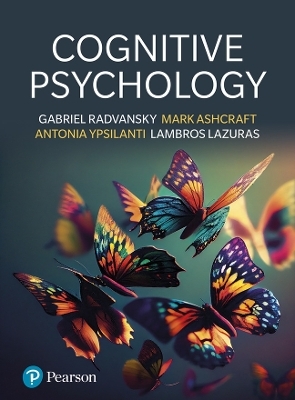
Cognitive Psychology
Pearson Education Limited (Verlag)
978-1-292-73015-8 (ISBN)
With a clear and straightforward style, this easy-to-follow textbook explores the core topics and concepts through contemporary research, globally relevant, diverse examples and ‘Cognition in everyday life’ to show how relevant Cognitive Psychology is to all of us. Highlighting the research and achievements of key People/figures from around the world and the impact they have had on cognitive psychology. With coverage of Neuropsychology and Neuroscience, Cognition and Emotion, and Social Cognition, including topics like empathy, theory of mind, social rejection and loneliness, this combination of depth and breadth of content, provided in an accessible and multimedia/interactive way helps students to dive into this intriguing subject area.
Prof Lambros Lazuras is a Chartered Psychologist (CPsychol, British Psychological Society) with expertise in social cognition and decision-making. His research is supported by prestigious funding bodies and spans mental health, substance misuse, and health-related behaviours. Lambros is a Professor and Director of Research at the School of Psychology, Sport Science, & Wellbeing at the University of Lincoln, UK. Dr Antonia Ypsilanti is Associate Professor in Cognitive Psychology and Psychobiology at Sheffield Hallam University. She is a leading researcher in the field of loneliness with a focus on understanding how cognitive biases influence social connections and decision-making in clinical and non-clinical populations. Dr Ypsilanti is the co-Director of the Campaign to End Loneliness and a co-Leader of the Global Ageing Thematic Group of Cochrane Reviews. Prof Gabriel Radvansky is Director of Graduate Studies at The University of Notre Dame, specialising in cognition, the brain and behaviours. Prof Mark Ashcraft was an American academic and the chair of the Department of Psychology at the University of Nevada Las Vegas.
1 Understanding Cognitive Psychology
1.1 Thinking about thinking
1.2 Memory and Cognition Defined
1.3 An Introductory History of Cognitive Psychology
1.4 Cognitive Psychology and Information Processing
1.5 Measuring Information Processes
1.6 The Standard Theory and Cognitive Science
1.7 Themes of Human Cognition
2 Neural Basis of Cognition
2.1 The Brain and Cognition Together
2.2 Basic Neural Functions
2.3 Important Brain Structures and Function
2.4 Cognitive Neuropsychology
2.5 Connectionism
3 Sensation and Perception
3.1 Psychophysics
3.2 Visual Sensation and Perception
3.3 Pattern Recognition
3.4 Top-Down Processing
3.5 Object Recognition and Agnosia
3.6 Auditory Sensation and Perception
4 Attention
4.1 Multiple Meanings of Attention
4.2 Basic Input Attentional Processes
4.3 Controlled, Voluntary Attention
4.4 Attention as a Mental Resource
5 Short-Term and Working Memory
5.1 A Limited-Capacity Bottleneck
5.2 Short-Term Memory Retrieval
5.3 Working Memory
5.4 Assessing Working Memory
5.5 Working Memory and Cognition
6 Learning and Remembering
6.1 Preliminary Issues
6.2 Storing Information in Episodic Memory
6.3 Boosting Episodic Memory
6.4 Context
6.5 Facts and Situation Models
6.6 Autobiographical Memories
6.7 Memory for the Future
6.8 Semantic Memory
7 Memory and Forgetting
7.1 The Seven Sins of Memory
7.2 Forgetting Through Decay and Interference
7.3 False Memories, Eyewitness Memory, and 'Forgotten Memories'
7.4 Amnesia and Implicit Memory
8 Language
8.1 Linguistic Universals and Functions
8.2 Phonology
8.3 Syntax
8.4 Lexical Factors
8.5 Semantics
8.6 Brain and Language
9 Language Comprehension
9.1 Conceptual and Rule Knowledge
9.2 Reading
9.3 Reference, Situation Models, and Events
9.4 Conversation and Gesture
10 Reasoning and Decision-making
10.1 Formal Logic and Reasoning
10.2 Decisions
10.3 Classic Heuristics, Biases, and Fallacies
10.4 Framing and Risky Decisions
10.5 Adaptive Thinking and 'Fast and Frugal' Heuristics
10.6 Other Explanations
10.7 Limitations in Reasoning
11 Problem-solving
11.1 Studying Problem-solving
11.2 Basics of Problem-solving
11.3 Gestalt Psychology and Problem-solving
11.4 Insight and Analogy
11.5 Means–End Analysis
11.6 Improving Your Problem-solving
12 Social cognition
12.1 The Neural Basis of Social Cognition
12.2 Understanding the self
12.3 Understanding Others: Mentalising and Empathising
12.4 Responding to Adverse Social Signals
13 Cognition and Emotion
13.1 What Is Emotion?
13.2 Emotion and Perception
13.3 Emotion and Memory
13.4 Emotion and Language
13.5 Emotion and Decision Making
14 Research Methods in Human Cognition
14.1 Purpose of Research Methods in Cognitive Psychology
14.2. Reaction-Time Based Tasks
14.3 Visual search tasks
14.4. Neurophysiological Methods
14.5 Neuroimaging and Brain Stimulation Methods
14.6 Research Integrity and Ethics
| Erscheinungsdatum | 08.07.2025 |
|---|---|
| Verlagsort | Harlow |
| Sprache | englisch |
| Gewicht | 1110 g |
| Themenwelt | Geisteswissenschaften ► Psychologie ► Allgemeine Psychologie |
| Geisteswissenschaften ► Psychologie ► Verhaltenstherapie | |
| ISBN-10 | 1-292-73015-3 / 1292730153 |
| ISBN-13 | 978-1-292-73015-8 / 9781292730158 |
| Zustand | Neuware |
| Informationen gemäß Produktsicherheitsverordnung (GPSR) | |
| Haben Sie eine Frage zum Produkt? |
aus dem Bereich