


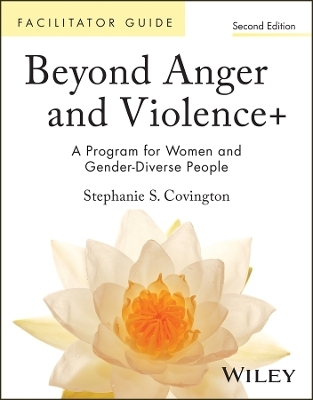
Beyond Anger and Violence+
A Program for Women and Gender-Diverse People Facilitator's Guide
2026
|
2nd edition
John Wiley & Sons Inc (Verlag)
978-1-394-39186-8 (ISBN)
John Wiley & Sons Inc (Verlag)
978-1-394-39186-8 (ISBN)
Beyond Anger and Violence: A Prevention Program for Women is a forty-hour, evidence-based, gender-responsive, trauma-informed treatment program specifically developed for women who have difficulty managing anger. The curriculum uses a Social-Ecological Model to understand anger and violence. This four-level model considers the complex interplay between individual, relationship, community, and societal factors. It addresses the factors that put people at risk for experiencing overwhelming feelings of anger and perpetrating assaultive acts or destruction of property. This model is used by the Center for Disease Control and Prevention and was used in the Prison Rape Elimination Act (PREA) research on women in prison. The model:
Identifies biological and personal history factors that increase the likelihood of becoming a victim or perpetrator of violence. Some of these factors are age, education, income, substance use, or history of abuse.
Examines relationship factors that increase risk because of relationships with peers, intimate partners, and family members.
Explores the settings, such as schools, workplaces, and neighborhoods, in which social relationships occur and seeks to identify the characteristics of these settings that trigger angry verbal behavior and destructive actions.
Included in the package are a Facilitator Guide and a Participant Workbook. Presented in a twenty-session format, the Facilitator Guide contains the theory, structure, and content needed to run effective groups. The Participant Workbook is designed so that women can process, record, and refer back to their therapeutic experience.
The Facilitator Guide is written for those who will be facilitating the therapeutic intervention Beyond Anger program. It contains an overall description of the program and step-by-step instructions for conducting the twenty sessions of the program including tips on conducting group sessions and materials needed for each session. The Guide provides a background into the type of environment that is necessary for a therapeutic program to be effective, considerations for the facilitator in conducting the program, and descriptions of the theories and knowledge that are the underpinning of the program. The Guide also provides a profile of women who use aggressive or violent behavior, discusses whether women are becoming more violent, and presents theoretical perspectives on women and anger.
The Participant Workbook is used by participants for reviewing the content of the sessions, writing their thoughts and reactions, and completing activities during and after sessions. It helps participants:
Understand the relationships between thoughts, feelings, and behaviors.
Learn new skills, including communication, conflict resolution, decision making, and calming soothing techniques.
Understand the effects of our families, our relationships, communities, and the larger society on our lives.
Understand more about the roles of anger and violence.
Become part of a group of women working to create a less-violent world.
Identifies biological and personal history factors that increase the likelihood of becoming a victim or perpetrator of violence. Some of these factors are age, education, income, substance use, or history of abuse.
Examines relationship factors that increase risk because of relationships with peers, intimate partners, and family members.
Explores the settings, such as schools, workplaces, and neighborhoods, in which social relationships occur and seeks to identify the characteristics of these settings that trigger angry verbal behavior and destructive actions.
Included in the package are a Facilitator Guide and a Participant Workbook. Presented in a twenty-session format, the Facilitator Guide contains the theory, structure, and content needed to run effective groups. The Participant Workbook is designed so that women can process, record, and refer back to their therapeutic experience.
The Facilitator Guide is written for those who will be facilitating the therapeutic intervention Beyond Anger program. It contains an overall description of the program and step-by-step instructions for conducting the twenty sessions of the program including tips on conducting group sessions and materials needed for each session. The Guide provides a background into the type of environment that is necessary for a therapeutic program to be effective, considerations for the facilitator in conducting the program, and descriptions of the theories and knowledge that are the underpinning of the program. The Guide also provides a profile of women who use aggressive or violent behavior, discusses whether women are becoming more violent, and presents theoretical perspectives on women and anger.
The Participant Workbook is used by participants for reviewing the content of the sessions, writing their thoughts and reactions, and completing activities during and after sessions. It helps participants:
Understand the relationships between thoughts, feelings, and behaviors.
Learn new skills, including communication, conflict resolution, decision making, and calming soothing techniques.
Understand the effects of our families, our relationships, communities, and the larger society on our lives.
Understand more about the roles of anger and violence.
Become part of a group of women working to create a less-violent world.
Stephanie S. Covington, PhD, LCSW, is an internationally recognized clinician, author, lecturer, and organizational consultant and is a pioneer in the field of women's issues, addiction, trauma, and recovery. With over thirty-five years of experience, she is noted for her work in the design and implementation of gender-responsive and trauma-informed treatment services in public, private, and institutional settings. She is the author of numerous books, as well as ten research-based, manualized treatment curricula, including Beyond Trauma: A Healing Journey for Women, Helping Women Recover: A Program for Treating Addiction, and Voices: A Program for Girls.
| Erscheint lt. Verlag | 31.5.2026 |
|---|---|
| Verlagsort | New York |
| Sprache | englisch |
| Themenwelt | Geisteswissenschaften ► Psychologie ► Familien- / Systemische Therapie |
| Medizin / Pharmazie ► Medizinische Fachgebiete ► Psychiatrie / Psychotherapie | |
| ISBN-10 | 1-394-39186-2 / 1394391862 |
| ISBN-13 | 978-1-394-39186-8 / 9781394391868 |
| Zustand | Neuware |
| Informationen gemäß Produktsicherheitsverordnung (GPSR) | |
| Haben Sie eine Frage zum Produkt? |


