


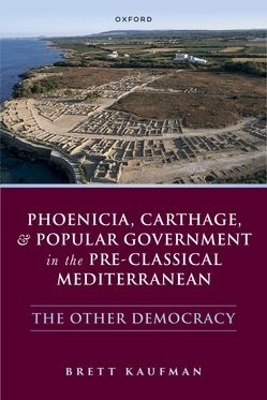
Phoenicia, Carthage, and Popular Government in the Pre-Classical Mediterranean
The Other Democracy
Seiten
2025
Oxford University Press (Verlag)
978-0-19-886768-5 (ISBN)
Oxford University Press (Verlag)
978-0-19-886768-5 (ISBN)
Despite popular perception, the Greeks didn't invent democracy. The idea of the assembly in the town square can be traced back to Mesopotamia, but how did democracy reach the Greeks? This book uses archaeology, inscriptions, and historical texts to show that it was the Phoenicians who introduced the idea of the democratic state to the Aegean.
From Aristotle to John Adams, great minds of government have revered Carthaginian democracy as the purest expression of a people's will. Yet today, while Phoenician influence on the Graeco-Roman worlds has been revisited and corrected from the perspectives of art, architecture, industry, crafts, and writing systems, the sphere of government in general and constitutional democracy in particular are still largely, and incorrectly, considered to be purely within the preserve of ancient Greece or Athens.
This book is the first comprehensive treatment of Phoenician government, drawing on archaeological, epigraphic, and historical sources. The Phoenicians introduced a brand of state-level society that enfranchised not only men, but also women, children, and even slaves into the popular assembly. Phoenician governmental leaders fostered a foreign and domestic policy that emphasized development, political stability, and economic growth insured by mutual incentives, as well as shared ritual practice, marriage alliances, social mobility, and concern for commoners, at home and abroad. This sustainable form of global leadership lasted for around eight centuries (~1000–146 BC).
This work in no way attempts to diminish the exceptional Athenian democracy and its subsequent positive effects on political history and the peoples who have benefited from its legacy. Rather this work amplifies ancient Greek democracy to help us better understand its origins, as well as expanding democratic heritage. In turn, it serves as an historical corrective that recenters democracy as a conversation and a competition between peoples as opposed to a monolithic institution. It highlights an alternative model of imperial democracy.
From Aristotle to John Adams, great minds of government have revered Carthaginian democracy as the purest expression of a people's will. Yet today, while Phoenician influence on the Graeco-Roman worlds has been revisited and corrected from the perspectives of art, architecture, industry, crafts, and writing systems, the sphere of government in general and constitutional democracy in particular are still largely, and incorrectly, considered to be purely within the preserve of ancient Greece or Athens.
This book is the first comprehensive treatment of Phoenician government, drawing on archaeological, epigraphic, and historical sources. The Phoenicians introduced a brand of state-level society that enfranchised not only men, but also women, children, and even slaves into the popular assembly. Phoenician governmental leaders fostered a foreign and domestic policy that emphasized development, political stability, and economic growth insured by mutual incentives, as well as shared ritual practice, marriage alliances, social mobility, and concern for commoners, at home and abroad. This sustainable form of global leadership lasted for around eight centuries (~1000–146 BC).
This work in no way attempts to diminish the exceptional Athenian democracy and its subsequent positive effects on political history and the peoples who have benefited from its legacy. Rather this work amplifies ancient Greek democracy to help us better understand its origins, as well as expanding democratic heritage. In turn, it serves as an historical corrective that recenters democracy as a conversation and a competition between peoples as opposed to a monolithic institution. It highlights an alternative model of imperial democracy.
Brett Kaufman is an archaeologist, Semitic languages specialist, and archaeometallurgist. He is Assistant Professor of the Classics at University of Illinois Urbana-Champaign. His research has been funded by the National Science Foundation, the National Geographic Society, the National Natural Science Foundation of China, and the Getty Research Institute.
| Erscheinungsdatum | 23.12.2025 |
|---|---|
| Zusatzinfo | 57 figures and 3 maps |
| Verlagsort | Oxford |
| Sprache | englisch |
| Maße | 165 x 242 mm |
| Gewicht | 671 g |
| Themenwelt | Geisteswissenschaften ► Archäologie |
| Geschichte ► Allgemeine Geschichte ► Vor- und Frühgeschichte | |
| Geschichte ► Allgemeine Geschichte ► Altertum / Antike | |
| Religion / Theologie ► Christentum ► Kirchengeschichte | |
| ISBN-10 | 0-19-886768-9 / 0198867689 |
| ISBN-13 | 978-0-19-886768-5 / 9780198867685 |
| Zustand | Neuware |
| Informationen gemäß Produktsicherheitsverordnung (GPSR) | |
| Haben Sie eine Frage zum Produkt? |
Mehr entdecken
aus dem Bereich


aus dem Bereich
auf den Spuren der frühen Zivilisationen
Buch | Hardcover (2023)
C.H.Beck (Verlag)
CHF 27,95
Konzepte – Methoden – Theorien
Buch | Softcover (2024)
UTB (Verlag)
CHF 55,85
die archäologische Wahrheit über die Bibel
Buch | Softcover (2023)
C.H.Beck (Verlag)
CHF 25,20


